Scale does strange things to a mini truck. The Chevy LUV was a little import pickup bought by people who needed something cheap, and nobody looked at one twice in a parking lot. Shrink it to 1:64, punch a supercharger through the hood and paint it yellow, and suddenly it’s the loudest thing on my shelf. This Hot Wheels Custom ’72 Chevy LUV gets more questions from visitors than castings I paid five times as much for.
Hot Wheels Custom ’72 Chevy LUV yellow paint and graphics
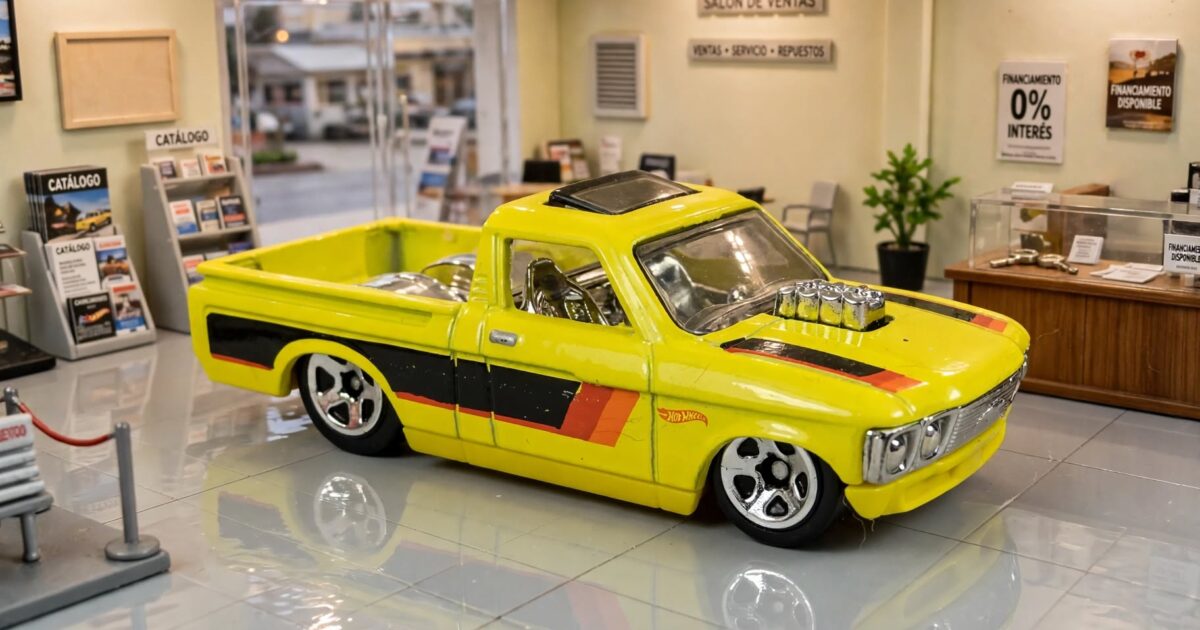
The yellow is bright and glossy, closer to a highlighter than to a factory color. On my example the finish is thick and even on the hood and the cab, with the gloss holding up across the flat bed sides where cheaper paint usually goes dull.
A wide black panel runs along the lower half of the bed and the door, with an orange and red block graphic at its front edge. The hood carries a matching black stripe with the same orange and red flashes near the cowl. It’s a 1970s van and truck graphic treatment, and it fits the era of the real truck exactly.
The exposed blower on the Hot Wheels Chevy LUV
The blower is the whole point of the car. A chrome supercharger with a row of injector stacks sits through a cut in the hood, angled back toward the windshield. It’s a separate chrome piece, not a painted shape, so it catches light from every angle.
Look through the side window and there’s more chrome inside: the engine carries back into the cabin area, and you can see shapes that read as a firewall and a bellhousing. Hot Wheels did the same trick on other drag builds, and it works because the eye fills in the rest.
The stacks are the detail I’d check before buying. They’re small and they stand proud of the hood, so they take the hit if the car gets handled or if the blister presses down on them. On mine they’re all upright and even. I’ve seen copies on the peg with one stack bent flat, and once that happens there’s no fixing it without a replacement part.
Sunroof and cab details on the LUV casting
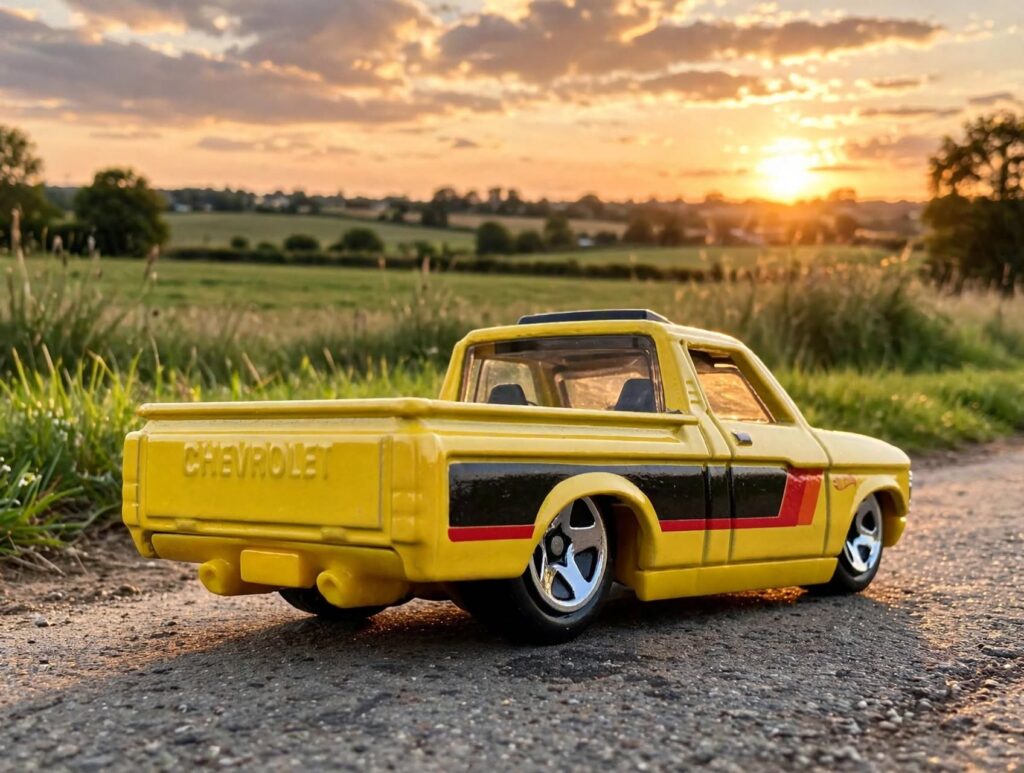
There’s a dark panel set into the roof, which reads as a sunroof. On a drag style build that’s an odd luxury, and that contradiction is my favorite thing about the car. Somebody built a blown mini truck and then stopped to think about getting a tan on the way to the strip.
The glass is clear and the windshield is large for the size of the cab, so the interior is easy to see. A chrome mirror sits on the door, and the door handle is cast in. The front grille is chrome with four round headlights, and the bumper is chrome too, which keeps the nose busy and bright against the yellow.
Chrome wheels and stance on the ’72 Chevy LUV casting
The wheels are chrome five spoke designs with whitewall style edges, and they’re the right size for the body. The truck sits low with a slight nose down attitude.
What makes the stance work is the bed. It’s empty and open, with the floor visible and the sides tall, so the rear of the truck looks light while the front looks heavy with the engine. That imbalance is exactly what a street machine should look like, and it’s why the truck reads as fast even sitting still on a table.
What the real Chevy LUV was
The LUV was Chevrolet’s answer to small Japanese pickups, a compact truck sold through Chevy dealers. It had a tiny engine, a short bed and no pretensions. Nothing about it suggested a blower.
That’s the joke the casting is telling. Taking a humble working truck and building it into something absurd is a real tradition in American car culture, and this model captures it better than most.
The proportions help. The real truck had a short wheelbase and a tall cab, so once the engine comes through the hood the whole thing looks nose heavy and ready to launch. A full size pickup with the same treatment just looks big. This one looks like it’s about to get away from somebody.
Why obscure trucks like the LUV make better castings
Here’s what I keep noticing. A Camaro or a Mustang at 1:64 has to compete with my memory of the real car, and it usually loses. A LUV has no such baggage. Almost nobody has a mental picture of one, so the casting gets to be the definitive version.
That’s also why mini trucks keep showing up in the hobby. They’re small, they’re boxy, and the shapes survive the shrink. My notes on starting a diecast collection make a similar point about picking subjects you like over subjects that are famous.
Is the Custom ’72 Chevy LUV hard to find
Mine came from a mainline wave, so it wasn’t a hunt. Custom trucks with chrome engine parts tend to move faster off pegs than plain cars, though, so don’t leave it for next week. Reading the code on the back of the card tells you which wave you’re looking at; I covered that in Hot Wheels case codes.
What the yellow Chevy LUV earned on my shelf
I didn’t expect much from it. It was a cheap casting of a truck almost nobody remembers today, and it has turned into one of the pieces I pick up most. Partly it’s the blower, partly it’s the yellow, mostly it’s that sunroof, which makes no sense.
It also photographs easily. The yellow holds its color under almost any light, and the chrome gives the camera something to catch. Set it down on a plain surface and it fills the frame on its own without needing a scene around it.
If Hot Wheels runs this one in orange with the same graphics, I’m buying it without thinking twice.