Almost everything this brand produces is a copy of a vehicle you could photograph in a car park. Delivery vans, fire engines, pickups, tractors, police cars. That is the whole identity of the brand: if it exists and it works for a living, somebody will eventually cast it.
This orange thing does not exist. There is no factory anywhere that built a Sahara Survivor, no owner’s club, no registration document, no road test in a magazine. It is an invention, and that makes it the most interesting casting in a range full of accurate ones.
The name is a clue in itself. Real vehicles are named by committees and marketing departments. Invented ones get names that describe what they are for.
What the Matchbox Sahara Survivor actually is
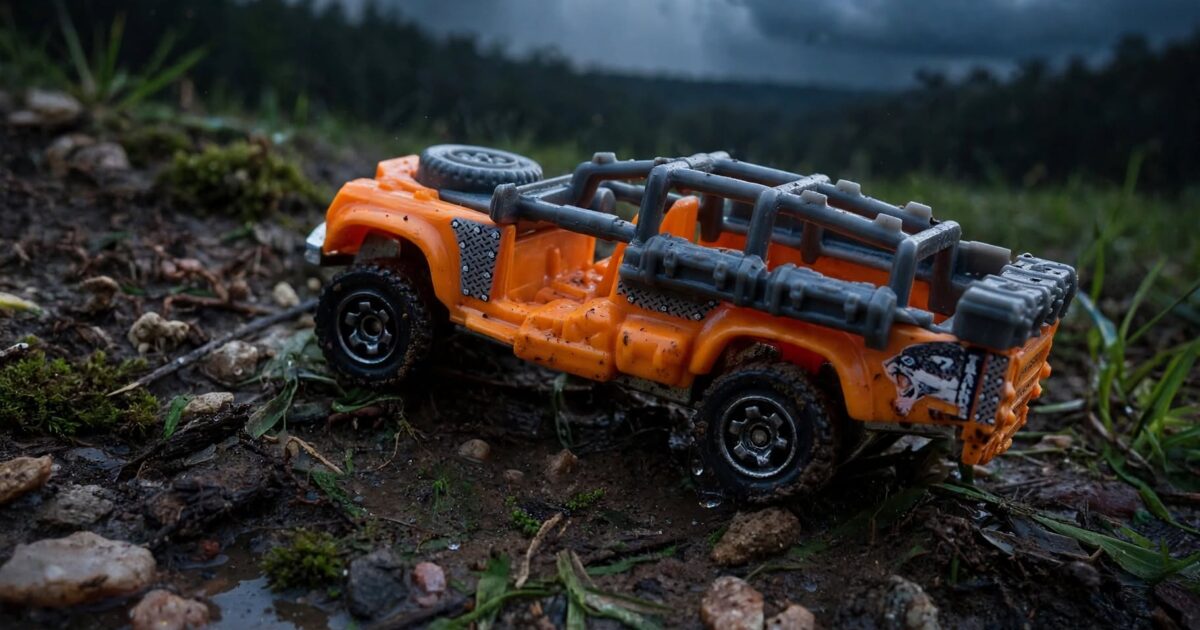
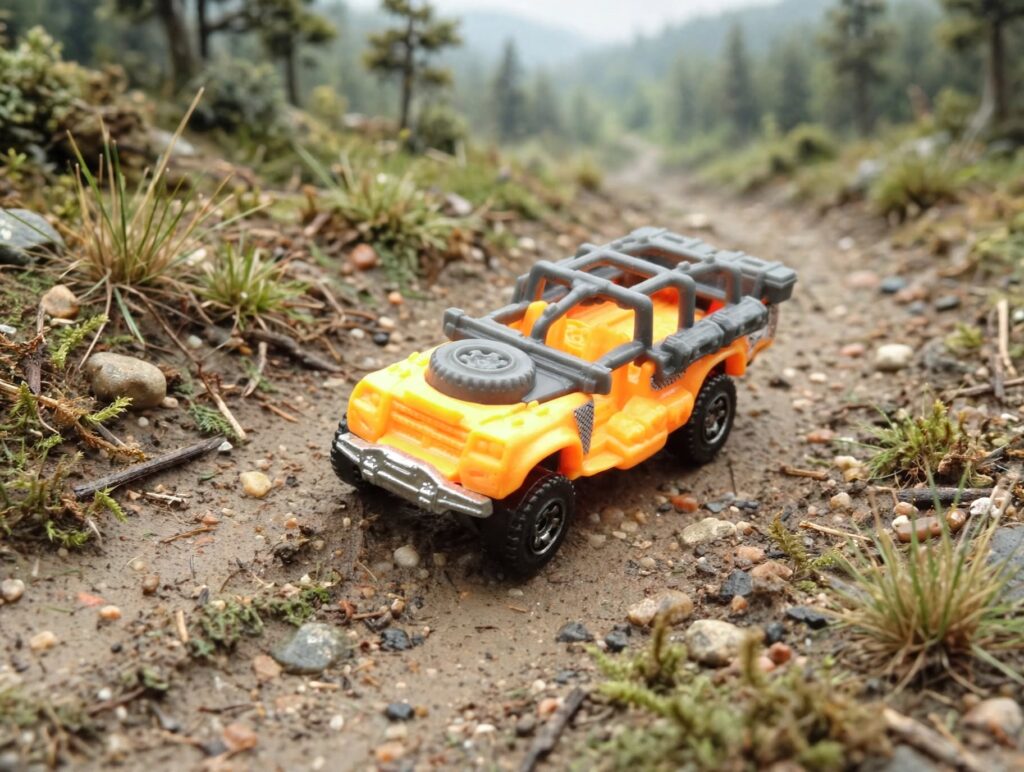
An open bodied four wheel drive with no roof, no doors and no windscreen. Over the top of it sits a grey tubular structure that is part roll cage and part luggage rack, carrying what look like fuel cans along each side.
On the hood there is a spare wheel lying flat, moulded in the same grey as the cage itself. The body is orange, the arches are cut high over chunky black tires, and the whole thing sits well off the ground.
Why an invented vehicle is unusual here
Licensing costs money and takes time. A brand that wants to put a particular truck on a peg has to negotiate with the manufacturer, and the manufacturer gets a say in how the thing looks.
An invented casting skips all of that. Nobody has to approve the proportions, nobody objects to the colour, and the designers can put whatever equipment they like on it. The usual rival brand built an entire business on this freedom, and the contrast between the two approaches is the subject of Matchbox versus Hot Wheels. Seeing that freedom used by the other brand is what makes this truck interesting.
The cage is the whole design
Take the grey structure off and there is not much left: a simple orange tub with wheels. Everything that gives this casting character is bolted to the top of it.
That is honest, because it is how real expedition vehicles work too. The base vehicle matters less than what has been attached to it, and anybody who has looked at a truck prepared for long distance desert travel has seen the same logic. Cage, cans, spare, lights, all added after the fact.
The cans are moulded as part of the cage, so nothing comes loose, and they sit low along the sides where the weight would actually go. Somebody thought about where to put them instead of scattering them across the roof for effect.
Orange paint and the printed details
The orange is bright and slightly warm, the colour real expedition vehicles often wear because it shows up against sand and rock. On the sides there are small panels printed to look like diamond plate, the metal tread you find on a working vehicle’s step or bed floor.
Printing a texture is a cheap trick, and it works well here. At arm’s length those panels read as a different material entirely, which breaks up the orange and makes the truck look assembled from parts instead of moulded in one piece.
The animal graphic on the rear quarter
Behind the rear wheel there is a printed graphic of a big cat, teeth bared, inside a bordered panel. It is the only decorative element on the whole vehicle and it is the one I keep going back and forth on.
As a design it tells you what the invented story is: safari, wildlife, somewhere hot. As a detail on a working vehicle it makes no sense at all, because nobody fitting out a desert truck decorates it. I have decided it belongs, since the truck is fictional anyway, and a fiction is allowed to signal which genre it is in.
Wheels, clearance and the way it sits
The tires are chunky with a deep moulded tread, wrapped around black wheels with a simple hub, and the ride height is genuinely tall. There is real daylight under the chassis and the suspension area is visible from the side.
That matters more than it sounds. Most castings sit low because low looks fast, and a vehicle designed to cross rough ground needs the opposite. The proportions here are built around clearance and they read correctly because of it.
The wheels also sit at the extreme corners with almost no overhang front or rear, which is what you want for approach and departure angles on broken ground. Those are real engineering considerations showing up on an invented toy.
Photographing an open bodied truck
It is the easiest subject I own after the military jeep. Dirt, gravel, a few loose stones and some dry grass, and the vehicle is immediately somewhere.
The open body helps, because the grey cage casts shadows down into the orange tub and gives a photograph some internal structure. Shoot it low, from the front three quarter angle, with something crossing the frame in the foreground. My diorama guide covers the surfaces that work for this kind of scene.
Where an invented truck belongs
On the shelf, next to the real ones, doing a job none of them can do. A collection built entirely on accuracy slowly turns into a catalogue, and a catalogue is not quite the same thing as a collection.
What this casting offers is a vehicle somebody designed for the pleasure of it, without a manufacturer looking over their shoulder. The cage, the cans, the spare on the hood and the angry cat on the back are all choices made by a person who wanted the truck to look prepared for something. That shows, and it is the reason it keeps earning its space.
I would still like a version in plain sand or dull green, with no cat on the back. The equipment alone carries the whole idea.