A diecast collection is a strange sort of record. Nobody sets out to document the motor industry, and yet after a few hundred cars the shelf turns into a rough map of who built what, which shapes caught on, and which decades produced more interesting metal than others.
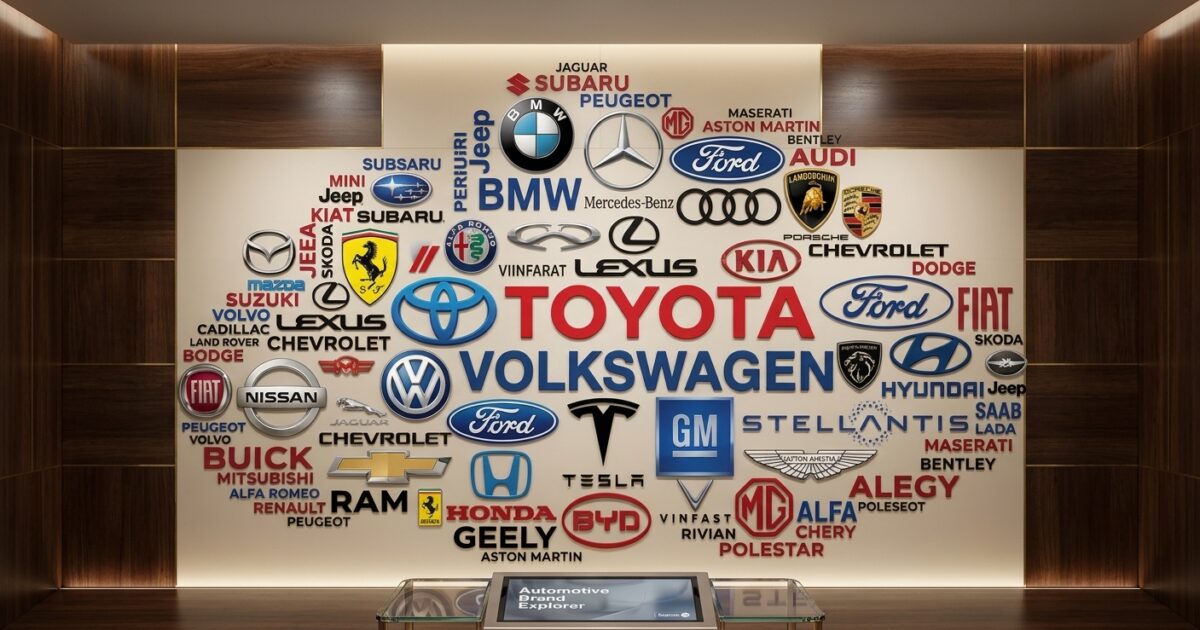
This page lists the carmakers, grouped by where each one comes from. A few individual models have grown large enough here to need pages of their own, and those are named inside the manufacturer that built them. If you are looking for the companies that make the models instead of the cars, that is a different list, and it lives on the diecast car brands page.
American manufacturers
The deepest section of any collection, because American toy manufacturing and American car design grew up together.
Ford Motors has given the hobby more shapes than anybody, from hot rods built out of thirties coupes to modern rally cars. General Motors Company covers the corporate group behind the biggest supplier of pickups and muscle cars, and two of its models have outgrown it here: the Camaro and the Corvette. Dodge brings the muscle era and its modern revivals, and Jeep is the shape every off road vehicle since has been measured against.
British manufacturers
Small companies, strange ideas, and an influence on this hobby far out of proportion to how many cars they built.
Jaguar Cars built the grand tourers that barely exist in diecast. Land Rover made flat panelled working vehicles that survive being shrunk better than almost anything. Lotus chased lightness above everything else, and Morris Motors produced the small car that changed what a small car could be. Aston Martin sits apart from all of them, building expensive coupes for people who wanted something quieter than an Italian supercar.
German manufacturers
Precision, repetition and a habit of building the same shape better every few years.
BMW is the marque collectors argue about most, because every generation has its defenders. Mercedes Benz covers everything from taxis to racing cars. Porsche has one silhouette it has refined for sixty years and a racing history that produced half the castings in this category. Volkswagen built the most reinterpreted body in the entire hobby, and that shape has a page of its own at the Beetle.
Japanese manufacturers
The group that arrived late to diecast ranges and then took over a large part of them.
Nissan Motors is the company that sold cars under two names for decades, which is why Datsun has a page of its own and why collectors keep mixing the two up. Toyota Motors built the most reliable cars in the world and, almost by accident, several of the most collectable. Mitsubishi is here for the rally cars and for the ordinary crossovers nobody else bothers to cast.
European manufacturers
Everything else from the continent, and some of the most interesting shapes on any shelf.
Renault built small hot hatches and rally cars that only appear in ranges sold on that side of the Atlantic. Audi turned four wheel drive into a performance idea. Ferrari needs no introduction and appears in every price bracket from multipack to serious collector model. Lamborghini builds wedges and angles that survive being shrunk because almost everything defining them is a hard edge. Volvo Cars spent decades making boxes and then produced some of the best looking estates ever sold.
Manufacturers and models are not the same list
A note on how this site is organised, because it causes confusion. A manufacturer page covers a company: what it built, when, and why its shapes keep turning up in toy ranges. A model page covers one vehicle in that much depth, and only exists when a single car has produced so many castings that it needs its own space.
Three vehicles have reached that point here, and all three are named above inside the company that built them. Everything else sits under its manufacturer, which is where it belongs.
Why collect by manufacturer at all
Because it gives a shelf a spine. Buying whatever looks good on the peg produces a pile. Buying along one line, whether that is a manufacturer, a decade or a body type, produces something that can be read.
A manufacturer is the easiest spine to start with, since the badge is printed on the car and the information is free. If you are still deciding how to organise what you buy, my guide to starting a collection goes through the options.
Which carmaker has the most diecast models?
Ford and the General Motors brands between them account for an enormous share of what has ever been produced at this scale, helped by decades of American toy manufacturing and by shapes that lend themselves to customising.
Why are some carmakers missing from toy ranges?
Licensing and market. A brand has to agree to the use of its name and shapes, and a toy maker only pays for that if the cars will sell in the countries where it does business.
Are licensed models more accurate than unlicensed ones?
Usually, because the licence often comes with access to the manufacturer’s own reference material. An unlicensed casting has to approximate a shape without using the badge.
What is the difference between a car brand and a diecast brand?
A car brand built the real vehicle. A diecast brand built the model of it. The two have nothing to do with each other beyond a licensing agreement, and they are covered separately on this site.
Should I collect one manufacturer or many?
Start with many and let a favourite emerge. Most collectors find that one or two marques keep pulling them back, and narrowing down later costs nothing.