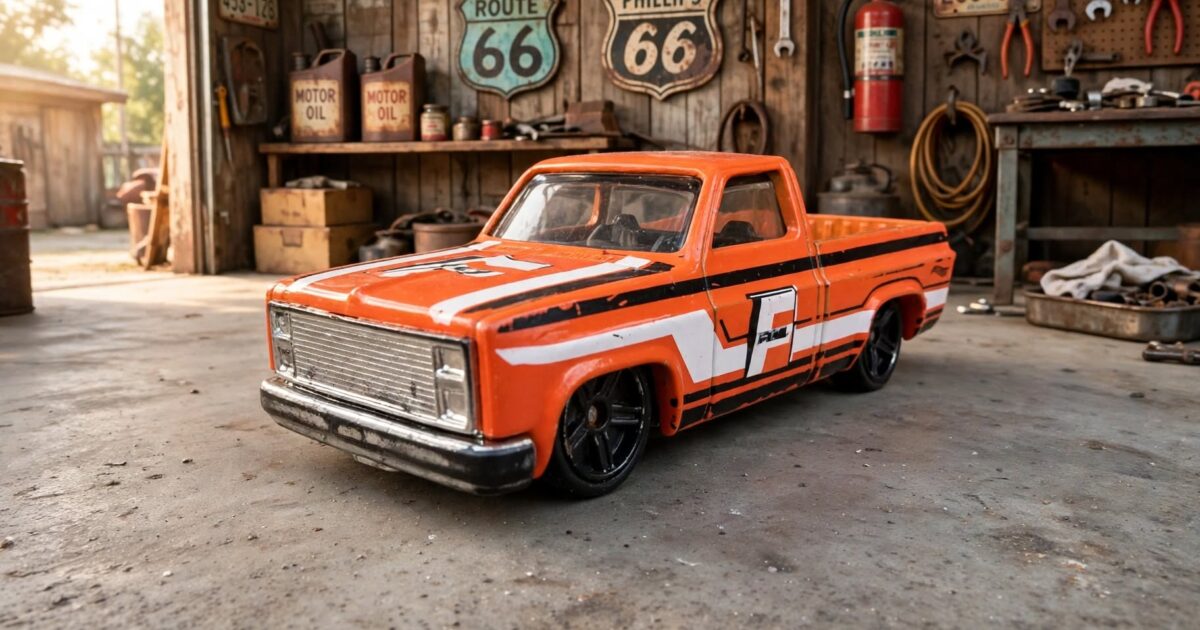
A pickup exists for one reason. There is a box on the back and you put things in it. Everything else about it, the frame, the springs, the ride height, the gearing, is arranged around that one job.
This orange one has been lowered until the rocker panels nearly touch the ground. Load the bed and the suspension would be on the bump stops before you finished. The single thing this vehicle was built to do has been designed out of it, and I still like it, which is the interesting part.
What the Hot Wheels ’83 Chevy Silverado looks like
A long bed, single cab truck from the era when a pickup was a flat sided box with a cab bolted to the front. Straight lines everywhere, squared wheel arches, a tall slab of a door and a grille that is a plain rectangle split by one horizontal bar.
The body is bright orange. Across the hood and down each flank runs a thick white stripe with black edging, stepping down behind the door and finishing in a large white F on the rear quarter. Small sponsor logos sit along the lower door.
Why losing the function does not ruin it
Here is the argument I keep having with myself. A lowered pickup is useless as a pickup, and uselessness usually bothers me on a model.
It does not here, because the real culture this copies is honest about the trade. Nobody slams a truck and then complains it cannot carry gravel. The whole point of the style is a statement: this truck does not have to work any more, and I have the money and the time to make that obvious. The casting reproduces a real attitude, not a fantasy.
The graphics agree with that reading. Racing stripes on a work truck are not claiming the vehicle races. They are saying the owner cares what it looks like parked.
The square body reads perfectly at this size
Every line on this truck is straight. No compound curves, no subtle surface transitions, no soft shoulder that needs careful tooling to survive being shrunk.
The result is a casting that looks correct in any light, on any surface, from any angle. Curved bodies need good lighting to show their shape. This one is all hard edges and flat planes, so it holds together even in a bad photograph on a dull afternoon.
It is also why this generation of truck appears in so many ranges. A shape this simple is cheap to tool and almost impossible to get wrong, which makes it attractive to every brand with a budget.
The empty bed is doing nothing
A long bed is a lot of flat orange. On this casting it has a ribbed floor and nothing else, no toolbox, no fuel cans, no tarpaulin, no spare wheel lying in the corner.
That emptiness is consistent with the custom, so I cannot really call it a fault. It is still a missed opportunity, because the bed is the largest single surface on the vehicle and anything sitting in it would give the eye somewhere to land. A folded cover or a low toolbox would have cost almost nothing to tool.
The tailgate is the opposite, and it is well done. The Chevrolet name is pressed into it, the handle is a separate recessed shape, and the lower edge carries a thin bumper that wraps around the corners.
Graphics borrowed from the parts aisle
The lettering and the logos come from companies that sell components, the kind of names that appear on a workshop shelf instead of a billboard. That is the correct register for a truck like this, because the people who build them buy from exactly those catalogues.
The printing on mine is clean, with the stripe crossing the door gap without a step and the large letter sitting square on the quarter panel. On a graphic running the full length of a long body, any misalignment shows immediately.
Black wheels and the stance
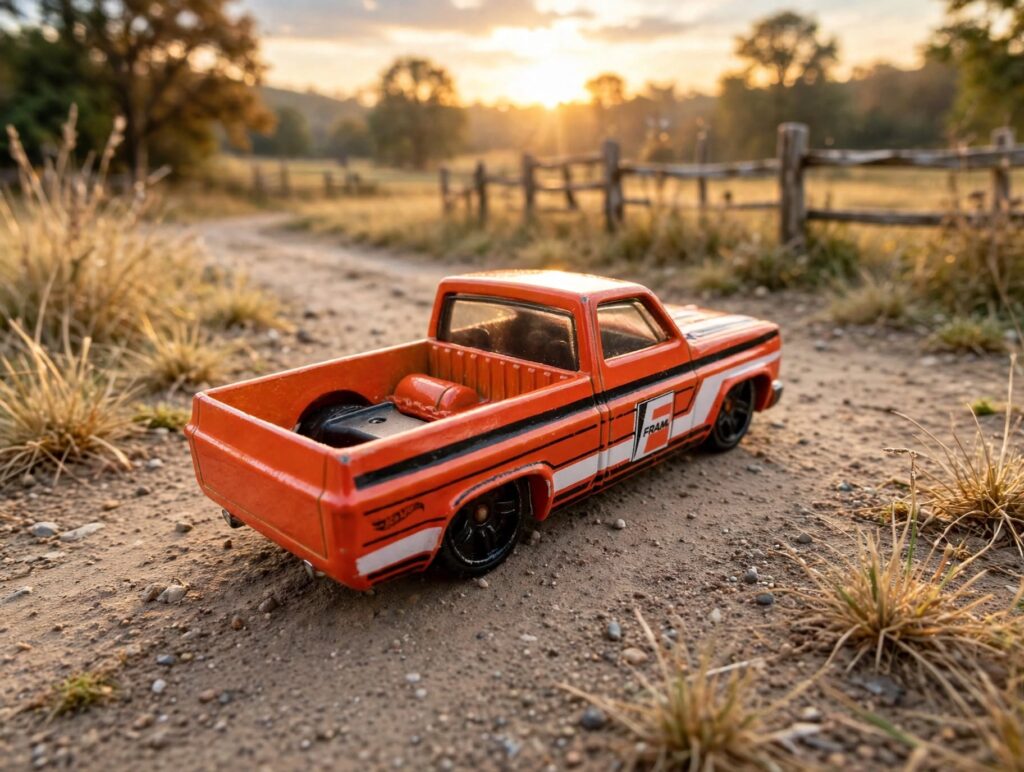
The wheels are black with a fine multi spoke face, filling the arches and sitting flush with the body. There is almost no gap above the tires, and the truck sits level instead of raked.
Level is the right call. A lowered truck with a nose down rake reads as a drag vehicle. Sitting flat and even, this one reads as a street truck, which is what the graphics and the long bed are telling you it is.
Where it sits among the other Chevrolet pickups
I have a few of these now, across different years and different brands. Some stock, some lowered, one in another scale entirely. Lined up together they show how much of a truck’s character comes from ride height alone.
Two castings of the same vehicle, one at factory height and one on the floor, tell you more about design than any single model can. If you want to work out which release a particular example came from, the card code explains it, and I covered reading those in Hot Wheels case codes.
Do I mind that it cannot work
Not any more. I used to think a working vehicle should look like it works, and the stock replicas made by the other big brand still do that job on my shelf. That difference between the two approaches is the whole subject of Matchbox versus Hot Wheels.
What changed my mind is that this truck is not pretending. It does not have a fake toolbox or a decal claiming to be a contractor. It is an orange box on the ground with racing stripes and a parts company logo, openly about appearance, and there is something clean about a vehicle that admits exactly what it is for.
I would take it again in dark blue with the same stripe. Orange is loud, and on a body with this much flat surface a quieter colour would let the square proportions do the work.