Pick up ten small cars from ten different makers and you will find ten different ideas about what a model car is for. One brand lowers everything and adds flames. Another copies the family hatchback outside your window down to the trim strip. A third builds farm machinery in a scale nobody else uses.
None of them is doing it wrong. They are answering different questions, and once you know which question each brand is answering, choosing what to buy gets a lot easier.
This page is a map of the brands behind the cars on this site, with links to the reviews and guides where each one gets covered properly.
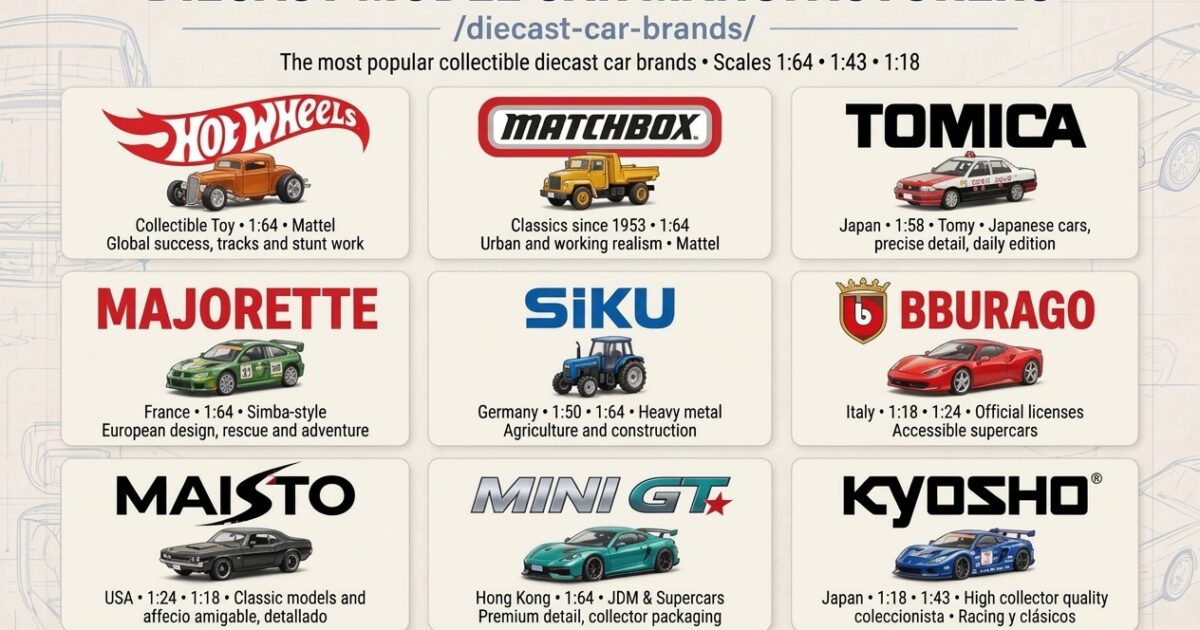
Hot Wheels
The one everybody starts with. Hot Wheels builds fantasy as readily as reality: real licensed cars sit on the same pegs as invented castings that never existed, and even the real ones are usually lowered, widened and given wheels nobody ever fitted.
That is the brand’s whole personality. It is not trying to document cars, it is trying to make toys that look fast standing still. If you are new to all of this, start with what a Hot Wheels car actually is, then read about case codes so you can work out which wave a car came from.
The two questions every new collector asks about this brand are covered in are Hot Wheels a good investment and Treasure Hunt versus Super Treasure Hunt.
Matchbox
The opposite instinct. Matchbox builds working vehicles at something close to correct proportions: vans, ambulances, pickups, jeeps, tractors, the traffic that fills a real street.
Where the other brand cuts a roof off and adds a blower, this one keeps the ride height and gets the door handles right. Neither approach is better, and a shelf with both on it is more interesting than a shelf with either alone. I set the comparison out in full in Matchbox versus Hot Wheels.
Majorette
A French maker with a European range: hatchbacks, city cars, vans and the occasional supercar, often with working suspension and sometimes with doors that open.
The castings are solid and the paint is usually very good for the money. The habit that divides people is the wheels, which often come in bright colors that have nothing to do with the real vehicle. My longer take is in collecting Majorette.
Maisto
A budget brand with a huge range, best known for larger scale models and for small cars sold in bins and multipacks. Quality varies more than with the bigger names, and the pleasure is in finding the good ones.
What Maisto does well is subjects nobody else bothers with: fifties racing cars, lowriders, ordinary sedans, open sports cars from the wrong decade. The cars themselves are usually stock, which makes them useful next to a shelf full of customs.
Welly
Another high volume maker working across several scales, with a strong European and Asian catalogue. Welly is where you find the cars that never make it into American toy ranges: superminis, compact off roaders, family SUVs.
The larger Welly models carry details that are impossible at mainline size, including opening doors, separate mirrors and full interiors. The trade is panel fit, since a door that opens needs clearance and the shut lines end up wider than on a sealed body.
Bburago
Known above all for large scale display models, the kind with hinged doors and a propped hood. The brand also produces small cars, and the thing to understand is that the reputation does not transfer down. At three inches there is no room for the features that made the big ones appealing, so a small Bburago competes on the same terms as everybody else: shape, paint, stance and wheels.
Siku
A German maker with an obsessive licensing habit and a range built around the vehicles of its own market: commercial trucks, agricultural machinery, service vehicles and the occasional car. Scales are chosen so everything in the range looks right beside everything else in the range, which also means it looks wrong beside anything from another brand.
Tampo work is the strength. Siku will reproduce a registration, a model designation and even a printed web address if the real vehicle carried one.
Greenlight and Johnny Lightning
Two American makers working at the collector end of the market. The cars are usually stock, the licensing is specific, often tied to films, television or particular model years, and the detail level sits above mainline standards.
Expect rubber tires, separate photo etched parts on some releases and prices to match. These are the brands people move to after a few years of buying from pegs.
How to choose between brands
Start with what you want the shelf to look like. If you want a street, buy from the makers that build stock vehicles. If you want a car show, buy the customs. If you want both, buy both and let them argue with each other.
Scale matters more than brand once you have chosen a direction, because a mismatched scale ruins a display faster than a mismatched brand ever will. My guide to starting a diecast collection covers that decision, and the diorama guide covers what happens once you start photographing them.
Which diecast brand is the most accurate?
For factory correct proportions and stock ride height, Matchbox, Welly and Siku are the ones to look at. Greenlight and Johnny Lightning go further on detail, at a higher price.
Is Hot Wheels or Matchbox better?
They are built for different purposes. Hot Wheels makes customs and fantasy castings, Matchbox makes working vehicles. The honest answer is that a collection needs both.
Are all diecast cars 1:64?
No. The number on the package is a guideline, and brands adjust it so cars of very different real sizes all fit the same package. Some makers use 1:60, 1:55 or odd ratios of their own.
Which brand is best for a beginner?
Any of the mainline makers, because they are cheap, easy to find and forgiving of mistakes. Buy a few from different brands before committing money to one.
Do diecast brands make the same car?
Constantly. Popular shapes get made by everybody, which is a gift for collectors: the same car from three brands shows you exactly what each one prioritises.