Most vehicles on a shelf are empty. Empty beds, empty boots, empty roof racks, nothing inside them and nothing on top. They look like cars in a showroom, which is another way of saying they look like they are going nowhere at all.
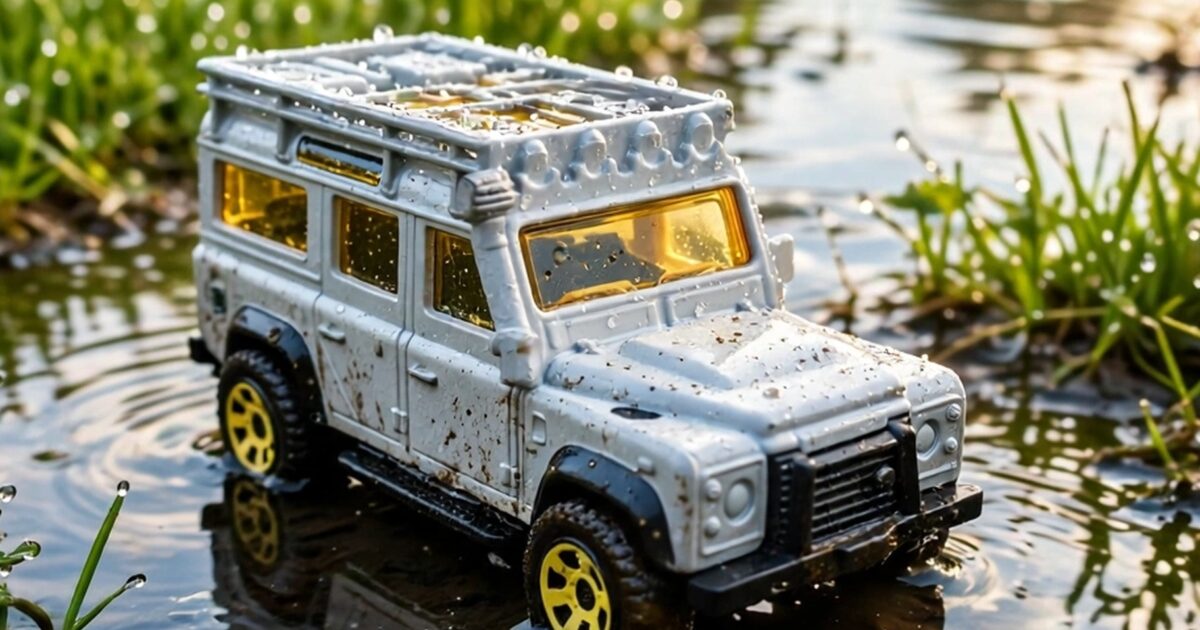
This white Defender has a load strapped to the roof. A shaped yellow mass sitting in the rack, cast as part of the model, and it changes the whole reading of the vehicle. An empty vehicle is parked. A loaded one is already on its way somewhere.
What the Matchbox Land Rover Defender 110 gives you
The long wheelbase version, white, with the squared off body that stayed in production for decades with only small changes. Flat panels, upright glass, a roof that meets the sides at a right angle, and almost no styling anywhere on it.
Across the roof there is a black rack running most of the length of the vehicle, and in it sits the load. Along the lower sides there are printed black panels with a diamond plate texture, and DEFENDER is lettered in small capitals just above the sill.
Why cargo changes a model so much
Think about what you are looking at when you see a vehicle with gear on it. Somebody packed that. Somebody decided what was needed, lifted it up onto the roof, tied it down and set off. All of that is implied by a single shape on a roof.
I have complained about this before, about a police pickup whose load bed was left completely empty. The absence is a missed chance, because cargo is the cheapest storytelling available to a casting designer. No extra tooling for a chassis, no licensing, just a moulded mass and a decision about where it goes.
The load here is a simple shape, not a crate or a tent or anything specific, and that vagueness is deliberate. A specific object would tie the vehicle to one story. A shaped mass lets it be luggage, supplies, equipment, whatever the person looking at it decides.
The yellow glass
All the windows are tinted a strong amber yellow, which is a habit this brand returns to again and again on its off road vehicles. It is not accurate. Real Defenders have clear glass like everything else.
What it does is read as heat and dust from a distance. Yellow glass on a white body says desert, says sun, says somewhere a long way from a city. It is a cheap signal and it works, and I would rather have it than correct clear glass on a vehicle this plain.
White paint on a working vehicle
White is the default colour for vehicles that work for somebody: fleets, aid organisations, survey teams, rental companies in hot countries. It photographs badly in direct sun and shows every mark on it, and none of that matters, because white paint is cheap to buy and it keeps the inside of the vehicle cooler.
On the model it does something useful. A white body gives the black graphics, the yellow glass and the gold wheels maximum contrast, so a vehicle with very little shaping still reads clearly from across a room.
The wheels and the stance
The wheels are gold with a black centre, wrapped in chunky tires with a deep tread, and the vehicle sits tall with genuine clearance showing underneath it.
Gold is an odd choice, and it is the one thing on this casting I would change. On a working vehicle it reads as decoration, and this casting is otherwise free of decoration entirely. A plain silver or dull grey wheel would have left the load and the glass to do the talking.
The tires themselves are good. The tread pattern is cut deep enough to catch shadow, and the sidewall has a visible shoulder, so from a low angle they look like rubber built for broken ground.
Flat panels and why they survive at this size
A Defender is built out of flat aluminium sheets folded at hard angles. There is no compound curve anywhere on the body, no subtle surface transition that needs careful tooling to capture.
That makes it one of the easiest shapes in the world to reproduce small, and it is why almost every brand has made one. Where a curved body needs good light to show itself, this one reads correctly under any conditions, flat on a desk or outside on a dull afternoon.
It also means the panel gaps and the door lines can be cast in as simple straight grooves, which is why the body looks assembled from parts instead of moulded in one piece.
Building a scene around a loaded vehicle
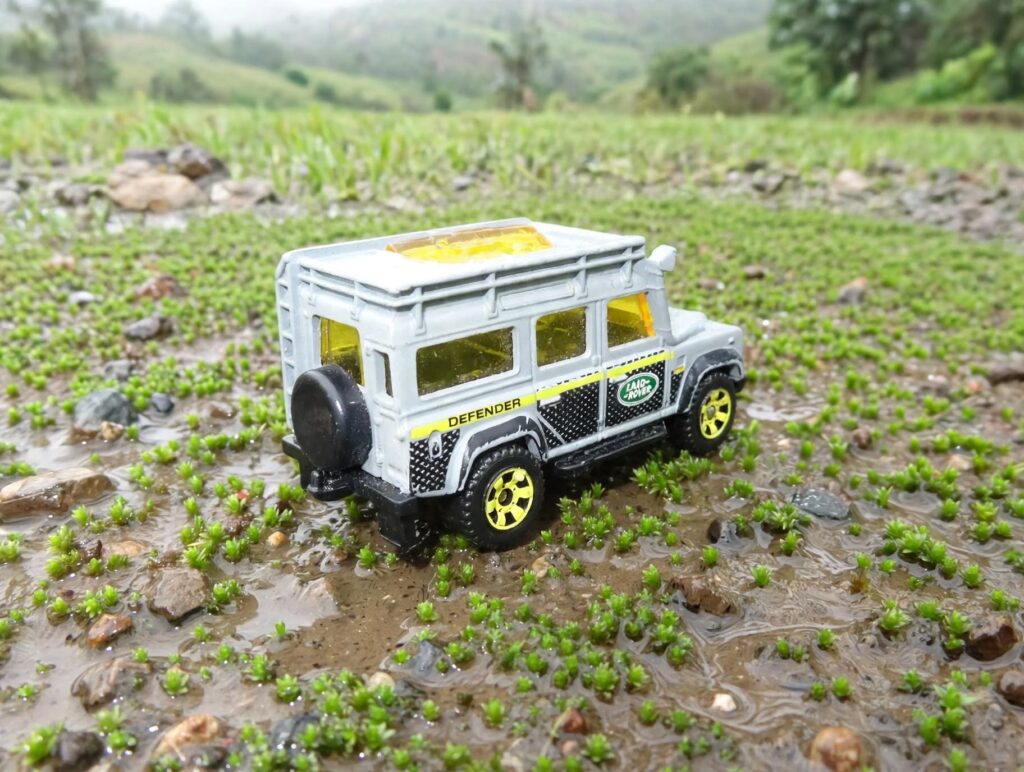
The load gives you a reason to put the model somewhere. A plain truck sitting on gravel is just a plain truck sitting on gravel. A loaded truck on the same gravel is halfway through a journey, and the viewer fills in the rest.
Shoot it with something ahead of it in the frame, a track running away or an obstacle it has to cross, so that the direction of travel is obvious. My diorama guide covers surfaces and backgrounds that suit vehicles like this.
The Defender I reach for
I own this vehicle twice, in two brands and two scales, and they do completely different jobs. The larger of the two is a detailed replica of a police vehicle, accurate right down to the crest printed on the door. This small one is a white truck with gear on the roof, heading somewhere nobody ever specified.
The small one gets handled more. Scale and detail are easy to buy, and both have their place, but a single moulded shape in a roof rack bought something neither of those can: a sense that the vehicle was in the middle of doing something when it got frozen. If you are working out what kind of collection you want, my starter guide is a reasonable place to begin.