
Modern cars usually lose in 1:64. Their character lives in gentle surfacing and fine grille detail, and both of those disappear the moment you scale them down. What you get is a smooth lump that could be any manufacturer.
The sixth generation Camaro escapes that, and the reason is worth understanding if you want to predict which modern castings will be any good.
Why the sixth generation Camaro works at this size
The real car launched in May 2015 as a 2016 model, styled by Hwasup Lee, sitting on the GM Alpha platform shared with the Cadillac ATS. Chevrolet claimed most of the architecture was unique to the Camaro.
What matters for a diecast is the shape language. This Camaro carries hard creases along the flanks, a heavily undercut lower front, and a roofline that drops in a straight line instead of a soft curve. Hard edges survive scaling. Soft surfacing does not.
Put this next to a modern sedan casting and the difference is obvious. The Camaro still reads as itself at 7 cm. The sedan reads as a bar of soap.
’16 or ’18 Camaro SS? Telling the castings apart
Mattel tooled the sixth generation Camaro more than once and listings mix them up constantly, so it helps to know what separates them.
The ’16 is the standard road car. The ’18 came out of the Hot Wheels 50th anniversary SEMA show car, designed by Brendon Vetuskey, and it carries the modifications that went with it, including a large rear spoiler and more aggressive wheels.
The spoiler is your fastest check in a photograph. A tall wing on the boot means you are looking at the anniversary car, not the standard one. If the deck is clean, it is the ’16.
Casting detail worth noticing
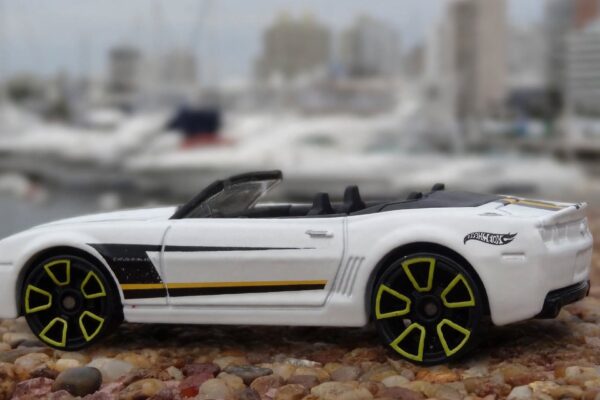
The front is the strongest part. The lower intake is a separate blacked out mesh section with real depth, so you get a shadow line under the nose instead of a painted rectangle. The headlight units are slim and properly recessed, which matters because those thin lights are half the car’s identity.
The rear haunches are correct too. On the real Camaro the rear fenders swell outward more than the front, and the casting keeps that, so the car looks planted from behind.
The weak point is the interior. Through the windscreen you can see a dark cabin with very little definition, which is normal at mainline level and still a shame on a car with clear glass.
The white and blue deco

Mine is white with a blue hood panel, a blue stripe running back along the lower door, and a pair of short blue hash marks on the front fender. The wheels are black with a blue outer ring.
The wheel and stripe colours matching is the detail I appreciate. It costs Mattel nothing extra to pick a wheel that ties into the deco, and plenty of releases skip it. Here the blue ring pulls the whole thing together.
White is a hard body colour in diecast because it shows every flaw in the paint and every misregistration in the tampo. On mine the blue hood panel has some visible wear at the front edge, which is exactly where you would expect it.
Is the Hot Wheels ’16 Camaro SS worth collecting?
For a modern muscle shelf, yes. It is cheap, widely available in different colours, and it is one of the better executions of a current car in the mainline range.
It does not carry the emotional weight of a ’67 or a ’69 Camaro and it never will. Those cars have decades of history behind them and this one has a decade. If your collection is built on nostalgia, this will feel thin.
Where it earns its place is in a Camaro generation lineup. Six generations side by side is one of the more satisfying displays you can build in this scale, and it costs very little because most of the castings are mainline cars.
What to check on a used ’16 Camaro SS
The front intake is where I look first on this one, and almost nobody does. It is the deepest recess on the car, it is a separate blacked out mesh, and on anything that has been pushed along a floor it gets crushed or filled with dust. A collapsed intake kills the shadow line that makes the nose work.
After that, the blue hood tampo. Highest flat surface, most handling, first to thin. Mine already shows wear at the leading edge.
White paint is the slow problem instead of the obvious one. It scuffs, and older loose examples stored in light go faintly cream. You will not see it alone; you will see it the moment you stand the car next to a fresh one.
Then confirm all four wheels carry the blue ring, since mismatched replacements are common, and roll it on a flat surface.
Building a Camaro generation shelf
This is the display I would build around it. Hot Wheels has covered every Camaro generation at some point, from the original Custom Camaro of 1968 through the ’67, the fourth generation convertible, the 2010 car and this one.
Lined up in order you get fifty years of American design decisions in a row of cars that cost less than one premium release. It also makes each individual casting more interesting, because you start noticing what carried over and what got abandoned.
So should you buy one?
A genuinely good modern casting on a car that had every chance to turn out dull. Sharp creases, a properly deep front intake, and wheels that match the deco. Watch the white paint when buying loose. Otherwise this is an easy one to recommend, especially if you are building the generation lineup.