Modern pickups are hard to make interesting at 1:64. They are big, flat sided, and most of their personality lives in the grille, which is the one thing that does not survive being shrunk down.
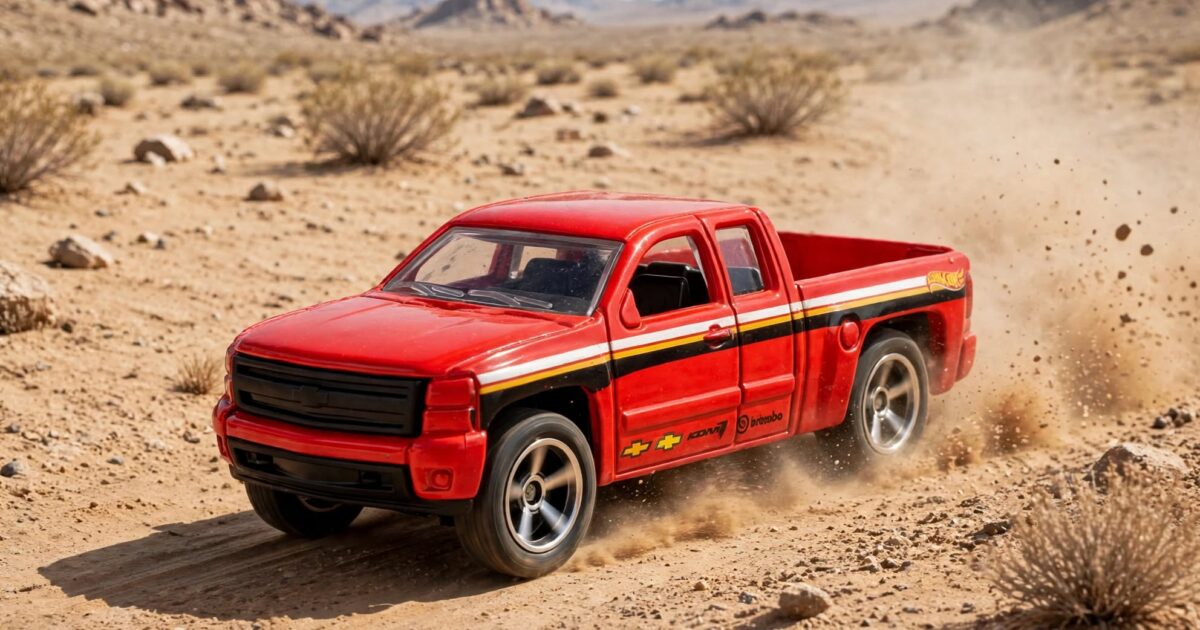
So when one comes out well it deserves saying so. This orange Silverado is slammed to the floor on deep dish wheels with a black and orange stripe package, and it looks like a truck somebody actually built.
Why lowering it saved the casting
Most diecast pickups are stock height or lifted. Mattel went the other way and dropped this one hard, so the tyres nearly fill the arches and there is barely a gap between the rocker panel and the ground.
That decision is doing all the work. At this scale your eye reads the space under a car as dead space, and a stock height pickup ends up looking tall and hollow. Fill that gap and the truck suddenly has intent.
It also plugs the model into something real. Lowered street trucks have been a serious scene in the United States and Mexico for decades, and this is a recognisable member of it instead of a generic pickup with small wheels.
Body detail and the extended cab
The extended cab is the right call for this body. It stretches the profile and balances the bed, where a regular cab would have left the truck looking stubby.
The rear half door is moulded in with its own handle and the shut lines are crisp enough to read through the paint. The grille is a blacked out two bar design and the headlight units have enough definition to separate from the bodywork around them.
The bed is open and hollow with ribbing on the inner walls. That is more effort than most pickups get and it matters if you build scenes, because an open bed is a bed you can load.
The orange and black deco
Strong orange, close to safety orange. A black band starts at the door and runs back over the rear fender with thin orange and yellow pinstripes framing it.
Along the lower door there is a row of small logos: a Chevrolet bowtie, a Hot Wheels flame, and a couple of aftermarket suspension and brake brand marks. Those little logos are the detail I like most. They say the truck was built by somebody with a parts catalogue instead of ordered from a showroom, and they are printed small enough to add texture without cluttering the side.
Modern pickups versus vintage trucks in a collection
Most 1:64 truck collections lean heavily vintage, because fifties and sixties pickups have shapes that are easy to love and Matchbox has been making them forever. That leaves an obvious hole at the modern end.
A shelf that runs from a fifties stepside to a slammed modern extended cab tells you something about how work vehicles turned into personal vehicles. A shelf of period trucks alone does not.
The lowered stance also gives you a different subject entirely. Vintage pickups in this scale are almost always presented as working vehicles. This one is presented as somebody’s weekend project.
Is the Hot Wheels Silverado worth collecting?
Solid mainline buy, not a must have. It is a modern vehicle with no racing history and no nostalgia attached, so it does not carry the weight of a ’69 Charger or a gasser and it never will.
Where it gets interesting is if you collect trucks specifically, or if you build street scenes. A lowered modern pickup fills a slot most collections leave empty and it looks nothing like the vintage stuff around it.
What to check when buying loose
It sits low, so the underside takes the punishment. Turn it over and look at the base and the lower rocker edges for scraping. A truck this low that lived on a carpet will show it immediately.
Then the deep dish wheels, which stick out further than standard ones and make first contact in any impact. Check the outer rim edges for flat spots.
Then the black side band where it crosses the door gap, the big flat hood and roof for scuffs, and those small lower door logos, which are the first graphics to vanish with handling.
Shooting it and using it in a diorama
Load the bed. Crates, a spare wheel, a couple of toolboxes, anything. It turns the truck from an object into a situation. In a street scene it works well in the foreground because the low body does not block whatever you put behind it.
Keep the camera low. Shooting a lowered truck from above throws away the only reason it looks good. Get level with the arches and let the stance do the job.
Why modern trucks are hard to shrink
The Silverado gets it right, and it is useful to know what it got right so you can spot the ones that do not.
Modern pickups carry their identity in the grille and in subtle body surfacing. Both suffer at 1:64. Fine grille patterns turn into a dark rectangle once you scale them, and gentle surfacing disappears entirely because there is not enough depth left to catch light.
What survives scaling is silhouette, stance and hard edges. That is exactly why lowering this truck worked and why the extended cab was the right body to choose. Mattel leaned on the things that still read at small size instead of trying to reproduce details that were always going to be lost.
Apply that test to any modern vehicle before you buy it and you will avoid a lot of dull castings.
Verdict
A well judged take on a subject that usually produces dull models. The stance, the extended cab proportions and those small aftermarket logos give it a clear identity. It will never be the valuable thing in your case, and if you collect pickups or build street scenes it earns its place the day it arrives.