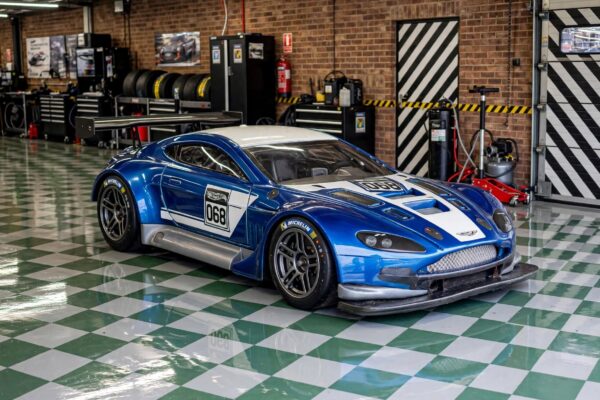
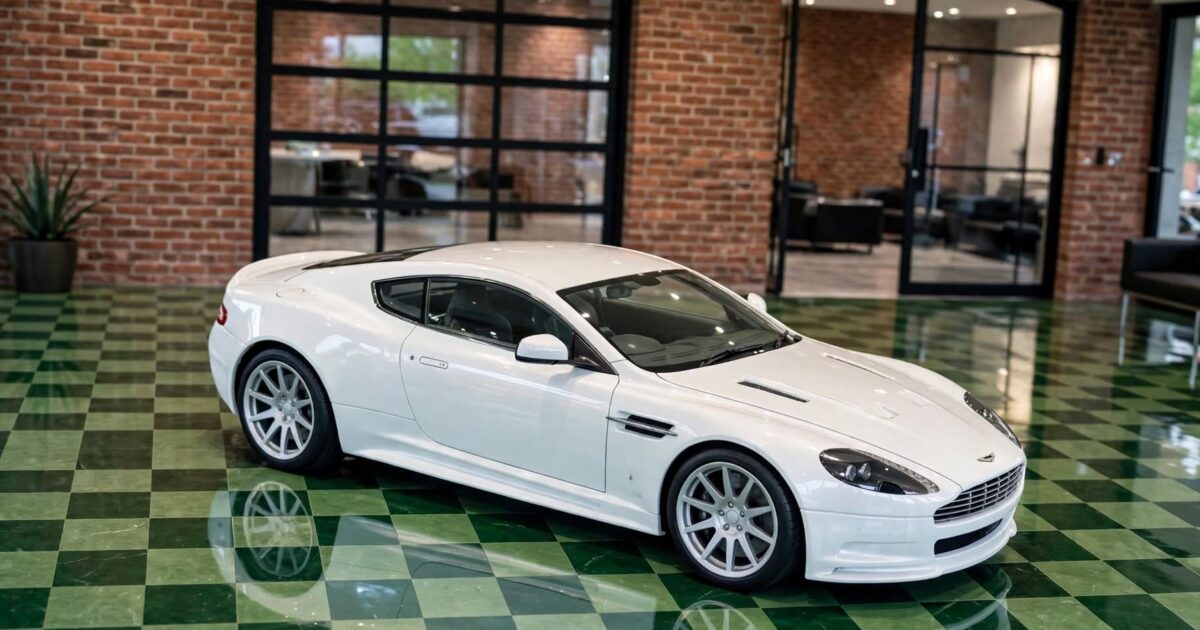
White paint. Silver wheels. No stripes, no flames, no sponsor logos, no number roundels. In a range where most cars are shouting, this one says nothing at all, and it is one of the better looking things I own.
Why Aston Martin shapes resist decoration
Aston Martin has spent decades refining one basic idea: a long bonnet, a cabin set far back, a wide low grille, and surfacing that flows rather than creases.
That design language depends on uninterrupted surfaces. Graphics across an Aston break the flow that the whole shape is built around, which is why the company’s own road cars almost never wear them and why the racing versions look so different from the street ones.
Hot Wheels understood that here. Leaving it plain was the correct decision, and restraint is not something the brand is famous for.
What the casting captures
The grille is the signature and it is done properly: a wide, low opening with a horizontal bar pattern, flanked by the headlight units which are moulded with internal detail and picked out in silver.
Along the flanks there are side strakes behind the front wheel arch, another Aston fixture, moulded as raised detail rather than printed.
The bonnet carries the correct twin vents, and the roofline falls away toward a short rear deck without the flat spot that cheap castings develop on long curved surfaces.
The glass is clear rather than tinted, which lets you see the interior. On a car this expensive looking, showing the cabin is the right call.
White paint on a curved body
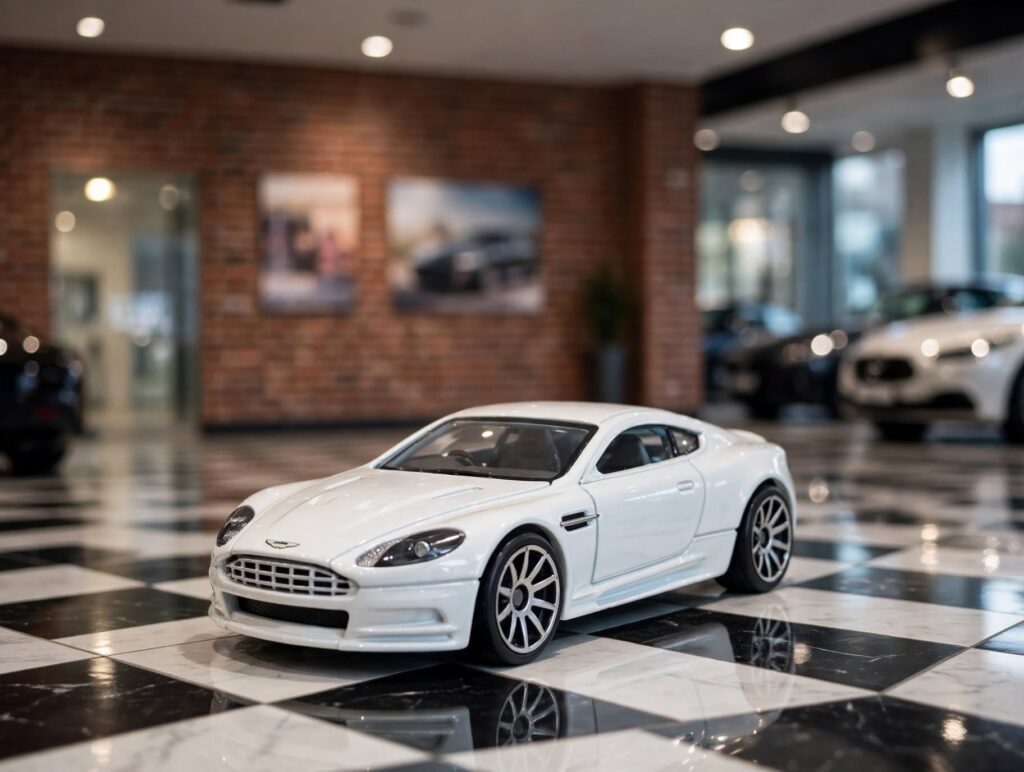
White is difficult and here it is also the right choice.
The difficulty is that white shows every flaw in the paint and every misalignment in the tooling. There is nowhere to hide a seam or a sink mark.
The reason it works is that white reveals surfacing better than any other colour. Where black shows only reflections and bright colours flatten everything, white lets you see the gentle changes in the body sides that define an Aston.
On my example the paint is even and bright, which given the price is more than I expected.
Licensed European cars in the mainline
Aston Martin, like BMW and Audi, belongs to a group of European manufacturers whose cars appear in the mainline range but never in large numbers.
They tend to be well executed, because a licensed luxury brand has approval rights and will reject a casting that misrepresents the car. That oversight is why European licensed castings are often better proportioned than the fantasy vehicles beside them on the peg.
It also means fewer releases and less variety in colour, so when you see one you like, buy it.
Judging a licensed casting
Licensed cars go through manufacturer approval, and you can see the fingerprints of that process if you know where to look.
The badge is the first tell. A licensed casting carries a correctly proportioned badge in the right place. An unlicensed one has a vague shape, or nothing at all.
The second is the grille, because it is the face of a brand and the part a licensing department will reject if it is wrong.
The third is proportion around the greenhouse, since manufacturers are protective of their rooflines.
Apply those three to any casting claiming to be a specific car. If all three hold up, somebody had access to real reference material, and the rest of the model is usually better for it.
Buying a loose DBS
White paint first, under angled light, across the bonnet and roof. Look for scuffing and for yellowing on older loose examples, which affects white more than any other colour and is impossible to reverse.
Then the grille. It is a wide low opening at the front of a long nose, so it collects dust and takes impacts. A crushed grille ruins the face of the car.
Then the side strakes, which are raised details at handling height and get rubbed.
Check the clear glass for scratching, and roll it for a bent axle. Long cars show a sag clearly from the side.
Plain cars on a loud shelf
A collection of graphic heavy castings eventually stops reading as individual cars and starts reading as noise. Every one is competing for attention and none of them wins.
One or two plain cars fix that. They give the eye somewhere to rest, and by contrast they make the loud ones look intentional rather than relentless.
This is the car I use for that job. Put it between two flamed muscle cars and all three look better.
The short version
A well proportioned casting of a shape that punishes mistakes, left undecorated because decoration would have ruined it, in a colour that shows off the surfacing. Cheap, quiet and better than it needs to be. Watch for yellowing when buying loose.