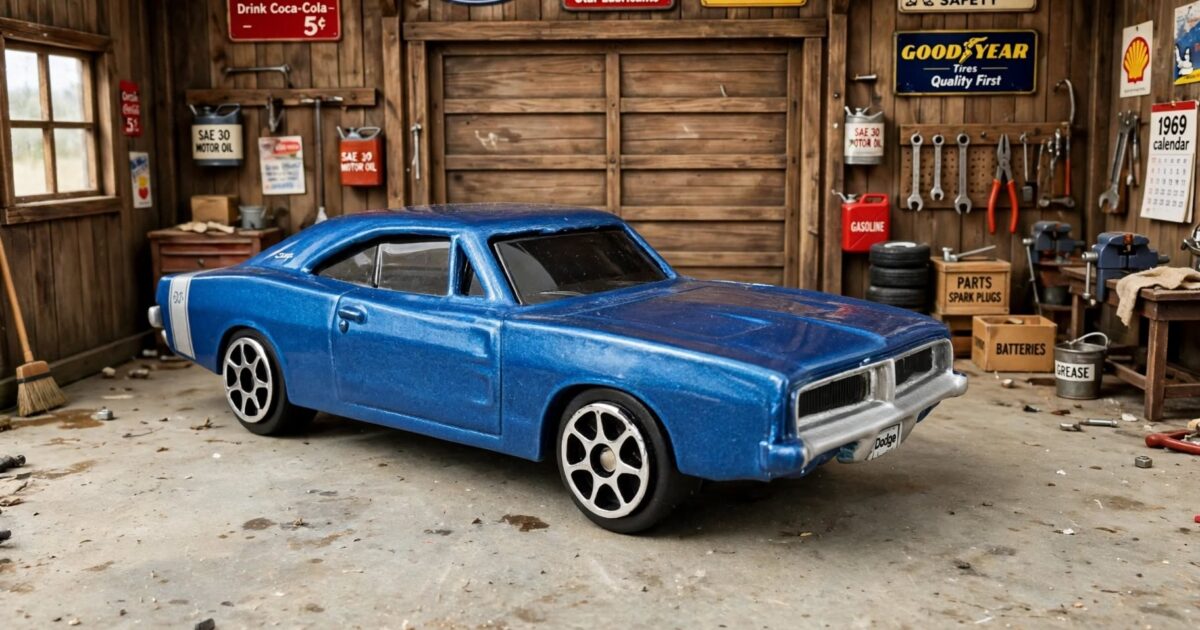
Look at the nose of this car and tell me where the headlights are. You cannot, because there are none visible. The real 1969 Charger hid them behind vacuum operated covers, so with the lights off the front of the car is one unbroken black rectangle inside a chrome bumper.
That is a problem for anybody making a small model. Headlights are how a casting gets a face, and this one has to work without any.
What the Maisto 1969 Dodge Charger R/T does with that blank front
It leans into it. The grille is a deep black recess running the full width between the bumper ends, split vertically in the middle, with nothing printed inside it. No lamp shapes, no silver dabs, no attempt to suggest what is behind the doors.
That restraint is correct and it takes some nerve. Plenty of castings would have printed headlights on a car that should not have any, because an empty face looks unfinished on a peg. Maisto left it alone, and the result reads exactly like the real thing sitting with its lights closed.
Blue metallic and the silver stripe
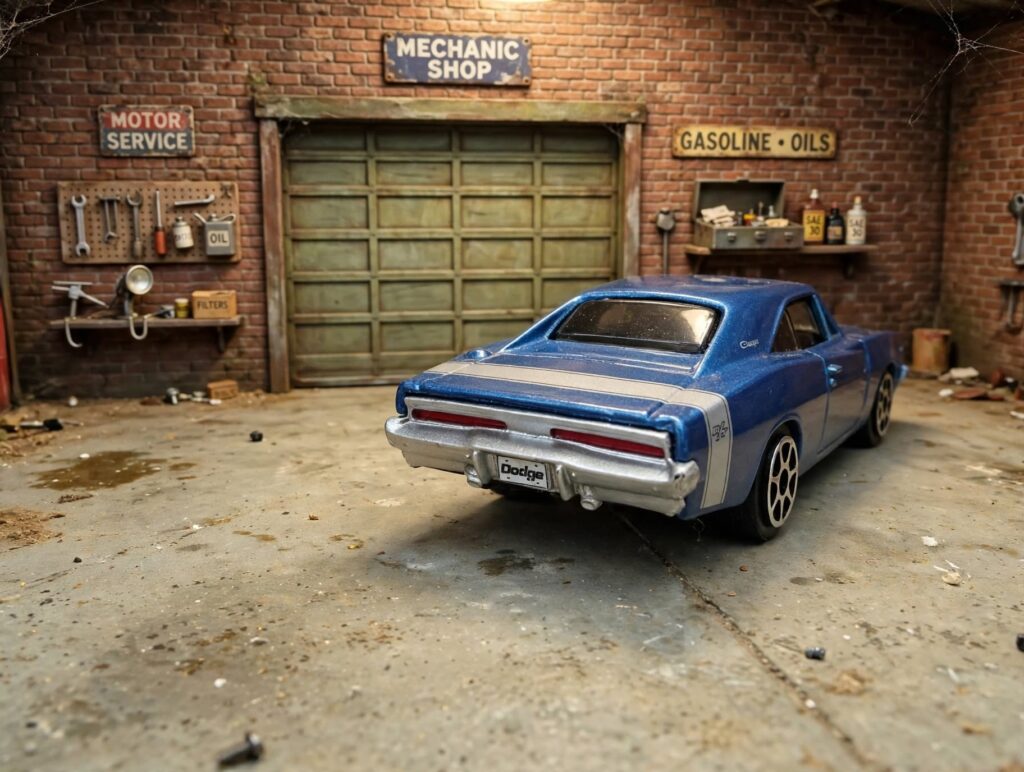
The body is a medium metallic blue with a fine flake, even across the roof and the long flat doors. On the rear quarter, just ahead of the taillights, there is a broad silver band wrapping over the top of the car.
It is a period stripe treatment, and on this blue it does the job that a contrasting color always does on a plain body: it breaks up a very long flank and gives the back half of the car some weight. A small R/T badge sits inside the stripe on the quarter panel.
The printing is clean on mine, with the stripe meeting the body line at the same height on both sides of the car. On a graphic that wraps over the roof, any difference between the two sides shows up immediately from a front three quarter angle.
The rear is better than the front
Turn it around and the car comes alive. The full width chrome bumper carries four red lamp shapes set into it in two pairs, there is a Dodge plate in the middle, and a chrome exhaust tip pokes out below on one side.
The rear glass is set into a recessed tunnel between two flying buttresses, which is the other feature that makes a 1969 Charger instantly recognizable. The casting gets the depth of that recess right, and from a low angle behind the car you can see the shadow it creates.
White eight spoke wheels and the stance
The wheels are white with eight open spokes and a chrome ring, and they are the most period correct choice on the model. Painted wheels like these were everywhere on American cars of the era, and they suit a body this size far better than chrome would.
The car sits level and low, with the tires filling the arches and very little gap above them. No rake, no lift. For a two ton coupe that is how it should look, planted and heavy.
The arches themselves are simple openings with no flare, which is accurate. Nobody widened these cars from the factory, and a casting that adds blisters to a Charger has stopped being a Charger and become something else.
What you see through the glass
The windows are clear with no tint, and inside there is a grey interior with a bench, a dash and a steering wheel. Nothing is painted, but the shapes are there and the glass area on this body is generous enough that you notice them.
The roof has a thin pillar either side of the rear window, so from a three quarter angle you look straight through the car. That openness is part of why this shape photographs so well.
One small thing I noticed holding it up to a lamp: the windscreen is quite thick, so the dash behind it distorts slightly at an angle. It is a limitation of a single moulded glass piece, and on a car with this much window area it is more visible than usual.
Owning more than one of the same car
Here is a question every collector eventually faces. I already have this model year in another brand and another color, and two more Chargers from other years. At what point does that become one Charger too many?
My answer is that the second example has to teach you something the first one could not. Different brand, different decade, different approach to the same metal. If the only difference is paint, the second one belongs in a drawer. If it changes how you read the first one, it earns a space. My notes on starting a collection cover how to avoid buying the same car five times by accident.
How this one photographs in a scene
The blank front end is the whole trick. Shoot this car head on under a single light and it looks sinister, because there is nothing for the eye to lock onto, no bright spots where the lamps should be.
Shoot it from behind instead and the chrome bumper and the deeply recessed rear glass do all the work. Both ends are strong, which is rare on a casting at this price. For surfaces and backgrounds that suit a car this dark, my diorama guide has the basics.
Do you need a fourth Charger
Probably not. I bought this one anyway, and the justification is that no other Charger I own makes the point this one does about what a designer can leave out.
The hidden headlights are a risk. They give the car no face, no friendliness, nothing to smile back at you, and the casting commits to that completely instead of cheating. That one decision is why the blue car now sits at the front of the row, with the red one, the gold one and the black one lined up behind it.