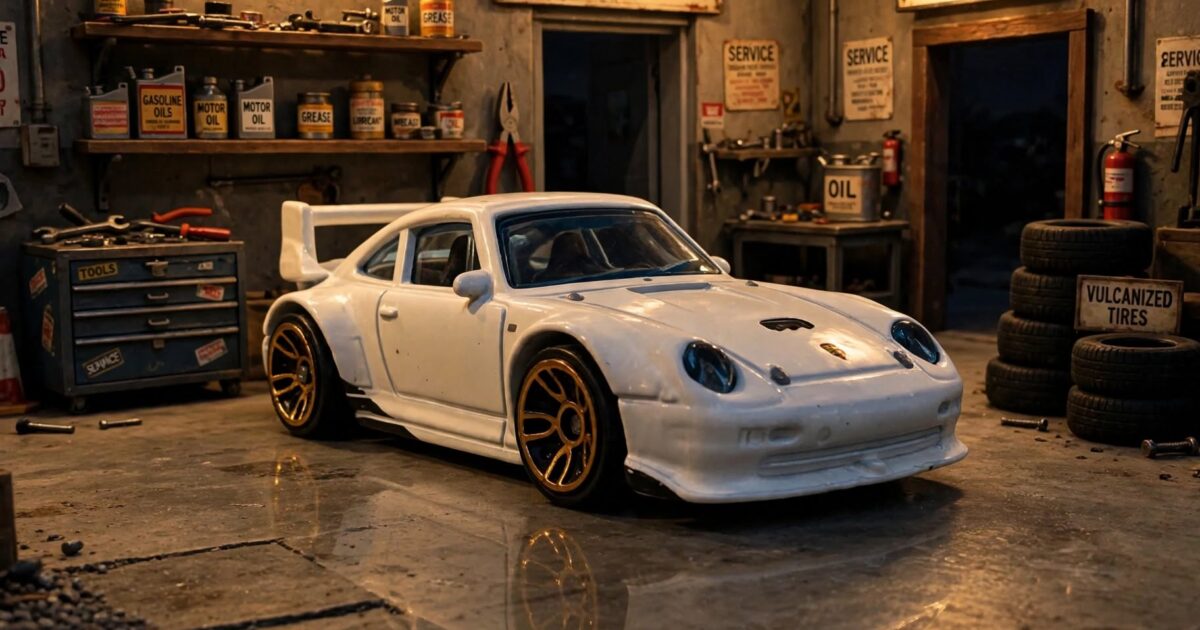
The whole point of a GT2 is that somebody took a road car and screwed extra bits onto it. Wider arches over the wheels, a deeper front bumper, a wing standing up off the engine lid. On the real thing those parts are separate pieces, with visible fasteners and a seam where they meet the body.
On this white casting they are the body. One piece of metal, flowing from door to flare with nothing to mark where one ends and the other begins, and that single manufacturing fact is the most interesting thing about the model.
What the Hot Wheels Porsche 993 GT2 gets right
The hard part, which is the shape. The 993 has a particular roofline, a low arc that drops into a short tail, and a nose that slopes down between two rounded fender tops. All three are here and all three are correct.
The arches are enormously wide. Viewed from the front the car is a narrow cabin sitting between two blisters, and the casting exaggerates nothing: that is how these cars look in the metal.
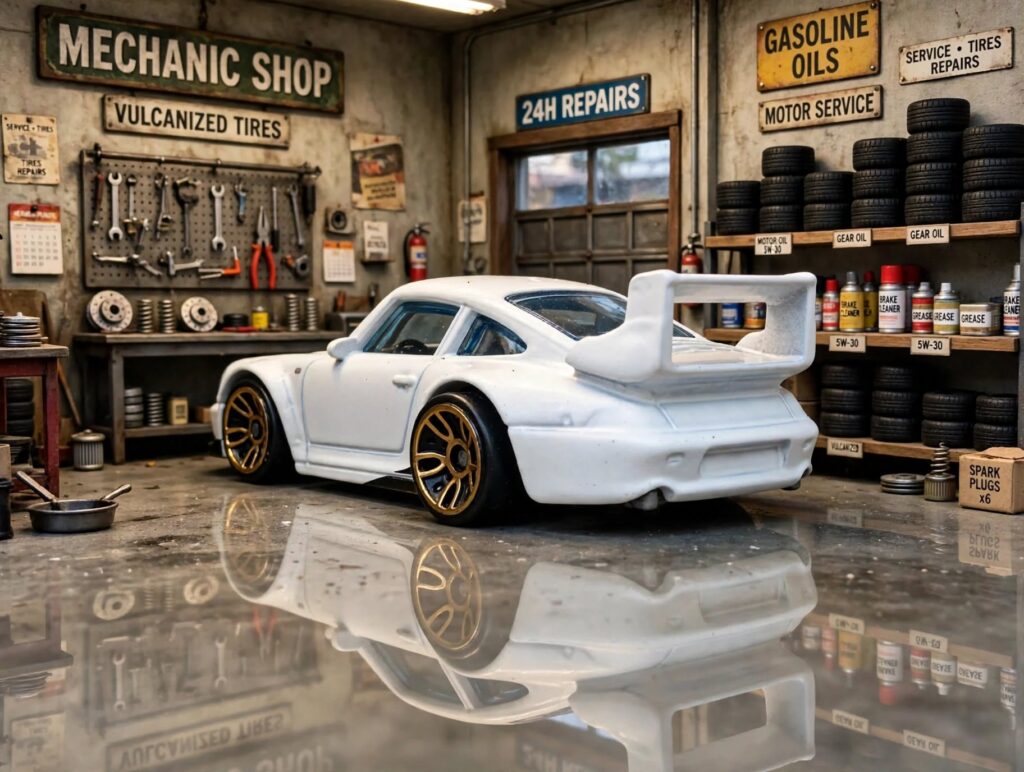
The rear wing is a serious piece of work
It stands tall on two thick uprights, with a flat upper plate and a deep vertical element below it that houses the intake. It is cast in one with the body, white like everything else, and it reads correctly from every angle.
Hot Wheels could have simplified it into a flat slab on two posts and nobody would have complained. They did not. From the side you can see daylight under the plate and between the supports, which is what makes a wing look like aerodynamics instead of decoration.
Where the moulded arches cost you something
Here is the complaint. A real GT2 has a line around each flare, and on many of them you can see the rivets. That hardware is the car’s signature, the visible evidence that this is a homologation special and not a Carrera with a body kit.
Mould it in and you lose all of that. What you get instead is a smooth, continuous surface that looks more like a modern widebody supercar than a nineties Porsche built to go racing. The shape is accurate, the story is not.
I would take a printed seam over nothing. A thin dark line following the arch edge would have cost one more step in the tampo machine and would have told the whole story of the car.
Why that trade is made every time
It comes down to tooling. Every separate piece on a casting needs its own mould, its own part in the assembly line and its own step where somebody fits it. At mainline prices there is room for a body, a base, a glass insert, an interior and wheels. That is the budget.
So anything that was bolted on in reality gets absorbed into the body, and the detail that survives is whatever can be cast as a shape or printed as ink. Understanding that one constraint explains most of what any small casting does and does not have.
It also explains why premium ranges cost what they do. Pay more and some of those pieces come back: a separate grille insert, soft rubber tires in place of the hard plastic ones this car rides on, a wing mounted on its own posts. The casting underneath is often the same tooling.
Gold wheels against a white body
The wheels are gold multi spoke designs with fine spokes and a deep face, and against plain white they are the loudest thing on the car. It is a period correct combination, since this was exactly the sort of wheel owners fitted in the nineties, and it saves the model from looking bare.
They also create an expectation. A white car with gold wheels looks special on a card, and people assume special means scarce. It usually does not. If somebody tries to sell you one on that basis, the actual markers are explained in Treasure Hunt versus Super Treasure Hunt.
Headlights, crest and the small print
The headlights are printed with a blue tint, set into the fender tops in the shallow ovals the 993 used. A small Porsche crest sits on the nose, and there is a single exhaust tip cast under the rear valance.
That is the whole decoration. No stripes, no numbers, no sponsors. On a car with this much bodywork going on, leaving the surfaces plain is the right call, and it puts all the attention on the arches and the wing.
Through the side glass there is a dark interior with a seat and a wheel, visible but not detailed. The glass itself is lightly tinted, which on a white car reads as a proper window instead of a hole in the bodywork.
How low it sits and what that means
The car is on the floor. The front lip is close enough to the surface that it catches on anything with texture, and the gap above the tires is almost nothing.
That is correct for the subject and it limits where you can put the model. It rolls on smooth concrete and glass, and it drags on carpet or gravel. Treat it as something to look at. If you are weighing up what to spend on castings like this, I went through the question in are Hot Wheels a good investment.
What the white GT2 is good at
Looking like a lot of car for very little money. The wing, the arches and the gold wheels add up to something that photographs like a model costing several times as much, and plain white turns out to be the right background for all three.
What it is not is a record of how the real thing was built. The seams and fasteners that made a GT2 a GT2 are gone, absorbed into one smooth piece of metal. I knew that going in, and I still reach for it, because the silhouette is right and the wing is genuinely well made.