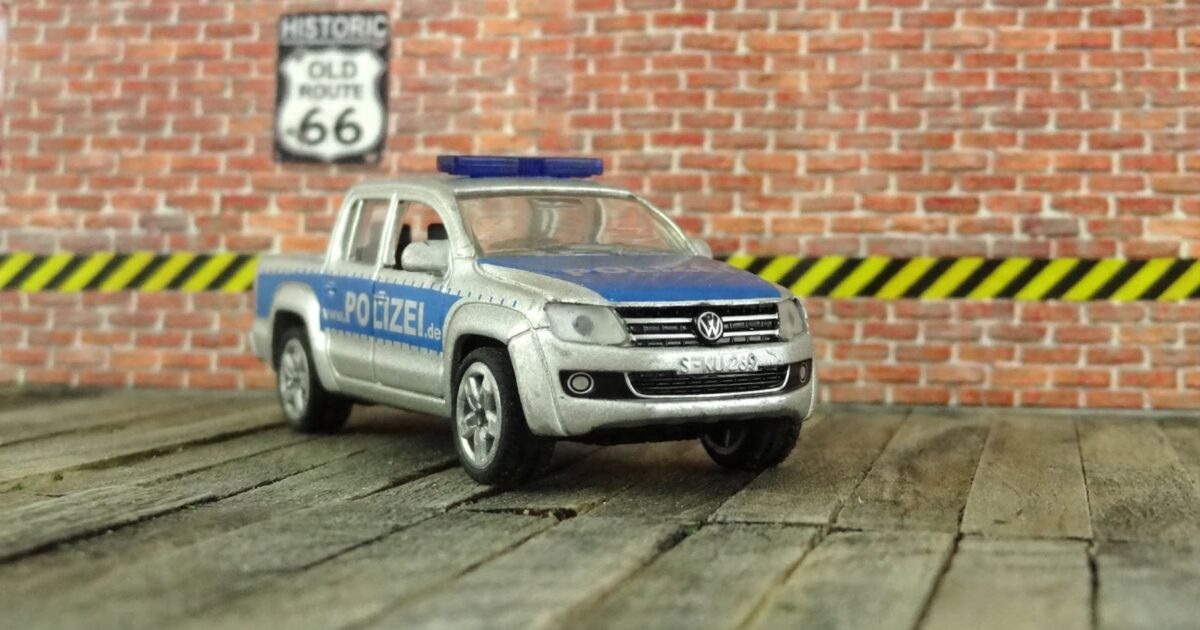
Read the lettering along the side of this truck. It says POLIZEI, which you expect, but look closer at what frames it. Before the word there is www and after it there is a dot de. The whole thing is a web address, printed on the door of a police vehicle, copied faithfully onto a toy.
I cannot think of another casting anywhere in my collection with a web address printed on it. It is the kind of detail that only exists because somebody licensed the real markings and reproduced them without asking whether a toy needed them.
What the Siku VW Amarok Polizei is modelling
A double cab pickup in police service, which is already unusual. Most European forces patrol in estates and hatchbacks, so a pickup in this role is a specialist vehicle, the sort of thing used where a patrol car has to tow, carry equipment or leave the pavement.
The body is silver with a broad blue band running along the lower doors and across the hood, edged with a dashed blue pattern that copies the reflective striping on the real vehicle. The bed sides stay plain silver, so the graphics sit entirely on the cab.
That split is deliberate on the real vehicle too. Markings go where people look, which is the doors and the hood, and the load area stays plain because nothing needs to be read there.
Why a URL dates the vehicle exactly
A web address on a patrol vehicle belongs to a specific window of time. Early enough that printing a domain on a car still felt like a useful thing to do, late enough that the force had a public website at all.
It is a better date stamp than the vehicle itself. A pickup shape stays recognizable for a decade or more, but printed contact details go stale quickly, and nobody puts them on a patrol car today because everybody already knows how to find a police force online.
The light bar and the roof
The bar sits across the roof above the windscreen, moulded in translucent blue plastic with a clear base, and it is the tallest and most fragile thing on the model. It stands proud of the roof with nothing protecting it.
Check it before you buy. A bent or clouded bar on a vehicle this clean ruins the whole front three quarter view, and it is not a part you can replace.
The cab glass is clear with no tint, and through it you can see a dark interior with seats and a wheel. On a vehicle with this much window area that matters, and the lack of tint also means the light bar’s blue reads properly against the roof instead of disappearing into a dark band.
The tailgate is where the lettering lives
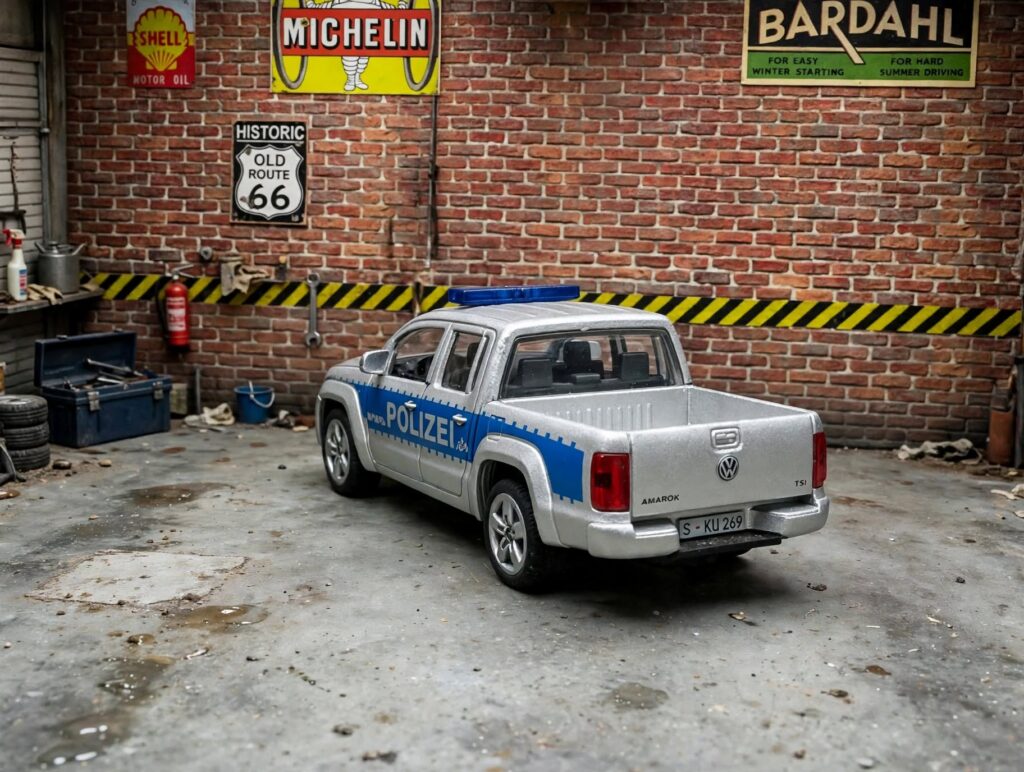
Walk around the back and there is more printed detail than most castings carry anywhere. A VW roundel in the centre, AMAROK on the left, TDI over on the right, red lamp units at the corners and a plate below the bumper.
The plate is where the brand signs its own work, using its name and a number in place of a real registration. It is the same trick other makers use, and here it is at least tucked away at the bottom of the tailgate instead of running along the flank.
The bed, the mirrors and the small parts
The bed is open with a ribbed floor cast into it, and the sides carry the pressed shapes the real truck has. It is empty, which is a missed chance. A pickup used by a police force would be carrying something, and a moulded case or a cone in the bed would have cost very little.
The mirrors are separate pieces on stalks, and like the light bar they stick out far enough to catch on things. Together those two parts decide the condition of any secondhand example you find.
The wheels are silver multi spoke alloys that fill the arches, and the truck sits at factory height with proper ground clearance underneath. No lift, no drop. For a working vehicle that is the only right answer.
Siku and the European approach to toy cars
Brands grow out of the roads around them. A German maker fills its range with vehicles you see on German roads, which means a lot of commercial trucks, agricultural machinery, vans and service vehicles, and very few fantasy castings.
It is the opposite instinct to a line built on customs and flames, and both instincts produce good toys for different reasons. I set out that split in Matchbox versus Hot Wheels, and this truck lands firmly on the stock replica side of it.
Scale, size and what it will sit with
This is a larger casting than a mainline car and it will not share a shelf with them comfortably. Brands like this one work to scales that keep every vehicle in the range the same relative size to each other, which is why a car and a tractor from the same maker look right together and wrong beside anything else.
That internal consistency is the strongest argument for buying several from one range instead of one from each.
If you are deciding what to commit to before spending money, my starter guide covers choosing a scale and sticking to it.
What the Amarok is for on a shelf
Honestly, it is for people who like reading small print. The appeal here is not the shape, which is a sensible modern pickup, and it is certainly not the color, which is plain silver.
It is the density of printed information: a URL, a model name, an engine designation, a plate, a striping pattern copied from a real vehicle. Hold it under a lamp and there is more to read on this truck than on any supercar I own, and reading all of it tells you something about where and when the original vehicle was working.