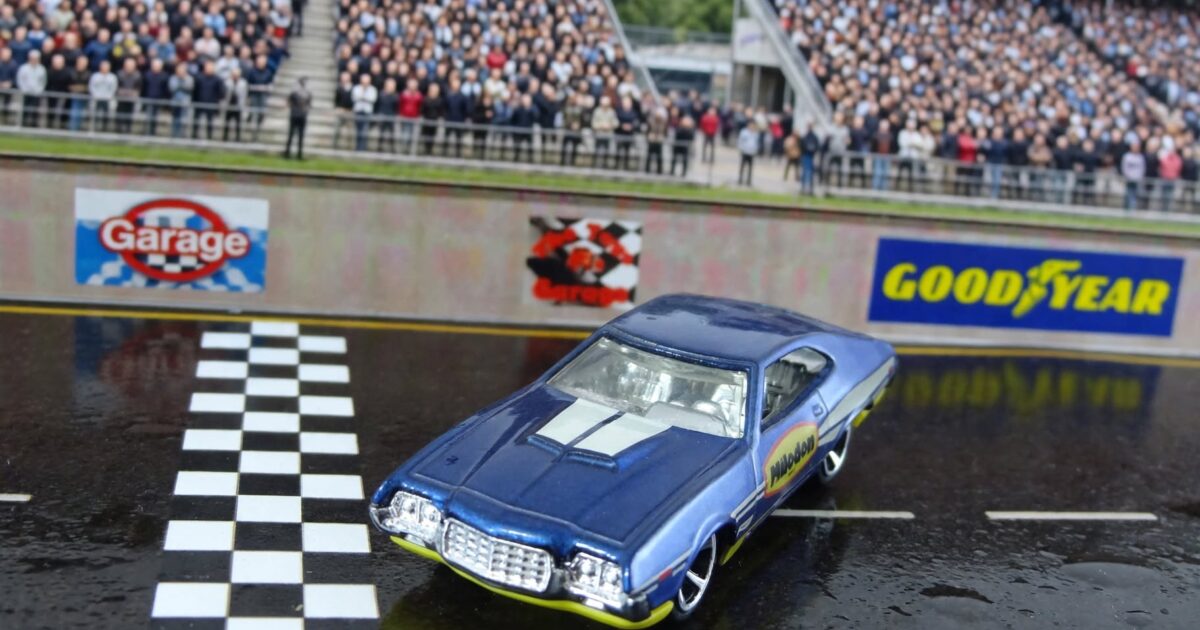
Look through the side window of this blue Torino. There is a chrome engine in there, sitting roughly where a passenger seat should be, with the intake stacks standing up against the glass.
That is not a mistake, and it is not laziness either. It is a deliberate signal, and once you learn to read it you start seeing it on castings everywhere.
What the chrome engine in the cabin means
On a serious drag car the engine moves back. Pushing the weight toward the middle of the chassis puts more load on the rear tires, and in the most extreme builds the motor ends up behind the front axle line with the firewall cut away to let it sit there.
So a chrome engine visible through the side glass is shorthand. It says this is not a street car with stripes, it is a car that has been rebuilt around going fast in a straight line. The casting says that without needing a scoop through the hood or a wing on the back.
The Milodon graphics and why they are quiet
The tampos are small yellow ovals on the door and the rear quarter carrying the Milodon name, which belongs to a real maker of engine components. Not a car brand, not a fuel company, but an actual parts supplier.
That is the sort of sponsor a real racer would carry, because the money in this kind of racing comes from the people who sell you the parts. A big soft drink logo would have looked wrong. These look like a car that got a deal on oil pans.
The printing on mine is crisp, with the oval edges clean and the yellow laid down solid instead of patchy. Small logos are where cheap tampo work falls apart, since a smudge on a shape this size turns the whole badge into a blob.
Blue over blue, with a white and yellow stripe
The body is a bright metallic blue with a visibly darker blue roof and hood area, so the car reads as two tones from above. Along the lower flank a white stripe edged in yellow runs from the front wheel back toward the rear, curving up over the quarter panel.
The stripe does the hard work on a shape this long. The 1972 Torino is a big car with a long flat side, and without a graphic cutting across it the flank would be a sheet of blue going nowhere.
The wheels are chrome five spoke designs, deep and slightly dished, and they suit the period. Black or gold would both have been defensible, but chrome against metallic blue is the combination these cars actually wore.
The yellow bumpers are the odd choice
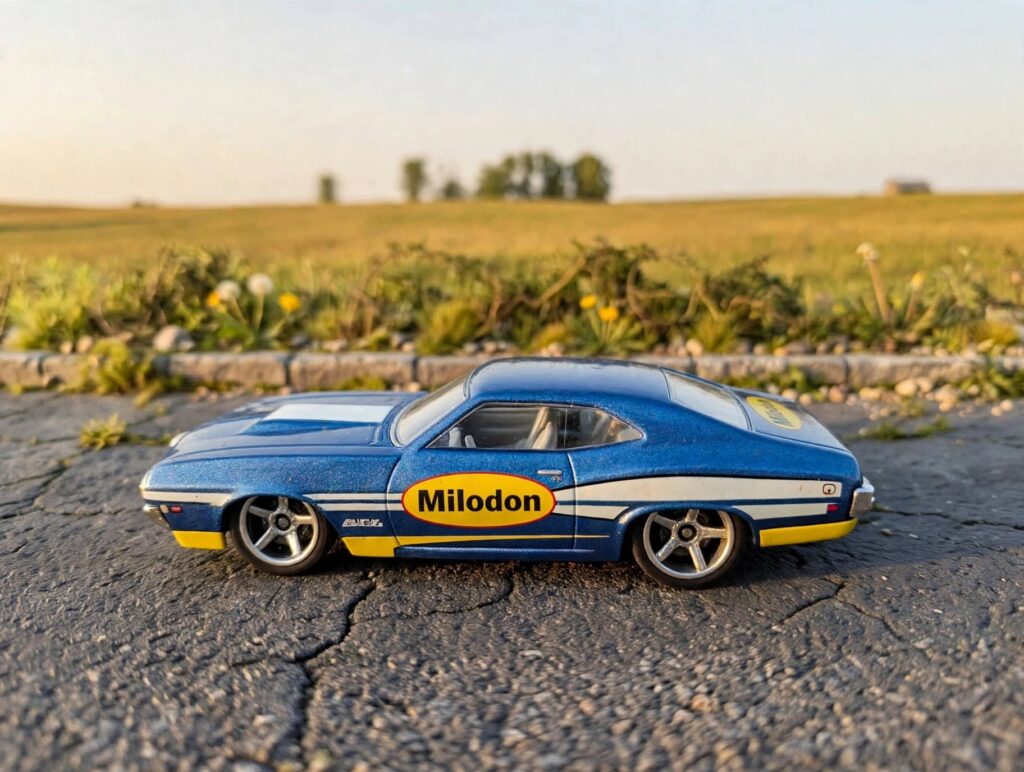
Front and rear, the lower valances and bumper sections are moulded in bright yellow plastic. Not painted, not chrome, yellow.
It is the one decision I keep going back and forth on. Against blue it works as a graphic, tying the lower edge of the car to the yellow in the stripe. As a model of a real race car it makes less sense, since those parts would usually be body colored, painted out or simply removed to save weight. I have decided I like it, mostly because a chrome bumper would have made the car look like a cruiser.
The nose is pure 1972 Ford
The front end carries a wide chrome grille with four headlight shapes set into it, two per side, and the casting picks them out individually instead of printing a silver smear.
Above it the hood has a long shallow bulge running down the middle, and the front corners drop away into the bumper. It is a lot of face for one car, and it is the detail that stops this reading as a generic American coupe.
Chrome is used sparingly elsewhere, which makes the front end stand out more. That restraint is the difference between a race car and a show car.
Fastback roof and the rear quarter
From the side the roof flows into the rear deck in one unbroken line, which is where this shape earns its reputation. There is no break, no sharp edge, just a long curve from the top of the windscreen to the tail.
At the back the lamps are printed red strips inside a chrome bumper, and a thin chrome strip runs along the rocker. The whole lower edge of the car is picked out, which gives the body a defined waterline.
The rear glass is large and clear, and because the engine sits forward of it you can see the chrome from behind as well. Walk around the car and the motor stays visible from almost every angle except straight on from the front.
Where this fits among Ford castings
Ford has given the hobby more shapes than anybody, and the seventies are the decade collectors skip. Everybody wants a sixties fastback or a modern performance car, and the big heavy coupes that came after them get ignored completely.
I put the longer version of that history together on my Ford page. If you want to work out which wave your example shipped in, the card code tells you, and I explained how to read one in Hot Wheels case codes.
The case for a sponsor car you have never heard of
Most people picking this up will not recognize the name on the door, and that is exactly why it works. A casting carrying a famous logo tells you about the logo. A casting carrying a parts supplier tells you about the car.
It makes you ask what Milodon is, which leads to what those parts actually do, which leads to why somebody would move an engine backward in a chassis in the first place. A toy that sends you off looking something up is doing more than sitting on a shelf, and this blue Torino did exactly that to me during the week I bought it.