Ask somebody to picture a muscle car and they will describe something from 1969 or 1970. Flat sides, sharp corners, a hood scoop. Almost nobody pictures this car, because by 1971 the rules had changed and the party was already ending.
Insurance companies had worked out what these cars cost them, emissions standards were tightening and fuel was about to get expensive. The 1971 GTX arrived into all of that, which is why it is the shape nobody remembers, and why this maroon casting is more interesting than another copy of a car everybody already owns.
What the Hot Wheels ’71 Plymouth GTX gets right
The curves. This body is nothing like the flat sided cars that came before it. The flanks bulge outward at the hips, pinch in at the doors, and the whole side of the car is one continuous curved surface with no hard crease anywhere.
The casting captures that, which is harder than it sounds. A curved body at this size needs light to read properly, because without a crease to catch a shadow the eye has nothing to grip. Hold this one flat under a single lamp and it looks like a dark lump with wheels. Tilt it ten degrees and the hips appear.
Maroon paint and the yellow stripes
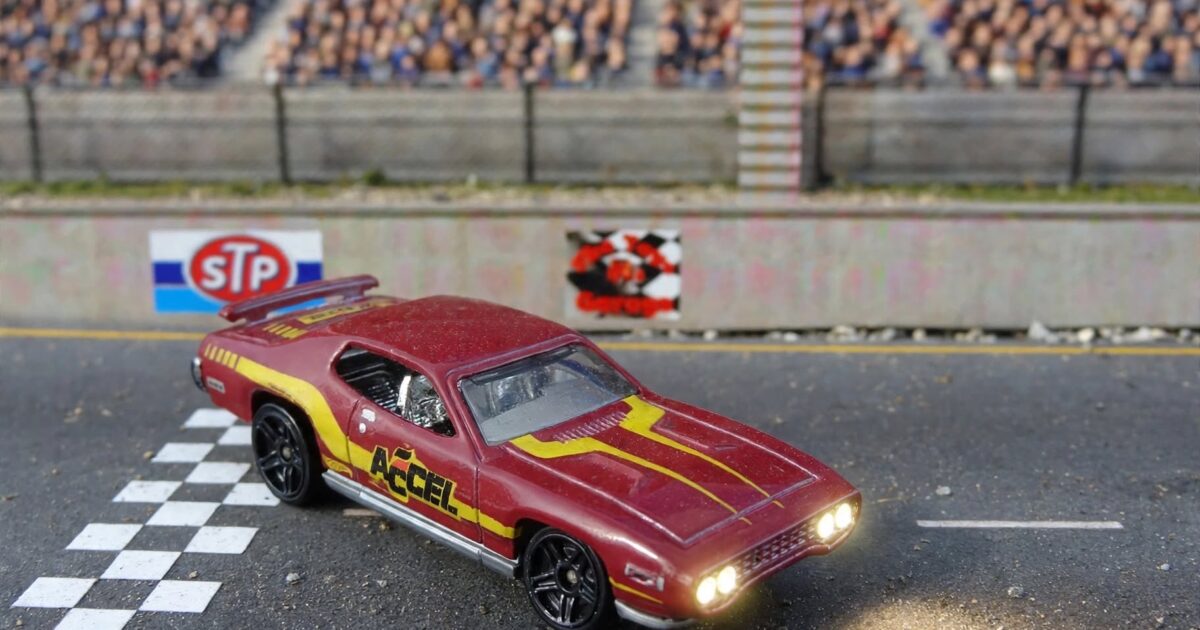
The body is a deep maroon with a metallic flake, closer to wine than to red, and it goes nearly black in shade. Over it, yellow stripes run along the upper flank and across the rear of the roof, with a stack of small yellow hash marks sitting just ahead of the rear wheel.
The stripes do something specific here. They follow the hip line, so instead of fighting the curve they trace it, and that is the only thing on the car telling your eye where the shape bulges.
The ducktail spoiler
At the back there is a raised lip running across the trunk lid, cast as part of the body and standing clear at the corners. It is not a wing on posts. It is a shaped edge in the metal, which is what these cars actually ran.
That restraint matters. A tall wing would have turned this into a different kind of car entirely, and the subtle version is more honest about what the 1971 car was: a muscle car trying to look respectable while the ground shifted under it.
Black wheels against a dark body
The wheels are black five spoke designs with a chrome centre, and on a maroon car they almost disappear. That is a real criticism. A dark wheel under a dark body means the lower half of the car reads as a single mass in most light, and the arches lose their shape entirely.
Gold or a bright chrome would have given the car a second accent to work with, and would have picked up the yellow in the stripes. As it is, the only contrast down there comes from the chrome bumpers at either end and a thin bright strip along the rocker.
The front end and the ACCEL tampo
The nose is a wide chrome bumper wrapping around a dark grille, with the headlights set into the outer corners in pairs. Above it the hood carries a long raised section running back toward the windscreen.
On the door and the rear quarter there are ACCEL tampos, the name of a company that made ignition components. It is a period correct sort of sponsor for a car like this, and on my example the printing is sharp with no bleeding into the maroon.
The rear is simpler, with printed lamp strips set into a chrome bumper and a plate recess in the middle. Less happens back there than at the front, which suits the car, since the nose is where this generation did its talking.
How it reads next to earlier muscle cars
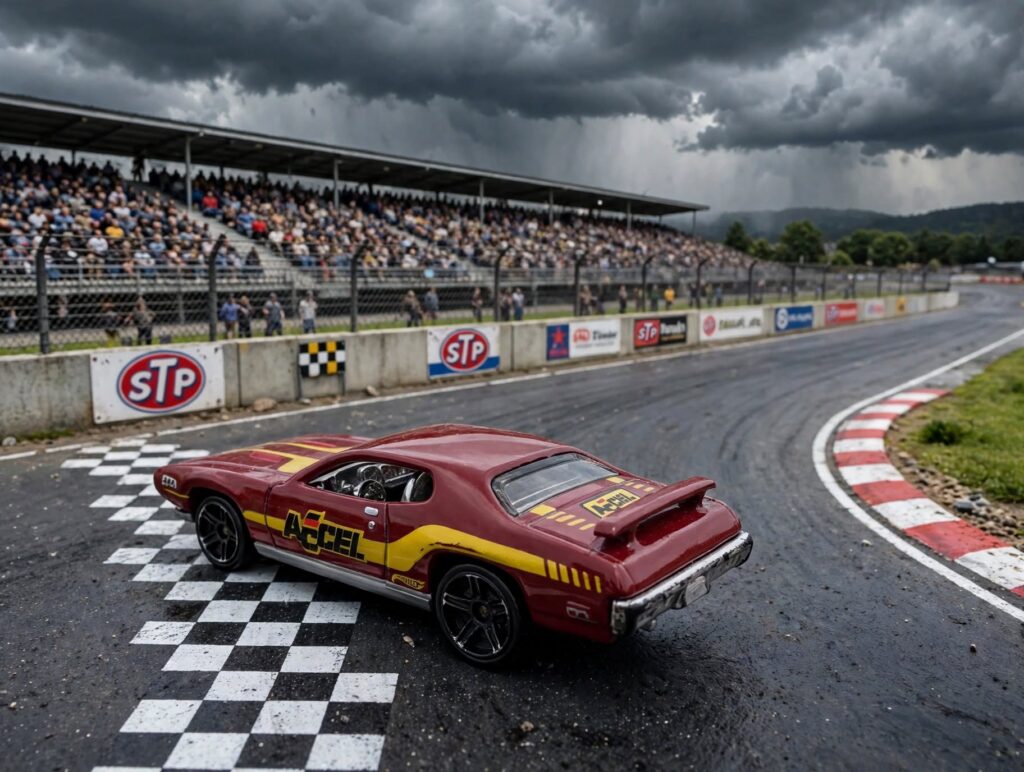
Put this beside a 1969 or 1970 car and the difference is obvious immediately. The older cars are flat boxes with attitude. This one is soft, rounded, almost bloated through the middle, and it sits lower and wider.
That change was not an accident. Styling moved toward the fuselage look right across the whole industry at the start of the seventies, and the muscle cars simply went along with it. The result is a car that looks heavier than its predecessors even when it is not.
For a casting that is a gift and a trap at the same time. The extra visual mass makes the model feel substantial in the hand, and it also means the shape needs better light than a boxier car to photograph well.
Is a less famous muscle car a better buy
For a collector, often yes. The famous shapes get reissued constantly and the prices on the desirable versions get silly. The cars from the last year or two of the era sit on pegs longer, cost less, and are the ones missing from most shelves.
None of that makes any of them investments. I went through that question properly in are Hot Wheels a good investment, and the answer does not change because a casting is less common on a peg. If somebody tries to sell you one as rare, the real markers are in Treasure Hunt versus Super Treasure Hunt.
Why the last one is the one to own
Because the end of something is more interesting than the middle of it. By the time this car was built, everybody involved already knew what was coming, and the result is a muscle car that looks like it is halfway through apologising.
That tension is sitting there in the metal: a huge engine under a hood on a body styled to look like a luxury coupe, with a modest spoiler and stripes that trace a curve instead of shouting. I have plenty of castings from the good years. This is the only one I own from the year the whole thing stopped being fun.