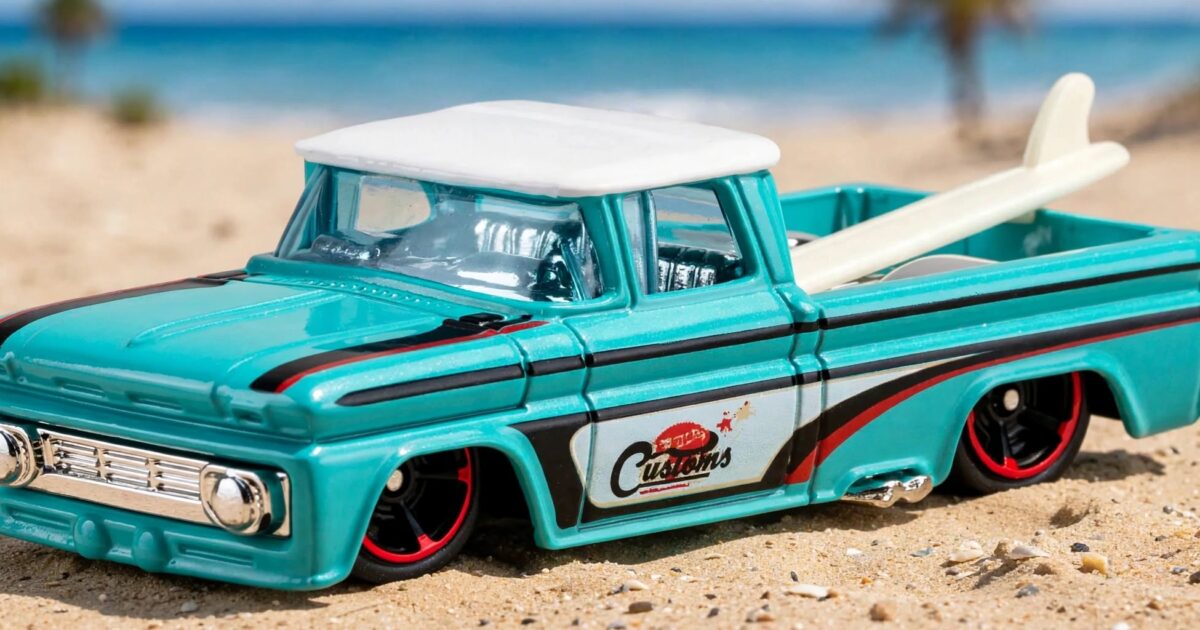
Most customs in my collection are trying to prove something. Louder engine, wider tires, lower stance. This Hot Wheels Custom ’62 Chevy pickup is the opposite. It’s turquoise, it has a white board lying in the bed, and the whole thing says the driver is going to park somewhere near the water and not move for six hours. I bought it on mood alone, which I almost never do.
Hot Wheels Custom ’62 Chevy pickup turquoise paint
The color is a soft turquoise with a hint of green, the kind of shade that showed up on American appliances and kitchen counters around 1960. On my example it’s even across the hood, the cab and the long bed, with no thin patches on the edges of the fenders where paint usually fails first.
The roof is painted white, a two tone treatment that was common on trucks of that era. It breaks up the body and makes the cab look lower than it is. Small choice, big effect.
The Customs tampo on the ’62 Chevy pickup
Behind the rear wheel there’s a white panel with Customs written in a script typeface, a red car silhouette above it and two small stars. It looks like a shop logo from a 1960s custom house, and that’s clearly the intent.
From that panel a red and black swoosh runs forward along the lower body, then flattens into a thin black and red pinstripe that carries along the bed side to the tailgate. The stripe is printed, not cast, and on mine it’s unbroken from front to back. On the tailgate there’s a Chevrolet bowtie pressed into the metal.
It’s a restrained package by Hot Wheels standards. There’s no flame job, no sponsor wall, no giant brand logo across the door. The graphics stay below the beltline and leave the upper body clean, which is why the two tone paint reads so clearly from across a room.
Does the surfboard come out of the ’62 pickup bed
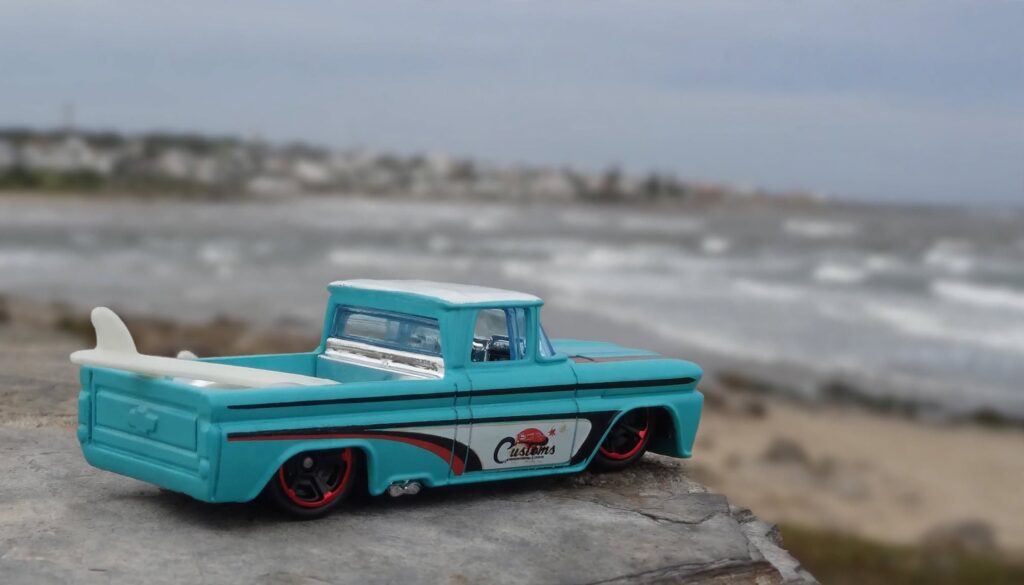
On my truck the board is a separate white piece lying diagonally across the bed, resting on the rail. It isn’t glued down on mine, which means it can fall out, and I’ve already lost track of it once under a desk. Check the back of the card or the bed before you buy, because Hot Wheels has done both removable and molded in accessories over the years.
I like that it’s plain white with no graphics. A printed board would date the car to one particular decade of surf culture. A blank one lets you decide.
It sits at an angle in the bed, as if tossed in on the way out. A board lined up straight would look staged. This one looks used, and that small bit of carelessness is the best design decision on the whole truck.
Red line wheels on a lowered Chevy pickup
The wheels are black with red outer rings, the modern Hot Wheels take on the old red line look. They’re small, which is correct here. Oversized wheels would have turned this into a different kind of truck.
The stance is low. The front sits slightly lower than the rear, giving the truck a gentle forward rake, and the body comes down close to the rock in my photos. A chrome exhaust tip pokes out below the cab on the passenger side, the only hint that anything serious lives under the hood.
Chrome interior detail inside the Custom ’62 Chevy pickup
Quite a lot, actually. The glass is tinted light blue, and behind it there’s a chrome interior with a bench seat, a steering wheel and a dash. Chrome interiors can look cheap on the wrong car. On a period custom, it reads as a polished build.
Through the rear window you can also see a chrome shape that suggests an engine or a firewall detail. It gives the cabin depth that most 1:64 trucks don’t have.
How the ’62 Chevy compares to other 1960s pickup castings
Pickups from this era have become a staple of the hobby, and most of them land in one of two camps: the honest work truck or the slammed shop truck. This one picks the second camp and then softens it with the board and the colors.
If you want to see how different brands treat these trucks, I compared a few in Matchbox versus Hot Wheels. The short version is that Matchbox keeps them stock and Hot Wheels cuts them down, and both approaches have a place on a shelf.
What tips this one over for me is that it doesn’t take itself seriously. A lot of lowered pickups end up looking angry about something. This one looks like it’s on holiday.
Building a 1:64 beach scene around the surf pickup
This is the easiest diorama subject I own. Sand, a strip of blue card for water and a low camera angle, and you’re done. The board gives the scene a story without any extra props. If you want to go further, my diorama guide covers backgrounds and lighting for small scenes.
Shoot it from behind and slightly low so the board and the tailgate are both in frame. That’s the angle that sells the whole idea.
One warning from experience: turquoise paint picks up fingerprints fast. After a session outdoors mine needed a dry cloth before it photographed well again, and I’d skip damp cleaning near the stripe.
My honest reason for keeping the turquoise ’62 Chevy
I don’t surf. I live nowhere near the kind of beach this truck belongs to, and I still reach for it more than most of the castings on that shelf. It’s the colors. Turquoise and white and a little red do something no amount of flames and blowers manages.
If Hot Wheels runs this casting again, I’d take it in pale yellow with the same board. And if you find one with the board still in the bed, grab it, because those boards walk off.