I have written more than once that flames belong low on a body, hugging the sill line, and that manufacturers who run them up over the doors and onto the roof are getting it wrong.
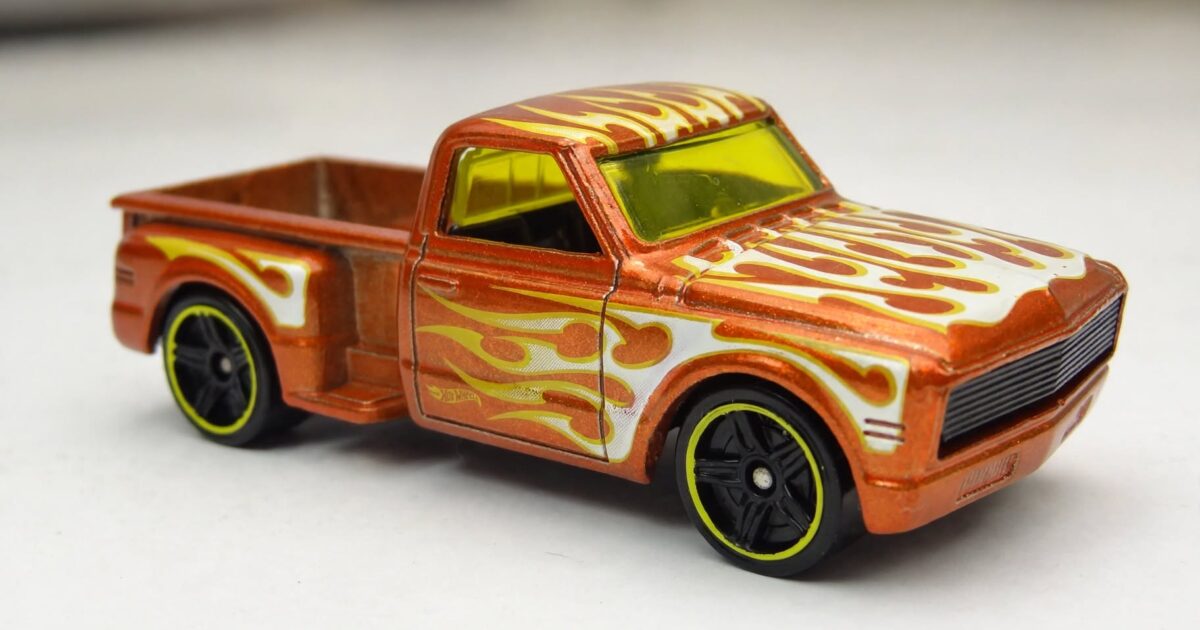
This truck runs them over the entire bonnet and across the roof, and I like it. So either I was wrong or this is the exception, and working out which took some staring.
Why the rule exists in the first place
Traditional hot rod flames start at the nose and travel back along the lower body, tapering as they go. The logic is that they represent fire trailing from the engine bay, so they follow the airflow along the sides.
Run them upward and that logic breaks. Fire does not climb over a roof while a vehicle is moving forward, so roof flames read as decoration rather than as an idea.
That is the argument, and on most cars it holds. A sedan with flames on the roof looks like somebody ran out of body and kept going.
Why this truck escapes it
Because a pickup cab is short and upright, and the bonnet is long and flat.
On a car, the distance from the nose to the rear of the roof is enormous, so flames travelling that far lose any relationship to where they started. On this truck the cab sits close behind the bonnet, so the flames cross a short gap and the whole treatment reads as one continuous surface.
The roof is also genuinely visible on a tall vehicle in a way a low car roof is not. Leaving it blank on a truck wastes a panel people actually see.
So the rule is really about proportions rather than about roofs, which I had not thought through properly before.
The deco itself
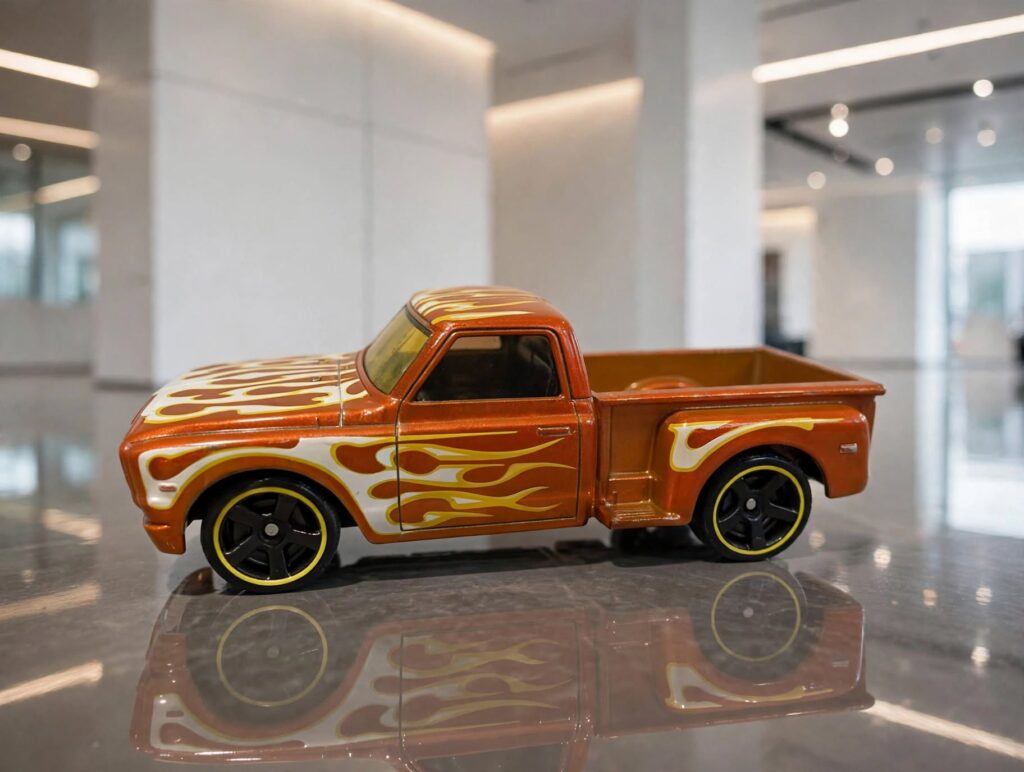
Copper metallic with a heavy flake, and flames in white with yellow outlines covering the bonnet, the roof, the front wings and the lower body sides.
The white gives the flames the contrast they need against a mid tone body, and the yellow outline separates them without going as hard as black would. On a warm copper body a black border would have looked heavy.
There is a fine texture visible inside some of the licks, which suggests the printing uses a halftone rather than solid fill in places. At normal viewing distance it reads as a subtle shading.
Yellow glass and how it changes the car
The windows are translucent yellow rather than tinted or clear, which is a decision that divides people.
It ties into the yellow in the flames and it makes the cab glow when light passes through, which on a photograph is striking. It also means you cannot see much of an interior.
Translucent coloured glass is a Hot Wheels signature and it is worth knowing how it ages. It clouds with handling more visibly than tint does, and some colours yellow further over years of light exposure, which on an already yellow part is less noticeable than it would be on clear.
This truck against the C10
I looked at a ’67 C10 recently and the two make a useful pair, because they are the same kind of vehicle given opposite treatments.
The C10 is black with fine gold pinstriping, restrained and expensive looking, the sort of truck that gets built slowly over years.
This one is copper with flames across every upward facing surface, loud and immediate, the sort of truck built to be seen from across a show field.
Both are legitimate custom traditions. Owning both shows the range better than owning two of either.
Buying a loose Custom ’69
The roof flames are the exposed ones here, which reverses the usual advice. Normally I tell people to check the flanks, but on this truck the most valuable printing is on the two surfaces that face upward and take the most handling.
Then the yellow glass, looking for clouding and scratching. Hold it up to a light source.
Then the bed, checking the inside and the top edges of the bed sides.
Copper metallic hides fine scratches and shows chips clearly. Inspect the wing edges, the cab corners and the tailgate.
Show trucks as a category
There is a whole tradition of trucks built purely to be displayed, with paint that costs more than the vehicle and beds too clean to ever load.
Manufacturers reproduce that tradition because it photographs well and because loud paint sells. What they rarely do is reproduce the other half of the custom scene, the trucks built to be driven hard and look worn.
If you collect pickups, the gap in most collections is a truck that looks used. Almost everything available is either factory clean or show clean, and nothing is honestly dirty.
Was I wrong about roof flames?
A loud casting that breaks a rule I had stated too broadly, and taught me the rule was about proportion rather than about roofs. Good flame printing with a well judged outline colour, and glass that photographs beautifully at the cost of hiding the interior. Check the roof before you pay.