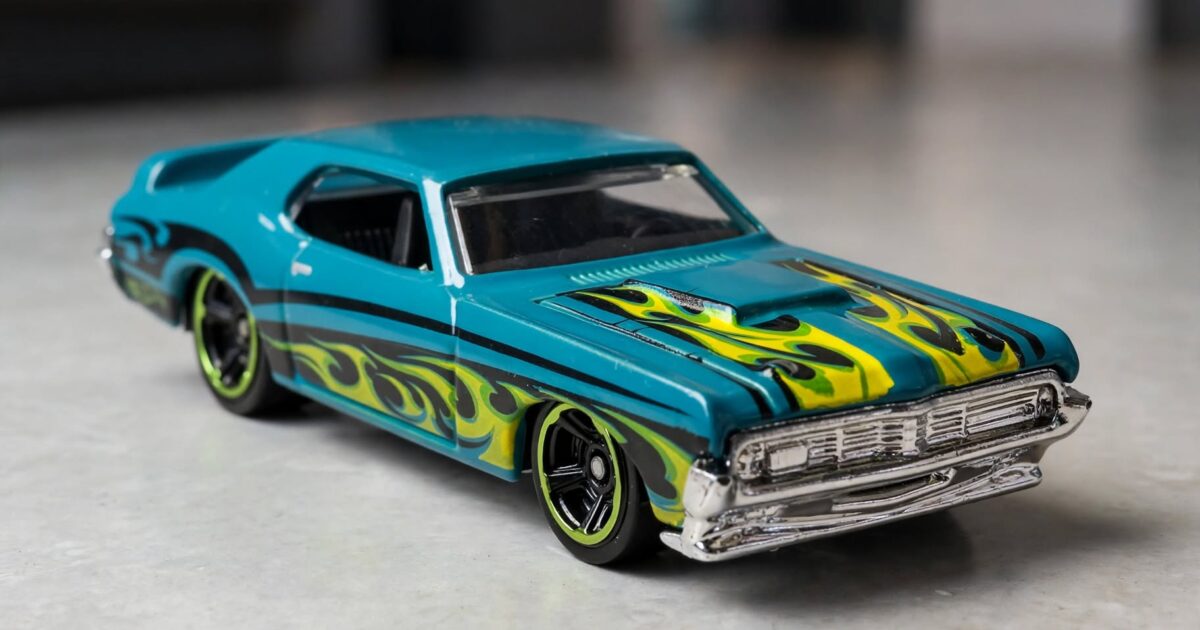
There is a small badge printed low on the front wing of this car that reads CJ 428. Most people will never notice it. It is the most interesting thing on the casting.
What CJ 428 refers to
It identifies the engine. The Cobra Jet was Ford’s big block performance unit, and 428 is its displacement in cubic inches.
Putting an engine code on the body is how American manufacturers advertised performance in that era. A badge on the wing told anyone in the next lane what they were dealing with, which mattered when cars were sold on displacement rather than on lap times.
Reproducing that badge at 1:64 is a research decision. It is tiny, most buyers will not read it, and leaving it off would have cost nothing. Somebody put it there because it belongs there.
The Cougar and its relationship to the Mustang
The Cougar shared its underpinnings with the Mustang, which was Ford’s car, and was sold as the more sophisticated alternative through Mercury dealers.
That positioning shows in the body. The Cougar is longer than the Mustang, with a more formal roofline and heavier front and rear treatments. Where the Mustang was aimed at young buyers, the Cougar was aimed at the same buyers a few years and one promotion later.
The Eliminator was the performance version, which is where the badge on this casting comes from, and it is the one collectors of the real cars chase.
Red with a white side stripe
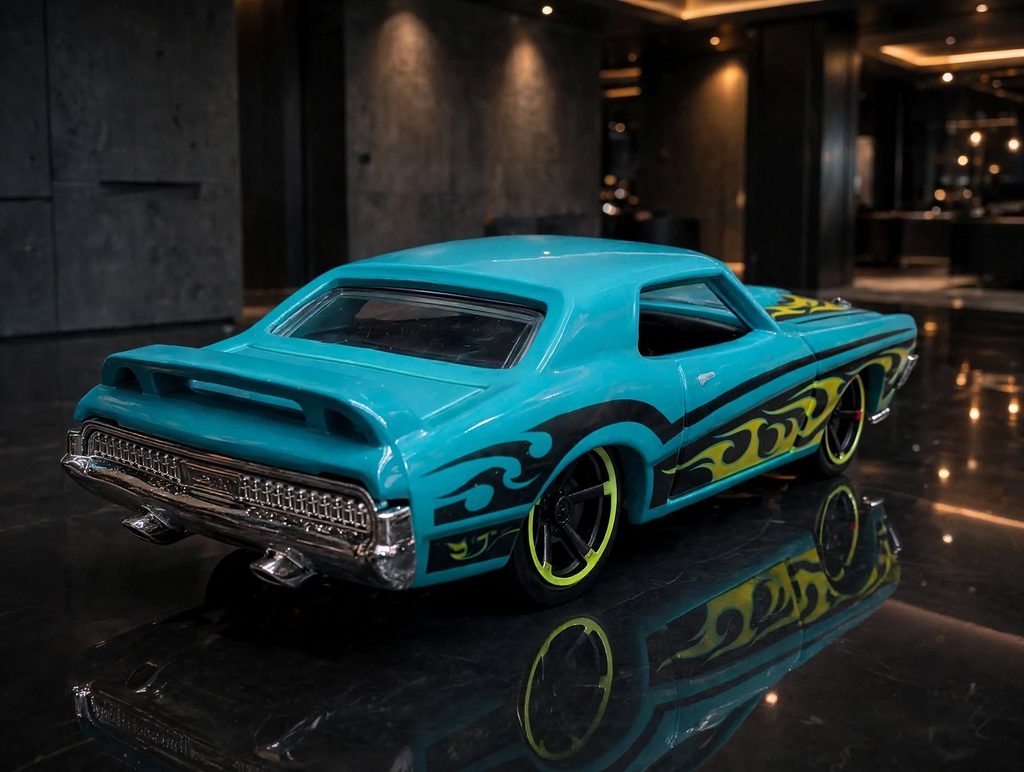
The deco is restrained and correct. A white stripe runs along the upper flank from the front wing to the rear quarter, with a second thinner line below it, and both wrap around the front of the car.
That treatment is period accurate. Stripes on cars of this era were narrow, geometric and applied over a solid colour, not the sprawling graphics that came later.
The red is a deep metallic that suits the shape, and the bonnet carries a raised scoop moulded into the panel.
Through the side glass you can see the interior, which on a casting this size is more than usually visible because the greenhouse is large.
Small badges and what they tell you
Worth developing into a general test, because it applies to every casting you consider.
A manufacturer that prints engine codes, trim badges and model designations in the correct places had access to reference material and cared enough to use it. A manufacturer that prints only the brand name did not.
The badges are also the first thing to wear off, which makes them a condition indicator. A car with crisp small badges has been handled carefully. A car with a clean body and missing badges has probably been cleaned aggressively at some point.
Look for them on the wings, the boot lid and the grille.
Cougar against Mustang on a shelf
These two are the clearest badge engineering comparison available in 1:64, and both are cheap.
The Mustang is shorter, with a more upright roofline and simpler surfacing. The Cougar is longer, heavier looking, with more elaborate front and rear treatments hiding the same basic car underneath.
Put them side by side and you can see exactly what a manufacturer changes when it wants the same engineering to reach a different buyer. It is more interesting than owning two Mustangs, and it costs the same.
Buying a loose Cougar Eliminator
The CJ 428 badge sits low on the front wing, right where fingers land when you pick the car up. It is the first thing to go and there is no repairing it.
Then the white stripe where it wraps around the nose, since printing over a curved surface at the front of the car takes the most abuse.
Then the bonnet scoop and the chrome bumpers at both ends.
Red metallic hides fine scratching and shows chips as dark marks against the paint. Check the wing edges and the boot lip. Mine shows some wear on the front bumper, which is normal.
Building a Mercury shelf
Two cars gets you most of the way. A Cougar and a Cyclone cover the pony car and the intermediate, which is where Mercury’s performance effort actually lived.
Add a Ford equivalent of each and you have a display that shows how the same corporation sold the same engineering to two different buyers. The Mustang against the Cougar is the clearest version of that comparison.
It costs very little because nobody is competing for the Mercury half of it.
Would I buy another?
Yes, and I would look for a different colour to sit beside this one. Correct period stripes, a moulded scoop, and an engine badge that somebody researched and most buyers will never see. That last detail is why this casting is better than it needs to be. Check the badge before you pay, because a Cougar without it is just a red coupe.