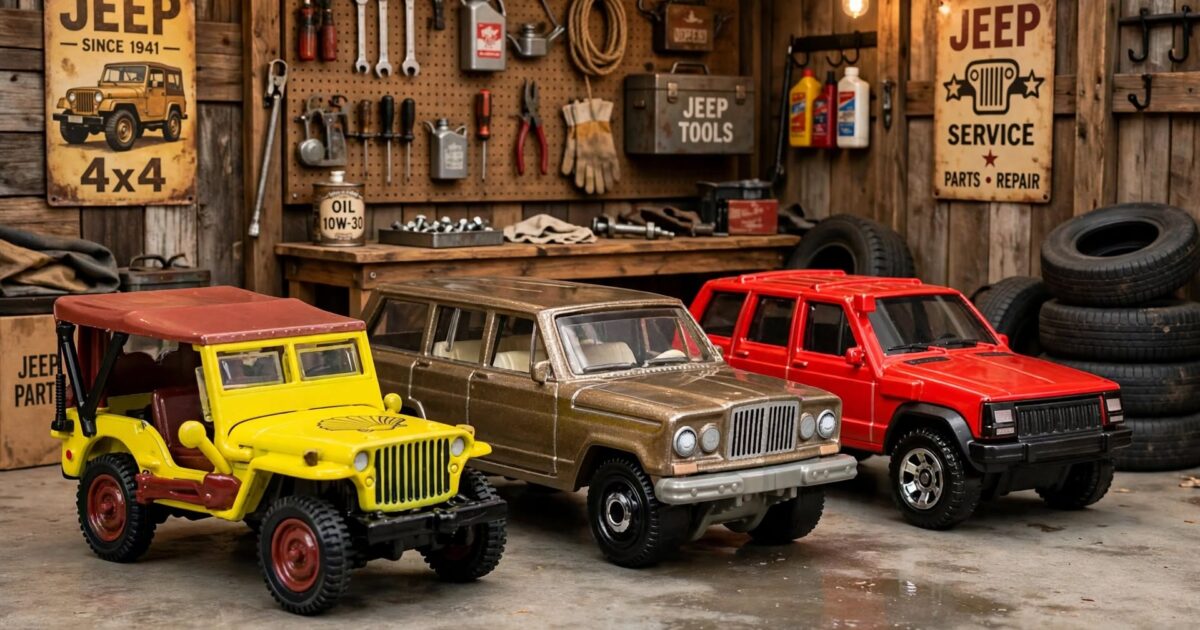
Most carmakers spend their lives trying to look new. Jeep has spent eighty years trying not to. Put a 1941 Willys next to a Wrangler built last year and a child could tell you they are related, which is not something you can say about any other brand on this shelf.
For a collector that stubbornness pays off in a specific way, and it has nothing to do with nostalgia. It has to do with flat panels.
Where the Jeep actually came from
In 1940 the US Army asked builders for a light reconnaissance vehicle and gave them a nearly impossible deadline. A small company called Bantam delivered the first working prototype. Bantam was too small to build the numbers needed, so the design went to Willys-Overland, which refined it into the MB, and Ford was brought in to build the same vehicle as the GPW.
So the most recognizable vehicle of the twentieth century was designed by a company that barely survived it, and mass produced by two others. That tangle is why ownership of the name got argued over for decades afterwards.
Why the name is still argued about
Two explanations compete. One says it came from GP, the military designation, slurred into a word. The other credits Eugene the Jeep, a creature from the Popeye comics who could go anywhere and do anything, which soldiers would have known well at the time.
Nobody has settled it. I lean towards the cartoon, because soldiers name equipment after jokes far more often than after paperwork.
The Jeep that went home from the war
The clever part came in 1945, when Willys put a civilian version on sale as the CJ. The military had spent four years giving the vehicle the best advertising campaign in history, free of charge, and the company simply sold the same thing to farmers.
That is why the lineage never broke. The CJ became the Wrangler in the eighties, and the Wrangler is still here. Eight decades of continuous production of essentially one idea.
Jeep changed hands more often than any other American marque
Willys-Overland was bought by Kaiser in the fifties. Kaiser sold the operation to American Motors in 1970. Chrysler bought AMC in 1987, mostly to get Jeep, and Chrysler has since been through Daimler, Fiat, and now sits inside Stellantis.
Five owners, and the product barely flinched. Each one worked out quickly that the thing they had bought was the shape, and that changing it would destroy the asset.
The Wagoneer, the Cherokee and the SUV nobody saw coming
Two models outside the Wrangler line matter more than people admit. The Wagoneer arrived in 1963 as a four wheel drive vehicle with comfort, which at the time was close to a contradiction. Then the XJ Cherokee came in 1984, built as a single unit instead of a body bolted onto a ladder frame, and that is the vehicle the entire modern crossover industry copied.
Neither gets cast as often as the Wrangler, and I think that is a mistake. The XJ in particular is all straight lines and flat glass, which is exactly what this scale likes.
Why a Jeep casting works at any price level
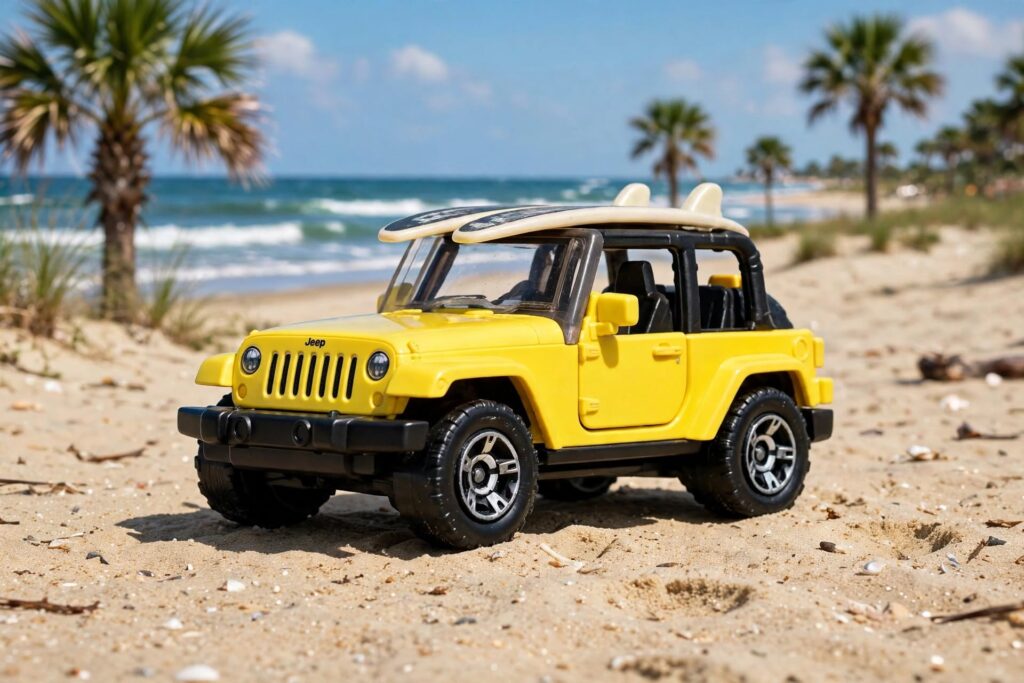
Here is the practical collector point. A Wrangler is a box with round headlights, a slotted grille, flat doors and exposed wheels. There are no complex curves to get subtly wrong, no roofline that has to flow into a rear quarter, no surface that catches light in a way cheap tooling cannot reproduce.
The result is that a budget brand can produce a Jeep that looks right, while the same brand will mangle a Porsche. I own Jeeps from supermarket blister packs that sit next to premium castings without embarrassing themselves. Try that with a curvy coupe and the gap is obvious from across the room. My review of the Matchbox Willys Jeep MB goes through how much detail survives on a simple shape.
What the seven slot grille does for a Jeep casting
Every Jeep has it, and at 1:64 it does an enormous amount of work. Those seven vertical slots plus two round headlights give the front of the model a face that the eye recognizes instantly, even when the car is an inch long and the tampo printing is rough.
It is the cheapest identity in the business. A manufacturer does not need a badge, a name or accurate proportions. Seven slots and two circles and everybody knows what they are looking at. That is why Jeep shows up in off road playsets, multipacks and fantasy ranges where licensing budgets are thin.
Jeep and Land Rover on the same shelf
The comparison is unavoidable, and it is the best argument in the off road section of any collection. Both started as military or agricultural tools. Both kept flat panels long after fashion moved on. Both are now sold partly on heritage.
Where they split is attitude. A Jeep looks like it was designed by an army in a hurry. A Land Rover looks like it was designed by a committee that owned farmland. Standing a Wrangler beside a Matchbox Defender 110 makes the difference obvious in a way no description does, and the rest of the companies covered here are listed on my car brand manufacturers page.
Who actually invented the Jeep?
Bantam produced the original prototype to the army’s specification, but the vehicle was mass produced by Willys-Overland as the MB and by Ford as the GPW. The design is a product of all three.
Is the Wrangler the same vehicle as the original Jeep?
Not mechanically, no. It is the direct descendant of the wartime MB through the civilian CJ line, and it has kept the proportions, the grille and the basic layout intact.
Who owns Jeep today?
Jeep is part of Stellantis, having passed through Willys-Overland, Kaiser, American Motors, Chrysler, Daimler and Fiat along the way.
Why do cheap diecast Jeeps look better than cheap diecast sports cars?
Because the shape is simple. Flat panels and straight lines are easy to reproduce in a mold, while complex curves show every flaw in cheap tooling.
Which Jeep models are most common in 1:64?
The Wrangler by a wide margin, followed by the wartime Willys. The XJ Cherokee and the Wagoneer appear far less often despite being just as suited to the scale.