Rover built elegant saloons for doctors and bank managers. In 1948 it also built a crude aluminium box on a ladder frame, intended as a short term earner while the factory got back on its feet after the war.
Rover the car company is gone. The short term earner is still in production, sells worldwide, and has a following that treats it as a religion. I know of no better example in the motor industry of a side project eating its parent.
The Land Rover was supposed to be temporary
The usual telling credits Maurice Wilks, Rover’s engineering chief, who used a war surplus Willys Jeep on his farm in Anglesey and could not find anything to replace it when it wore out. The design was sketched out, the story goes, on the sand at Red Wharf Bay.
What he proposed was a farm machine with a power take off, not a car. It was meant to sell for a few years to farmers while Rover restarted proper production. Within a short time it was outselling everything else the company made, which is the kind of accident no planning department ever manages on purpose.
Why the body is aluminium, and what that did to the shape
Post war Britain rationed steel and reserved it for exports. Aluminium alloy was available, partly because aircraft production had wound down, so the body panels were made of that.
Two consequences follow, and both still matter to collectors. The first is that the bodies do not rust, which is why so many early examples survive while the chassis underneath them rots away. The second is that the panels had to be simple. Aluminium formed in small volumes does not want to be curved, so every panel is flat and every corner is a fold. The look everybody now calls iconic began as a manufacturing constraint.
Series to Defender, four decades of one Land Rover
The Series I became the Series II in 1958, then the IIA, then the III, then the coil sprung Ninety and One Ten in the eighties, and the name Defender arrived around 1990. Across all of that the silhouette barely moved. Flat sides, a flat screen, a bonnet you could eat off, round headlights set in a plain grille panel.
Production of the original finally stopped in 2016, and a completely new Defender arrived a few years later. The new one is a good vehicle and it has nothing to do with the old shape, which is a sentence that annoys roughly half of the people who read it.
The Range Rover invented a category by accident
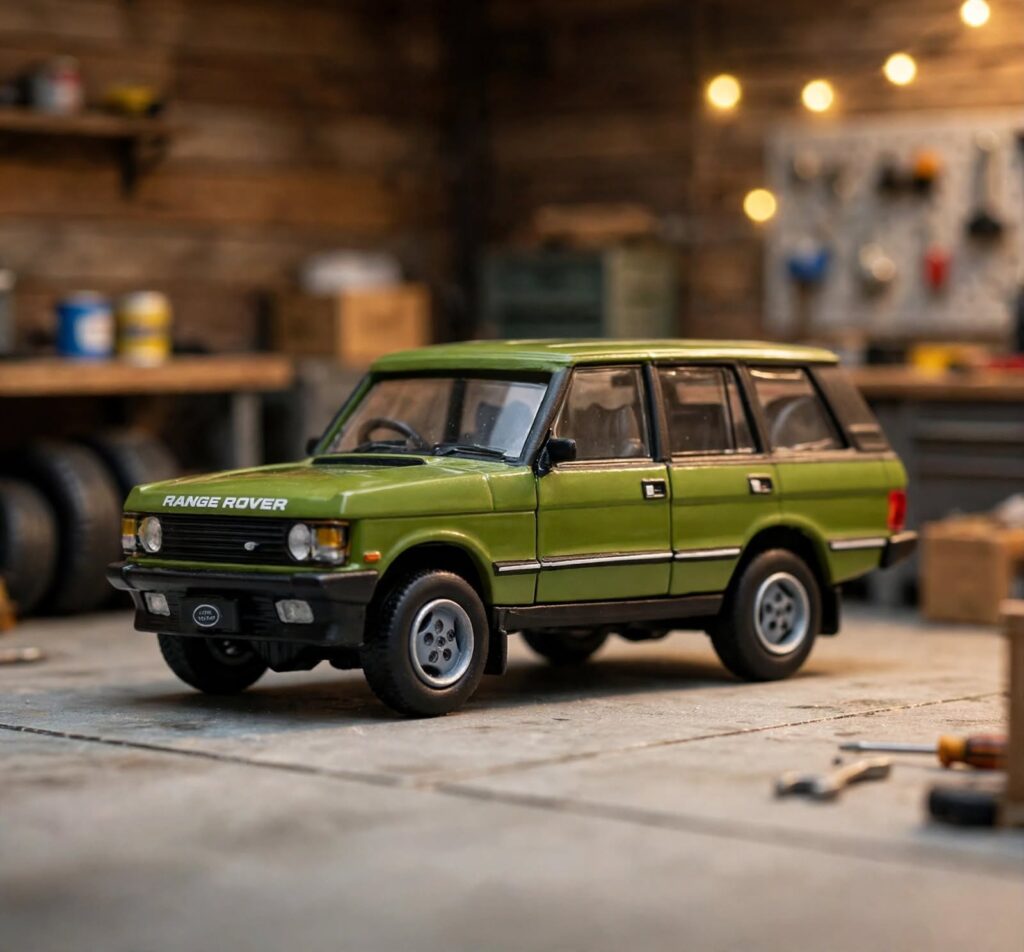
In 1970 the company put a comfortable body on the same basic engineering and sold it to people who had no intention of crossing a field. The Range Rover was fast on a road, quiet, and still able to climb a hill that would stop most things.
Nobody had combined those qualities before, and every luxury off roader since has been chasing that one idea. An early Range Rover was even shown at the Louvre as an example of industrial design, which for a vehicle with vinyl seats and hose down floors is a strange and very British outcome.
What Land Rover has been through in ownership
Rover went into British Leyland in the late sixties. Land Rover was later separated as its own business, sold to BMW in 1994, sold on to Ford in 2000, and then to Tata Motors in 2008, where it sits today alongside Jaguar.
Four owners in fourteen years would kill most brands. This one kept building the same vehicle throughout, which tells you how little the shape depended on who signed the checks.
Why a Land Rover casting lives or dies on its livery
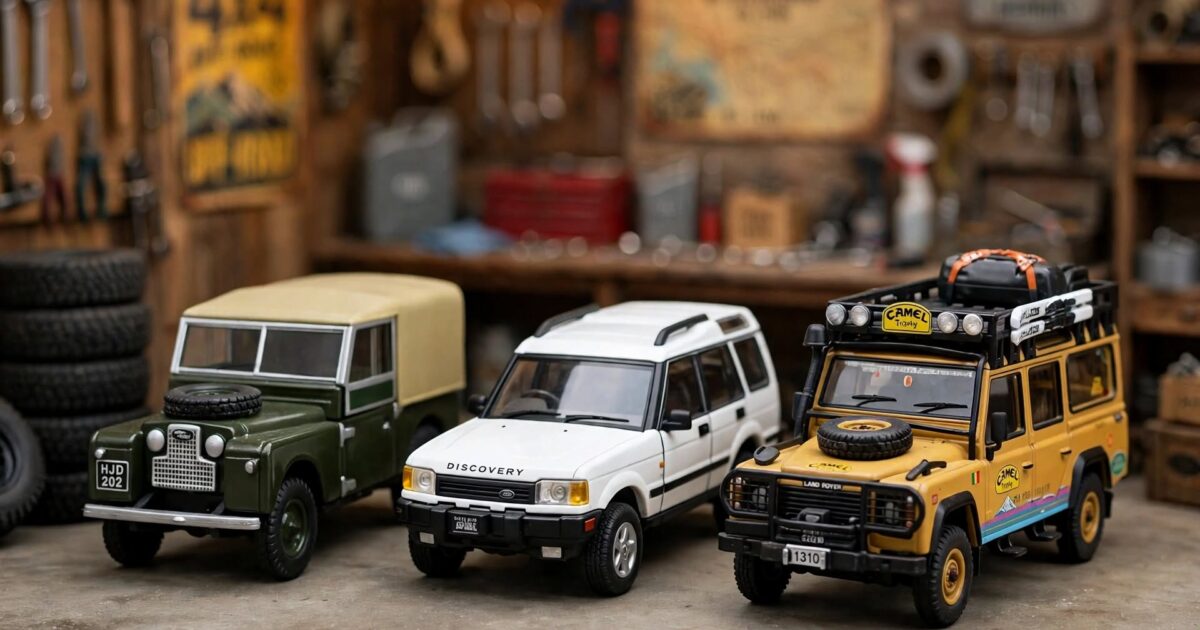
Now the part that matters on a shelf. A Defender is about as simple as a body gets, so almost every manufacturer produces a passable one. Flat panels, square arches, no surfaces that catch light in a tricky way. Even cheap tooling manages it.
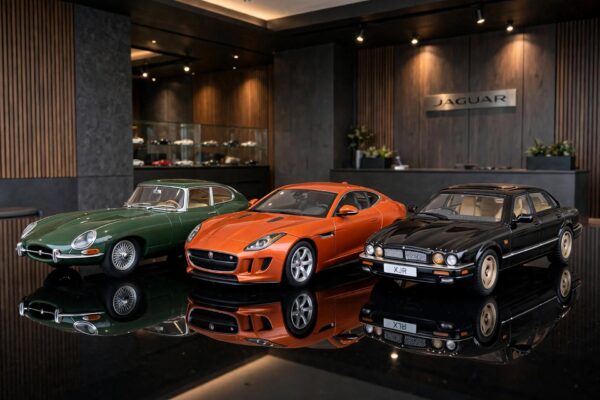
That creates a different problem. If every Defender looks roughly the same, the only thing separating a good casting from a dull one is what is printed on it. A plain white Defender is an outline. The same casting in police markings, expedition paint or a farm scheme becomes a character. This is the opposite situation to a Jaguar, where the shape does everything and the paint is incidental. My review of the Welly Land Rover Freelander covers what happens when the shape is softer and the brand loses that advantage.
Camel Trophy yellow and the power of a paint scheme
The best proof is the Camel Trophy. Those sandy yellow trucks with roof racks and snorkels ran through jungles in the eighties and nineties, and the color alone now signals the whole story to anybody who grew up with it.
Manufacturers know this. Expedition and service liveries sell. A Defender 90 in Guardia Civil markings does more work on a display than a plain one in any color, because it implies a job, a place and a reason for being muddy.
Where Land Rover sits next to everything else on the shelf
Mine lives with the Jeep section, and the two together make the clearest comparison in the hobby. The American answer was a wartime vehicle adapted for farms. The British answer was a farm vehicle that kept getting sent to war anyway.
If you collect off road vehicles at all, you end up with more Land Rovers than you planned, because they come in every range at every price, and because a square green truck looks correct on a diorama in a way a sports car never will.
Why are old Land Rovers made of aluminium?
Steel was rationed in post war Britain while aluminium alloy was available, so the body panels were made from it. The bodies resist rust as a result, though the steel chassis underneath does not.
What is the difference between a Series Land Rover and a Defender?
They are stages of the same lineage. Series vehicles ran from 1948 through the seventies on leaf springs, and the coil sprung models of the eighties eventually took the Defender name around 1990.
Who owns Land Rover today?
Tata Motors, which bought Land Rover and Jaguar together from Ford in 2008.
Why do so many diecast Land Rovers come in service liveries?
Because the shape is simple enough that the printing carries the model. Police, military, rescue and expedition schemes give a plain box an identity and sell better than plain colors.
Is the new Defender the same vehicle as the old one?
No. It shares the name and some styling references, but it is an entirely new design with different engineering, and collectors generally treat the two as separate things.