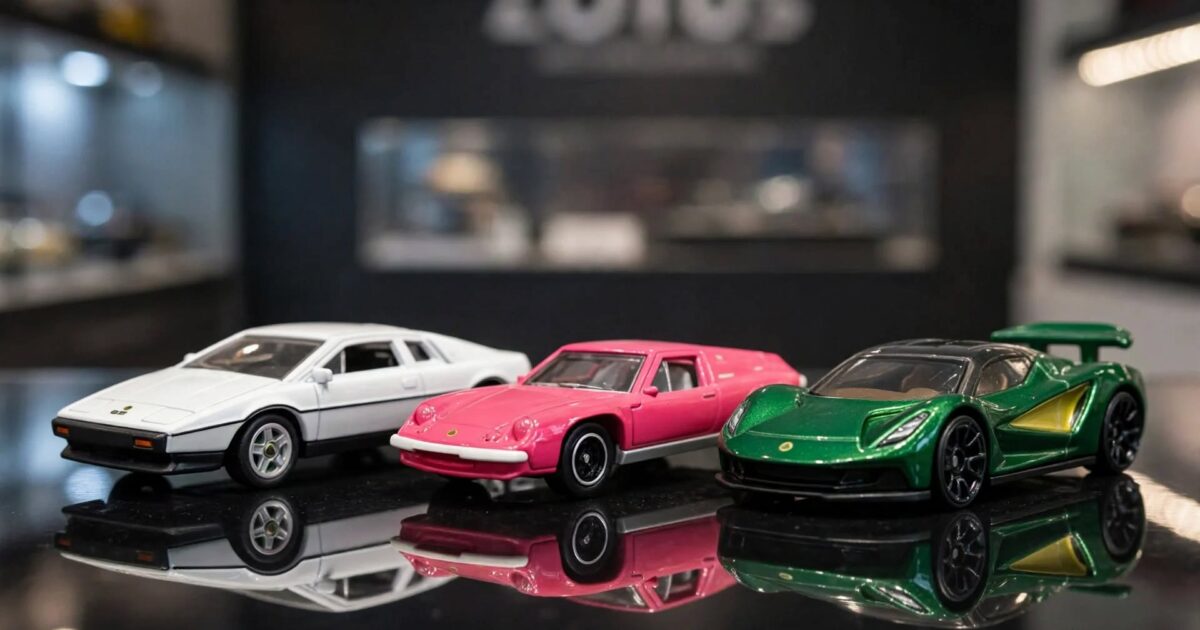
Every other marque on this site can be shrunk. A Ferrari at 1:64 is still a Ferrari, a Defender is still a Defender, and the thing that made the real car interesting survives the trip down to three inches.
Lotus does not survive it. The entire point of a Lotus is what is missing from it, and a diecast model is a solid lump of zinc alloy. You can reproduce the shape perfectly and still lose the argument.
Lotus was built on subtraction
Colin Chapman started building cars in 1948 and spent the rest of his life removing material from them. Where other engineers added power, he took out weight, on the grounds that a light car is quicker everywhere and not just in a straight line.
The phrase attached to him, simplify and then add lightness, gets printed on T shirts now. It was a working method, not a slogan. It meant thinner panels, smaller engines, structures that did two jobs at once, and a willingness to be right at the edge of what would hold together.
Colin Chapman’s rule and what it cost
The uncomfortable part of that philosophy is that it occasionally went too far. Lotus road cars of the sixties and seventies had a reputation for fragility, and the joke about what the letters stood for circulated among owners who had spent a weekend under one.
Chapman’s racing cars were also, at times, right on the limit of structural safety in an era that was dangerous enough already. I do not think you can write about the man honestly without saying that. What he built changed every car that came after, and some of it was built closer to the edge than anybody would accept now.
The Lotus Seven and the kit car escape hatch
The Seven arrived in 1957 as about the least car anybody could sell: four wheels, a tube frame, two seats and almost nothing else. Buyers in Britain could order it in pieces and assemble it at home, which had the convenient effect of avoiding purchase tax on a finished vehicle.
Lotus sold the rights to Caterham in the seventies, and the same basic design is still on sale today under that name. Seventy years of continuous production for a car that was deliberately unfinished.
What Lotus gave Formula One
More than any other small manufacturer. The Lotus 25 of 1962 put the driver inside a stressed monocoque instead of a tube frame, and within a few years everyone had copied it. The Lotus 78 and 79 of the late seventies used the underside of the car to generate downforce, which rewrote the rules of the sport so completely that the rule makers had to intervene.
Team Lotus won seven constructors’ championships. For a company run out of a British industrial estate, competing against factories owned by national carmakers, that record is absurd.
Why the black and gold Lotus livery still sells
Lotus also introduced something less admirable and more influential: full commercial sponsorship on a racing car. In 1968 the cars appeared in sponsor colors instead of national racing green, and the floodgates opened.
The black and gold scheme that followed is one of the two or three most reproduced liveries in diecast. It works because of contrast. Black body, gold pinstripe, gold wheels, and at 1:64 that combination stays legible when a complicated multi sponsor livery turns to mush. Manufacturers know it, which is why black and gold turns up on castings that have no connection to Lotus at all.
The Esprit, the wedge and the eighties
Giugiaro drew the Esprit as a folded paper wedge, and it became the Lotus most people can picture, helped by a film in which one of them drove into the sea and kept going.
Wedges are kind to small scale. Flat planes, sharp creases, a nose that comes to a point. A cheap casting of an Esprit looks more convincing than a cheap casting of almost any curved car of the same era, which is the opposite of the Jaguar situation.
Why a Lotus casting feels wrong in the hand
Here is the thing I keep coming back to. Pick up a 1:64 Lotus and it weighs the same as a 1:64 Mercedes. The proportions are there, the badge is there, and the one quality that defined the real car has been erased by the medium.
Worse, collectors treat heft as a sign of quality. We pick up a casting, feel the weight of metal, and decide it is a good one. By that standard a brand built on taking weight out is permanently disadvantaged. My review of the Hot Wheels Lotus Project M250 gets into how a small, light shape reads once it is rendered in solid metal.
Who has owned Lotus since Chapman
Chapman died suddenly in 1982 and the company has changed hands repeatedly since. General Motors owned it in the late eighties, an Italian owner took over in the early nineties, the Malaysian group Proton held it for about two decades, and the Chinese group Geely has run it since 2017.
Under Geely the cars have gone electric and heavy, which is either a betrayal or a necessary adaptation depending on who you ask at a car meet. The Elise generation of the late nineties, bonded aluminium and barely any mass, is the one that still gets talked about.
For the rest of the companies covered here, my car brand manufacturers page has the full index, and the comparison I find most useful is with Ferrari: two ways of reaching the same lap time, one by adding and one by removing.
What does simplify then add lightness mean?
It is the engineering philosophy associated with Colin Chapman: make a car faster by reducing its mass instead of increasing its power, since a light car accelerates, brakes and corners better.
Is a Caterham the same as a Lotus Seven?
Essentially yes. Caterham bought the rights from Lotus in the seventies and has built developed versions of the same design ever since.
Why is the black and gold livery so common in diecast?
It came from Lotus Formula One cars of the seventies and it reproduces beautifully at small scale, because the strong contrast stays readable where a busy livery does not.
Which Lotus models appear most often at 1:64?
The Esprit and the Elise are the most common, with occasional appearances from the Seven, the Europa and modern models. Lotus is far less represented than mass market brands.
Who owns Lotus now?
The Chinese group Geely, which took control in 2017 after previous ownership by General Motors, an Italian buyer and the Malaysian manufacturer Proton.