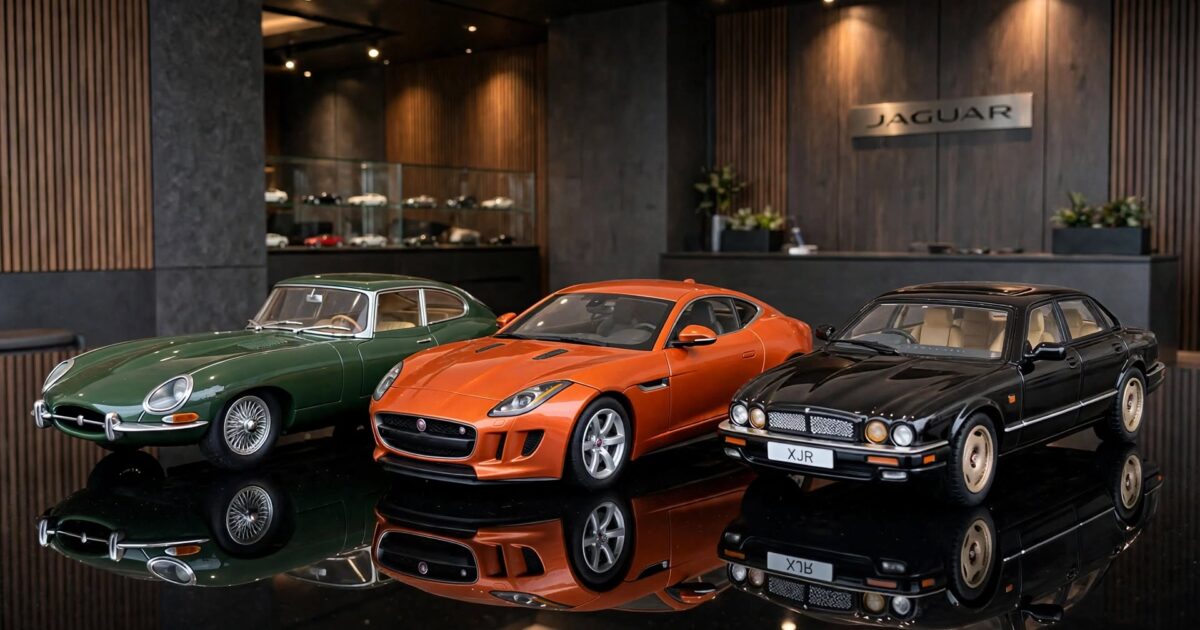
There is a test I use on any budget diecast brand, and it is not a Ferrari or a Lamborghini. It is a Jaguar. Give a cheap manufacturer a wedge and it will probably cope. Give it a long bonnet flowing into a small cabin with no hard line anywhere on the body, and you find out immediately how good the tooling is.
That is the thing about this marque. Jaguars were drawn by people who thought in curves, and curves are expensive to reproduce at any scale.
Jaguar started by building sidecars
In 1922 William Lyons and William Walmsley set up the Swallow Sidecar Company in Blackpool, making sidecars for motorcycles. Bodies for other people’s cars came next, then complete cars under the name SS.
Lyons had one obsession from the beginning, and it was proportion. He is said to have developed cars by having full size mock ups wheeled into the yard so he could look at them, and he would move a line by an inch until it satisfied him. For a company that began bolting bodies onto other firms’ chassis, that is an unusual way to work, and it set the pattern for everything that followed.
Why the company changed its name after the war
The cars were sold as SS before the war. By 1945 those two letters meant something else entirely across Europe, and the company dropped them. The model name Jaguar, already in use, became the name of the firm.
A corporate rename that ordinary would normally go unmentioned. This one earns a line, because it is the rare case where history forced a company to abandon a brand it had spent twenty years building.
The Le Mans years that built the Jaguar myth
Through the fifties Jaguar won Le Mans repeatedly with the C-Type and then the D-Type, a car with a fin behind the driver’s head and a monocoque structure borrowed from aircraft thinking. Those wins did for Jaguar what rally wins later did for Subaru. They turned a maker of handsome saloons into a performance brand overnight.
The road cars carried the credit. The XK120 had already shown what the straight six engine could do, and by the time the E-Type arrived in 1961 the reputation was in place.
Why the Jaguar E-Type is so hard to cast
The E-Type is the most beautiful car most people can name, and at 1:64 it is a trap. Its proportions are extreme: an enormous bonnet, a cabin pushed far back, a tail that tapers to almost nothing. In full size that reads as elegance. Shrink it badly and it reads as an error, like somebody stretched the front of the model by accident.
Getting it right needs a sharp mold around the headlight fairings, a windscreen angle within a degree or two, and a smooth surface with no flat spots along the top of the wings. Cheap castings fail at all three, and the result sits on the shelf looking vaguely like a cartoon. When a manufacturer does nail it, the car is one of the best looking objects in the whole collection.
What British Leyland did to Jaguar
In 1968 Jaguar was folded into British Leyland, the state backed group that eventually contained most of the British motor industry. The XJ6 saloon launched that same year and was, by common agreement, a superb car. What followed was a decade in which build quality and labor trouble damaged the name badly enough that the engineering stopped mattering to buyers.
I bring this up because it explains a gap in most collections. The seventies and early eighties are thin for British marques generally, and Jaguar in particular, and that is not an accident of casting choices. It is what happens when a brand spends fifteen years apologizing.
Ford, Tata and the owners who followed
Jaguar was separated out and privatized in the eighties, bought by Ford at the end of that decade, and sold on to Tata Motors in 2008 as part of Jaguar Land Rover. Under Ford it got the money for the XK8 and the modern saloons. Under Tata it got the F-Type and a run of aluminium bodied cars that were, technically, the best things the company had ever built.
More recently the brand has gone through a complete relaunch around electric cars, which caused a great deal of noise. Whatever comes of it, the back catalogue is what fills shelves, and that is not going to change.
Why Jaguar is underrepresented on the peg
Count the Jaguars in any mainline range and you will find very few, usually an E-Type and perhaps an F-Type or an XJ220. Compare that to the number of Mustangs.
Three reasons, in my view. The shapes are harder and more expensive to tool. The brand sells in small numbers, so the licensing case is weaker in the markets where toy cars sell most. And a Jaguar is a grand tourer, which is the category children ask for least and collectors ask for most, so it tends to live in premium ranges instead of blister packs. My review of the Welly Jaguar XK8 is a decent example of what a mid price brand manages with that kind of body.
What I keep on the British shelf
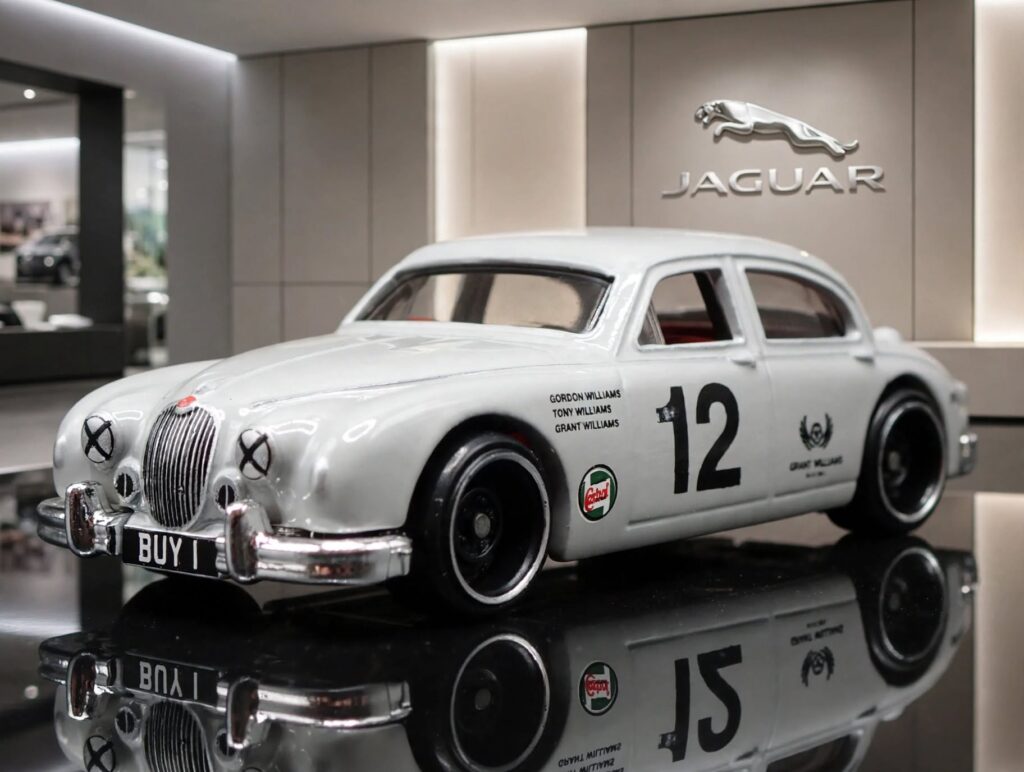
Mine has an E-Type, an XK8 and a Mk2 saloon, and the Mk2 is the one visitors pick up. It is the shape every British crime film of the sixties used for both the police and the robbers, and even people who know nothing about cars react to it.
Jaguar belongs next to Aston Martin on a shelf, since the two split the same territory from opposite ends: one built fast cars for people who wanted to be seen, the other for people who did not. The full list of what is covered here is on my car brand manufacturers page, and my piece on Aston Martin takes the other half of that argument.
Why was Jaguar originally called SS?
The company grew out of the Swallow Sidecar Company and sold cars under the SS name before the war. The initials were dropped in 1945 for obvious reasons and the model name Jaguar replaced them.
How many times did Jaguar win Le Mans in the fifties?
Several, with the C-Type and D-Type, and those victories are what turned the company from a maker of elegant saloons into a performance brand.
Who owns Jaguar now?
Tata Motors, which bought Jaguar and Land Rover together from Ford in 2008.
Why are there so few Jaguar diecast models?
A combination of complex shapes that cost more to tool, smaller sales than mass market brands, and a product type that appeals more to adult collectors than to children.
Which Jaguar is the best one to start with at 1:64?
The E-Type, if you can find a well executed one. It is the shape that defines the brand, and comparing two versions from different manufacturers teaches you more about casting quality than any guide.