I spent the mid 2000s rolling my eyes at these. The Hummer H3 was the small one, the one built on a pickup platform for people who wanted the look without the bill, and I had opinions about all of it. Then I found this red Welly Hummer H3 in a bin, paid almost nothing for it, and discovered something that keeps happening in this hobby: at 1:64 I don’t have to like the car to like the model.
Welly Hummer H3 red paint and body quality
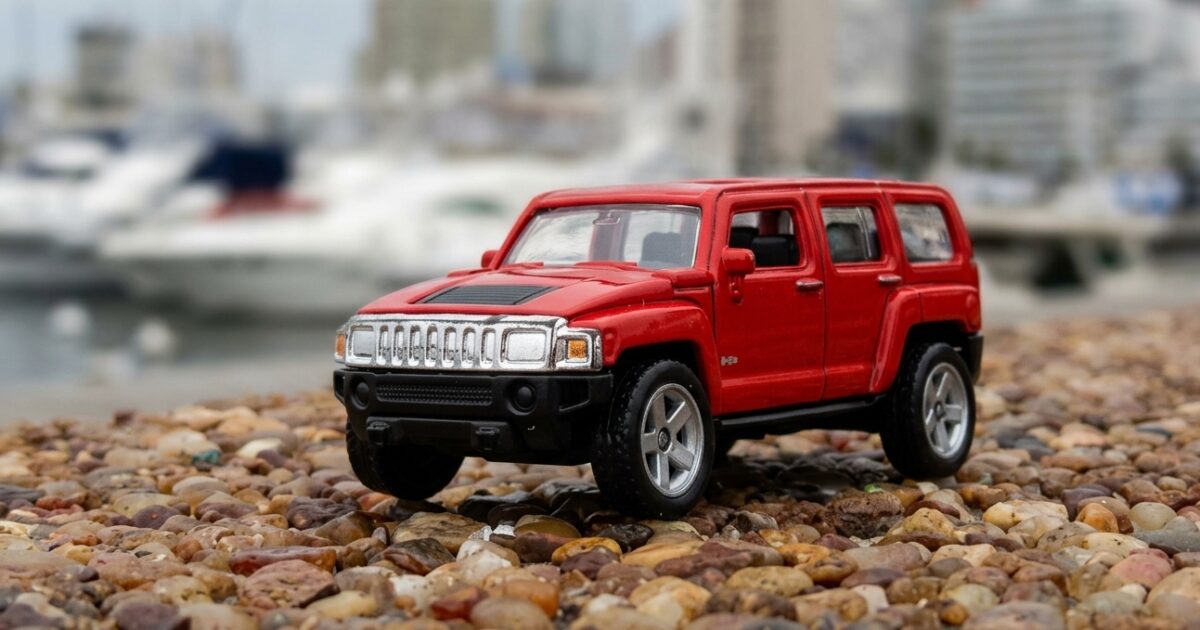
The red is solid and slightly warm, closer to a fire engine than a wine. It’s laid on evenly across the big flat door panels, which is the hardest part of a boxy body to paint well, and there’s no thinning along the roof edges or the wheel arch lips in my example.
The body is heavy diecast all the way to the rear hatch, with a black plastic base. In the hand it has weight, which some collectors care about and others don’t. I care about it, mostly because the weight makes the thing feel like a small tool instead of a trinket.
The chrome grille on the Welly Hummer H3
The grille is the H3’s whole face, and Welly gave it separate chrome treatment with the vertical slats picked out individually. There’s a chrome surround, clear headlight lenses with amber turn signals printed beside them, and a black lower bumper with round fog lamps molded into it.
On the hood there’s a black rectangular vent panel, printed flat instead of cast in. It breaks up the red and sits exactly where the real truck has its power dome. These are the details that separate a budget replica from a generic blob with a logo.
Why boxy SUVs survive the shrink to 1:64
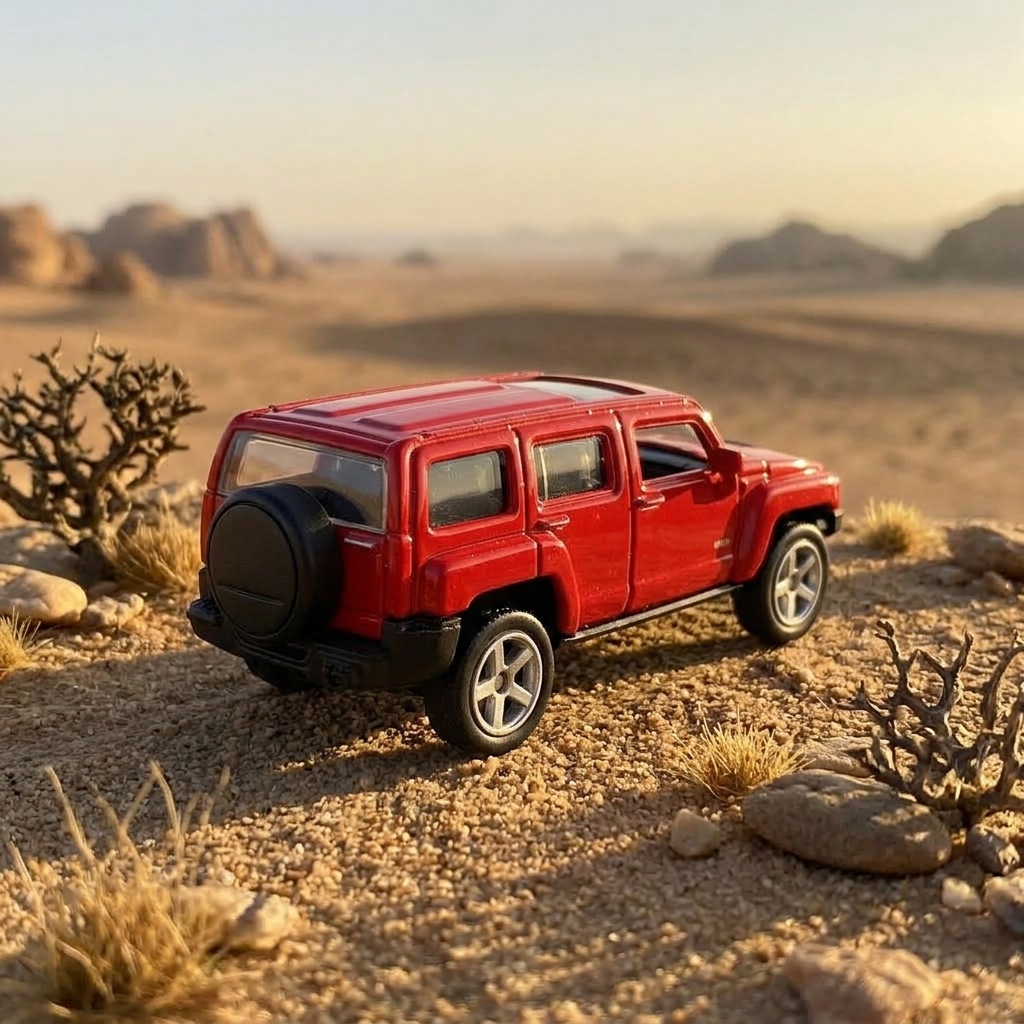
Here’s what I didn’t expect. Every line on this truck is a hard edge: flat doors, square glass, right angle fender flares, a roof that meets the pillars at ninety degrees. There’s nothing subtle to lose when the thing gets shrunk to three inches, so the shape arrives intact.
Compare it to something with soft, rolling bodywork and you’ll see the difference. Curves need careful tooling to survive. Boxes need almost nothing at all. The H3 was designed around a set of right angles, and that turns out to be a gift to the people making small copies of it.
Welly interior detail and glass
Look through the side windows and there’s a full black interior: front seats, a rear bench, a dash with a steering wheel. The glass is clear and thin, and because the H3 has tall upright windows all the way around, you actually see the cabin instead of guessing at it.
The rear quarter glass is the tall vertical slot the real truck had, and Welly got the shape right. Small thing, but that window is one of the few features that tells an H3 apart from an H2 at a glance.
The side mirrors are separate pieces on stalks, not lumps molded into the door. They stick out far enough to catch on things, so this one lives on a shelf and not in a pocket. I’ve snapped mirrors off cheaper models, and they never go back on straight.
Welly Hummer H3 wheels and stock ride height
The wheels are silver five spoke designs with black tires, sized to fill the arches without lifting the body. The truck sits at factory height, no lift and no drop at all, which fits exactly what Welly does.
There’s a decent amount of air under the body, and the tires actually look like all terrain rubber instead of the smooth donuts you find on cheap castings. From the front three-quarter angle, the combination of ride height and flares makes the truck look planted.
The flares are body colored and cast as part of the shell, with a thin black trim line at the bottom edge. On the real truck those were textured plastic. Painting them red keeps the model from looking like it has mismatched parts, which is the usual compromise at this price.
Why Welly stays stock while Hot Wheels cuts everything down
This is the split that defines the hobby. Welly builds factory replicas: stock ride height, correct wheels, real interiors, no flames. Hot Wheels takes the same vehicle and lowers it, widens it and paints it. Neither approach is better, and a shelf needs both to stay interesting. I went through the same question from a different angle in Matchbox versus Hot Wheels.
What Welly gives you is a reference point. Without a few stock vehicles sitting on the shelf, you slowly lose track of how far the customs around them have actually been pushed.
Owning a car at 1:64 that you dislike full size
This is the part I didn’t see coming when I started collecting. At full size, a vehicle is a financial decision, a parking problem and a statement about you. At 1:64 it costs the price of a coffee and takes up two inches of shelf.
That freedom means you can own the ugly ones, the unpopular ones and the ones you argued against. My collection got more interesting the moment I stopped buying only cars I’d want in my driveway. If you’re building a first shelf, I’d put that in the starter guide advice column: buy a few you’re sure you don’t like, and see which ones you keep picking up later.
What the red H3 proved to me
That a model can win on execution alone. I still think the full size H3 was the wrong truck at the wrong moment. The Welly version is well made, correctly proportioned, nicely painted, and it cost me less than a bus ticket across town.
It sits next to the lowered customs now, and it does a job none of them can do: it reminds me what a factory vehicle actually looks like before anybody takes a saw to it.