Buy this car and you will eventually notice something. Stand it next to a Hot Wheels of similar size and it looks slightly big. Not wrong, not out of place, just a fraction larger than it should be.
There is a reason. Welly’s NEX line is 1/60, not 1:64. At around 7 cm long it lives happily on the same shelf, and the difference is real.
What 1/60 means in practice
The scales are close enough that most people never notice, and close enough that mixing them on a shelf causes no problem at all. A 1/60 car of a small subject and a 1:64 car of a large subject will look perfectly natural together.
Where it shows is a direct comparison of the same vehicle. Put a 1/60 Audi TT beside a 1:64 Audi TT and the size gap is obvious. Put it beside a 1:64 pickup and nothing looks strange, because the real vehicles are different sizes anyway.
My advice is to stop worrying about it. Diecast has never been rigorous about scale, and Hot Wheels itself varies wildly across its own range to make everything fit the same packaging. Consistency of appearance matters more than the number on the box.
The first generation TT and why it still looks modern
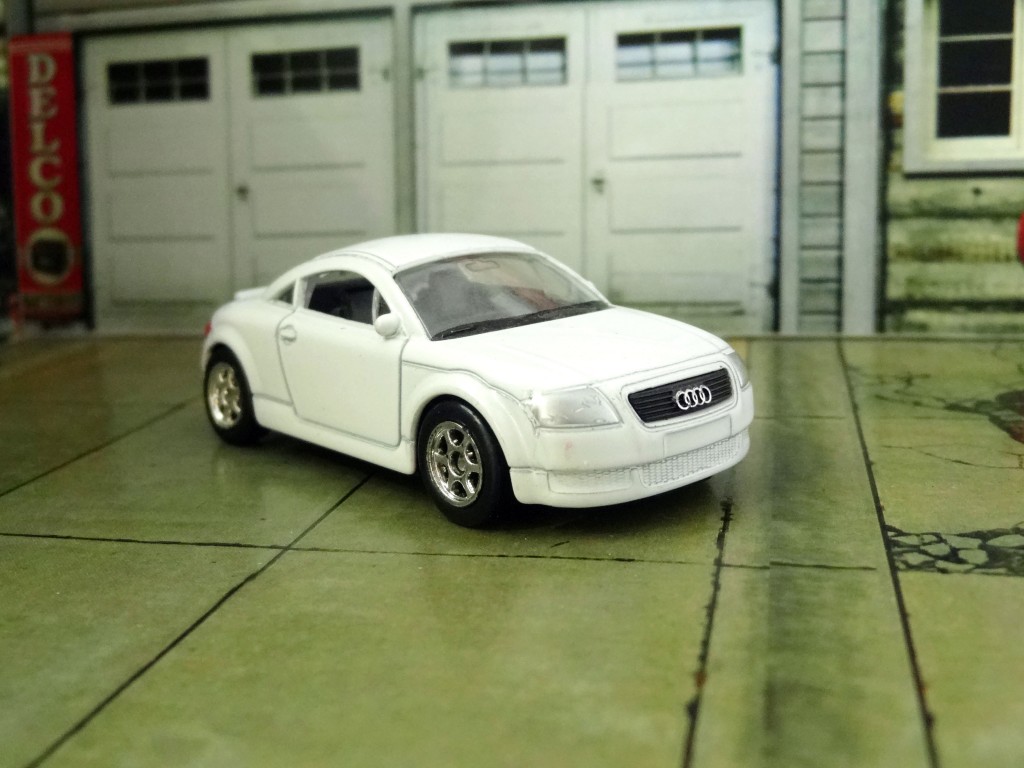
The 8N arrived in the late 1990s and looked like nothing else on the road. Two overlapping arcs for the roof and the body, wheels pushed to the corners, almost no overhang, and a series of aluminium detail touches inside and out.
It was a Bauhaus design exercise that somehow reached production nearly intact, and that is why it aged so well. Cars built around a clear idea usually do.
For a diecast the symmetry is the challenge. Get the arc of the roof wrong by a little and the whole car looks off, because there is no decoration to distract you.
Official Audi licence and what it bought
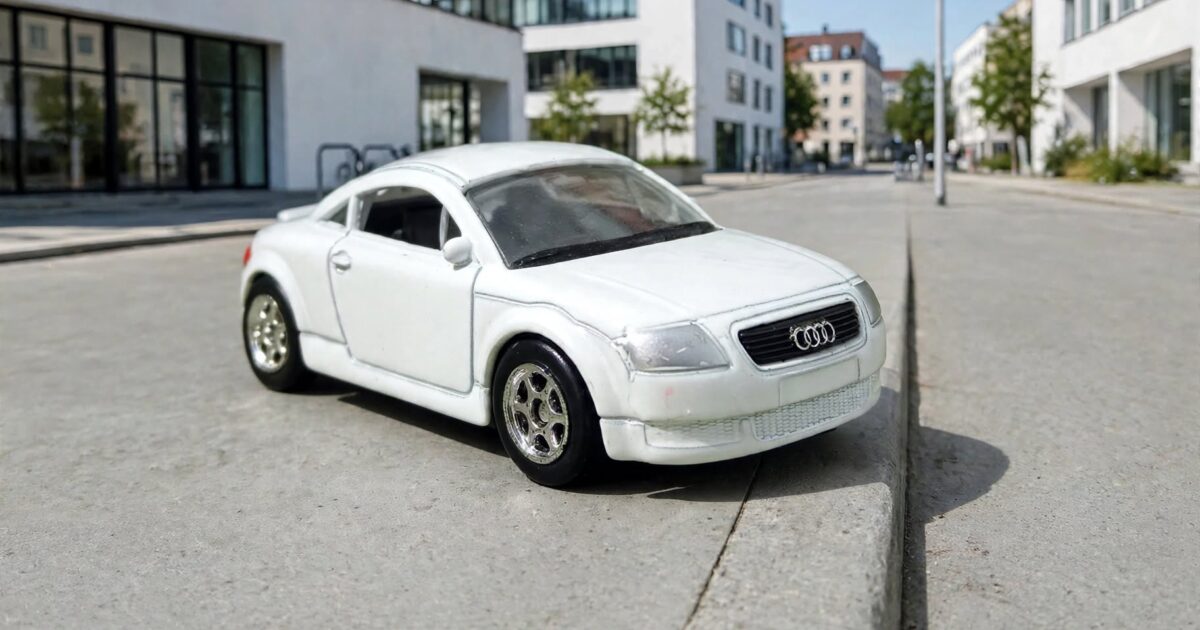
The NEX cars carry official manufacturer licensing, and the clearest evidence is on the nose. The four rings sit in the grille printed cleanly and correctly proportioned, not as a vague approximation.
The grille itself is a fine mesh in dark grey with a chrome surround, and below it a separate lower intake. The headlight units have internal detail visible through clear lenses.
[IMAGEN: detalle frontal con el logo de los cuatro aros y la parrilla]
Panel lines are the other place licensing shows. The door shuts, the bonnet edges and the fuel filler are all cut sharply enough to read under white paint, which is the hardest colour to show line detail on.
Everyday cars deserve shelf space
Count the ordinary cars in a typical 1:64 collection and you will usually reach zero. Everything is a supercar, a muscle car or a modified truck, because that is what sells.
The result is a display where nothing has any context. Put a Lamborghini next to a Ferrari next to a Corvette and the eye stops registering how extreme any of them are, since there is no baseline to measure against.
One hatchback or one coupe fixes that immediately, and this is where brands like Welly earn their place. They cover the cars people actually drove, and adding two or three to a shelf of exotics makes the whole arrangement read as a street instead of a showroom.
It also costs almost nothing, because nobody else is chasing them.
Is a Welly NEX worth buying?
For everyday European cars, yes, and that is the specific case for the brand. Welly covers hatchbacks, saloons and coupes that Hot Wheels ignores because they are not exciting enough to sell to children.
The value is decent too. These sit below premium prices and above supermarket mainlines, with detail closer to the top of that range than the bottom.
Where they fall short is the wheels. Mine has chrome multi spoke rims that are generic and slightly too shiny for the car, which is a recurring theme with brands in this price bracket. The bodies get careful attention and the wheels come from a shared parts bin.
What white paint hides and what it does not
White is generous with some flaws and merciless with others, which catches people out. It hides fine scratching far better than black does, so a car that photographs clean can still be scuffed in hand.
What it cannot hide is panel line quality and chips. Every shut line reads as a grey shadow, so a soft or filled line is obvious, and any chip down to bare metal glows against the paint.
On this casting check the four ring badge first. Small, printed, sitting at the very front where thumbs land, and a TT without a crisp badge loses the thing that separates a licensed model from a generic copy.
Then the lower front valance for scraping, the clear headlight lenses for clouding, and a roll test. Mine has marks around the front wheel arch, which is normal for a car that lived outside a case.
Where it belongs on the shelf
Group it with other European road cars instead of mixing it into a general display. Next to muscle cars the TT looks small and quiet. Next to other European coupes and hatchbacks it looks like part of a considered collection.
It also works well in a street diorama for the same reason the Bburago sedan does. Scenes need ordinary vehicles, and a white coupe parked outside a garage is more believable than another supercar.
In short
Clean licensing detail, sharp panel lines under difficult white paint, and a subject the big brands leave alone, in a scale that is technically 1/60 and practically indistinguishable on a shelf. The wheels are ordinary. Everything above them is better than the price suggests.