There’s a category of vehicle that nobody collects and everybody drives. Compact crossovers. They’re in every parking lot in the world, they outsell the interesting cars by a wide margin, and I had exactly zero of them until this blue Majorette Mitsubishi ASX turned up in a multipack. I kept it out of pure curiosity alone. It has stayed out because it does something that none of my other cars can do.
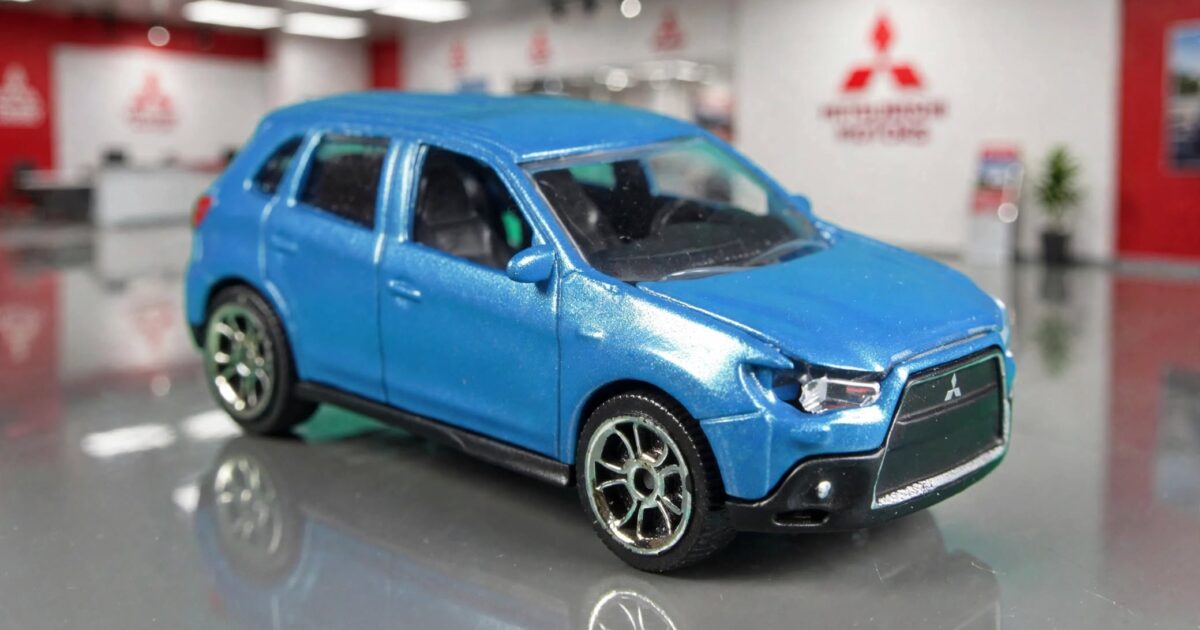
Majorette Mitsubishi ASX in metallic blue
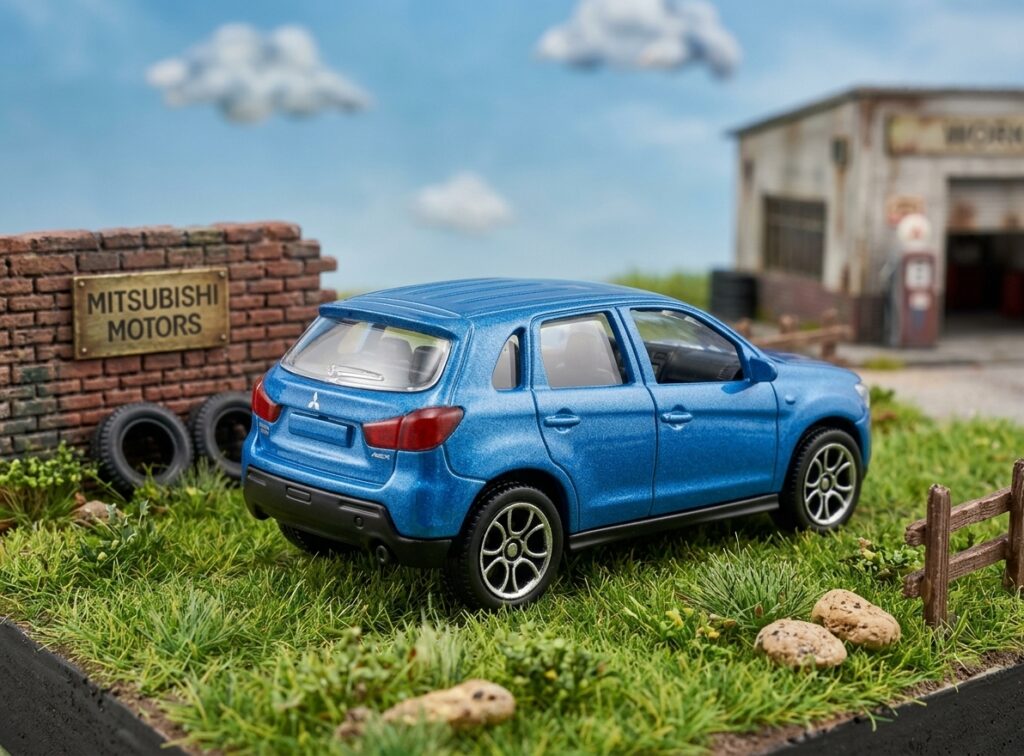
The paint is a bright metallic blue with a fine flake, and it’s the best thing on the model. It’s a modern manufacturer color, the sort of blue that shows up in a brochure next to the word Sport, and Majorette laid it on cleanly across the long roof panel.
The body has almost no graphics. There’s a small Mitsubishi diamond on the grille and nothing else on the flanks. For a car like this the restraint is correct. Stickers and racing numbers would turn an honest family crossover into a toy, and the whole appeal here is that it isn’t trying to be one.
ASX or Outlander Sport, which name is on the base
Sort this out before you file the car in your list. Mitsubishi sold this same vehicle as the ASX in Europe and parts of Asia, as the Outlander Sport in North America and as the RVR in Japan. Majorette prints one of those names on the base depending on the market the model shipped to.
If you tag your collection in a spreadsheet, pick one name and stick with it, then note the alternatives. I learned that lesson after chasing what I thought were two different castings and discovering they were the same car with different lettering.
The shark nose grille on the Mitsubishi ASX casting
The front is the only aggressive part of this vehicle, and the casting captures it. The grille is a black trapezoid with a chrome bar across the top, angled back into the nose. The headlights are clear separate pieces that run up over the fenders.
Below, the bumper has a black lower section with a chrome skid detail and small fog lamp recesses. It’s a surprising amount of structure for a car this plain.
The mirrors are cast into the doors on mine, painted body color, and the door handles are molded in with no separate paint. Those are the corners Majorette cuts at this price, and I’d sooner have them cut there than on the grille, which is the part anybody looks at first.
Majorette interior detail and glass area
This is where the model earns its place. Crossovers have enormous windows, and that means you can see everything inside. Through the glass there’s a full black interior with front buckets, a rear bench, a center console, a dash and a steering wheel.
The windshield is huge and raked, the side glass runs almost the length of the car, and the rear quarter window is a proper separate pane. On a low coupe, the interior is a dark cave you never see. Here it’s half the model.
The glass itself is clear and flat, with no blue tint. That helps, since a tinted screen would have hidden the work underneath. Hold the car up to a window and you can see straight through from one side to the other, which sounds like nothing until you try it with a sports car.
Why ordinary cars like the ASX are missing from collections
Walk along any collector’s shelf and count the supercars, the muscle cars, the lowered customs. Now count the cars you’d actually see on your street. The second number is usually close to zero, and that strikes me as a strange outcome for a hobby built entirely on miniature versions of the real world.
Part of it is that the manufacturers follow demand. Part of it is that we all buy what looks exciting on the peg. The result is a collection that represents nobody’s daily commute. I think that’s a gap, and filling it costs almost nothing, since these castings sit in bins and multipacks that nobody picks over.
Black and yellow wheels on the Majorette crossover
The wheels are the one odd note. They’re black with bright yellow outlines on the spokes, which is a Majorette styling habit and has nothing to do with any real ASX.
I’ve gone back and forth on them for weeks. On a stock family vehicle they’re wrong, and a plain silver five spoke would have been truer. On the other hand they stop the model from vanishing into the background, and for a vehicle this anonymous, that might well be the entire point. Majorette does this across its range, and I covered the brand’s habits in more detail in my piece on collecting Majorette.
Using the Mitsubishi ASX in a 1:64 diorama
Here’s the practical payoff. A scene full of sports cars just looks like a car show. Add two or three ordinary vehicles and it looks like a street. This ASX works as the car parked at the curb, the one waiting at the light, the anonymous background traffic that makes the hero car in front of it look like it’s actually somewhere real.
That’s the job no Lamborghini can do. If you’re building scenes, my diorama guide covers layouts, and my suggestion is to buy three or four dull cars before the next exotic.
Is the Majorette Mitsubishi ASX one to keep
I didn’t choose this car and I wouldn’t have paid full price for it. It still changed how I shop, because it showed me how empty my shelf was of anything resembling actual traffic.
The paint is good, the interior is far better than it needs to be, and the proportions are honest. If Majorette made a white one with silver wheels, I’d buy two and park them behind everything else, behind everything else on the shelf, which is exactly where the real ones always end up.