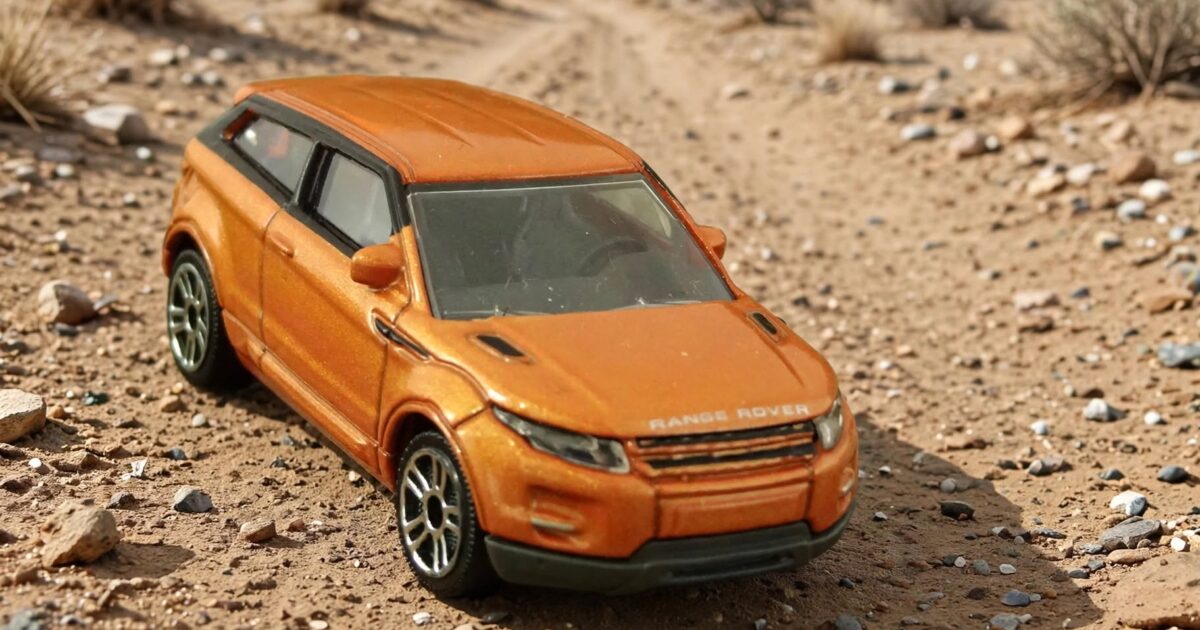
Land Rover made the Evoque in three bodies: a five-door, a convertible, and this, the three-door coupé. Only one of them survived.
The coupé was the version in the original concept, the one that made people want the car, and it was also the one that stopped making commercial sense. Buyers wanted the extra doors.
So the shape you are holding is the Evoque as it was meant to look, and the Evoque that mostly is not on the road.
The design that sold the car
The Evoque arrived looking like a concept that escaped. A roofline falling steeply toward the tail, a beltline rising to meet it, and a glass area squeezed into the narrow band left between them.
That is a styling exercise, not a packaging decision. It costs rear headroom and visibility, and it is the reason the car looked like nothing else in the segment.
The three-door takes it further. Without the rear door cut, the flank is a single uninterrupted surface from the front wheel to the tail, and the whole shape reads as one piece.
That is also why it sold badly. The compromise that makes the design work is the same compromise that makes the car awkward to use, and most buyers chose practicality. Land Rover eventually agreed with them.
What Majorette captured
The proportions first, which on a car this stylised is the entire job. Get the roofline angle slightly wrong and it becomes an ordinary small SUV.
Here the drop is correct and the rising shoulder line meets it where it should. The wedge reads from a three-quarter view, which is where this shape either works or collapses.
The black roof is a separate colour rather than body-coloured, matching the real car’s contrast roof option, and it visually lowers the body the way it does at full size.
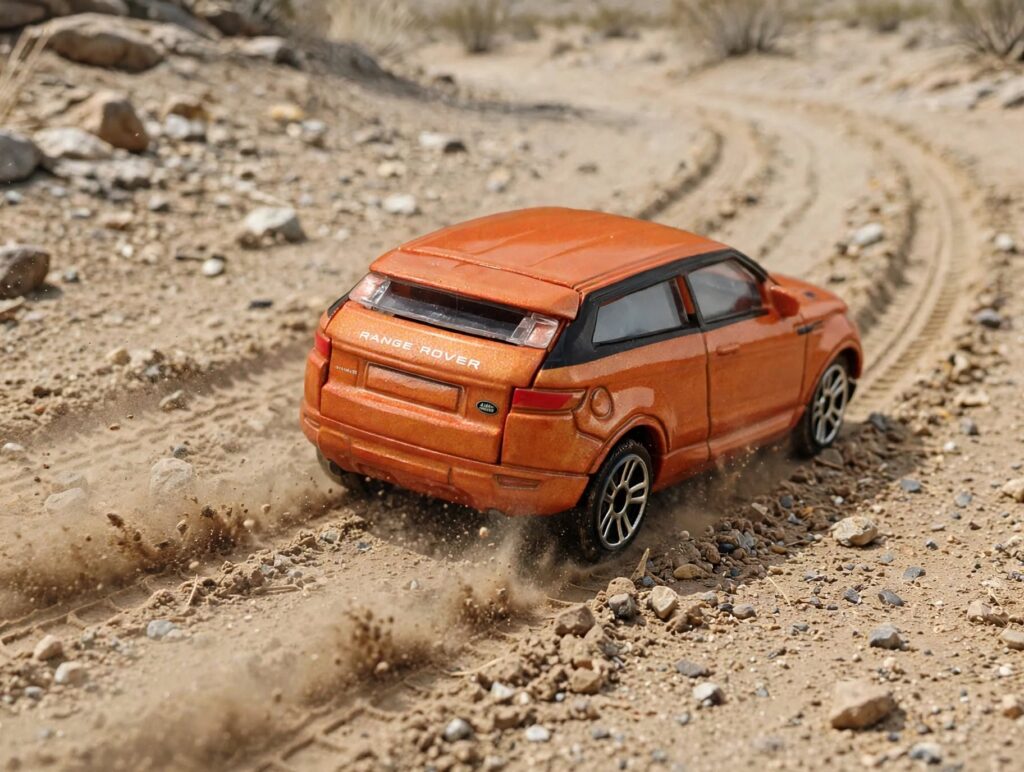
The badging is where the licensing shows. RANGE ROVER is printed across the bonnet lip and again on the tailgate, with the Land Rover oval on the rear quarter, all small and all legible.
Realistic ride height, and why it matters here
Majorette left it alone, which is their usual approach and the right one on this subject.
An Evoque is not a low car. It sits at SUV height on relatively large wheels, and the drama comes from the roofline rather than from the stance.
Lower it and you lose the tension that makes the design work: the whole point is a tall body with a coupé roof, and flattening the body removes one half of that argument.
The wheels are fine multi-spoke in chrome with black centres, slightly generic as usual at this price, and here they happen to suit a car that runs large alloys in reality.
Opaque metallic orange
The colour is doing more work than it appears to.
Orange is a difficult finish because it sits between warm and saturated, and a cheap version goes either muddy or fluorescent. This one has a fine metallic flake that keeps it looking like paint rather than plastic.
On a body with this much curvature, metallic is also the practical choice. Flat colour on a surface that curves continuously gives you no information about where the shape changes, and the flake catches the transitions.
The one place it works against you is inspection. Metallic hides fine scratching well, so a car can look perfect in a listing photo and show marks in your hand.
Three-door, five-door, convertible
Worth knowing because listings mix them up and the three-door is the one worth having.
Count the door shut lines on the flank. Three-door has one cut behind the front wheel and nothing after it. Five-door has a second cut before the rear arch.
The convertible is obvious from the roof, and it is the rarest of the three in real life and in 1:64.
There is a second check if the photo is poor. The three-door has a longer front door, noticeably longer than on the five-door, because it has to give access to the rear seats. Once you have seen the two side by side the difference is obvious even without counting shut lines.
A seller describing this as simply an Evoque is not lying, and they are also not telling you which one. Read the photo.
Modern SUVs in a 1:64 collection
Most collections have none, for the same reason they have no sedans: manufacturers make what sells to children, and that is sports cars and trucks.
The gap matters because SUVs are what people actually drive now. A street diorama without one looks like a street from 1995.
Majorette covers this ground better than the American brands do, which is consistent with what I have found across their range. Our guide to Majorette diecast worth collecting goes through the rest.
Buying a loose Evoque
The black roof is a separate painted section, so check the transition edge where it meets the orange. Two-tone paint chips at the boundary, and on this contrast it shows immediately.
Then the badging on the bonnet lip, which sits at the front where fingers land.
Then the lower front valance, which is dark grey and sits proud of the body.
Metallic orange hides scratches and shows chips as dark marks. Inspect the arch edges and the tailgate corners rather than the flat panels.
Also look at the rear glass, which on this body is a narrow strip set into a steeply raked tailgate. It is a small piece of clear plastic in an exposed position, and a scratch across it is visible from any angle because there is so little of it.
Bottom line
A correctly proportioned casting of a body style that barely survived, with clean licensed badging and a colour that reveals the curvature instead of flattening it. Ordinary wheels, as ever at this price.
Worth owning mostly because it is the three-door, which is the Evoque people wanted and mostly did not buy.