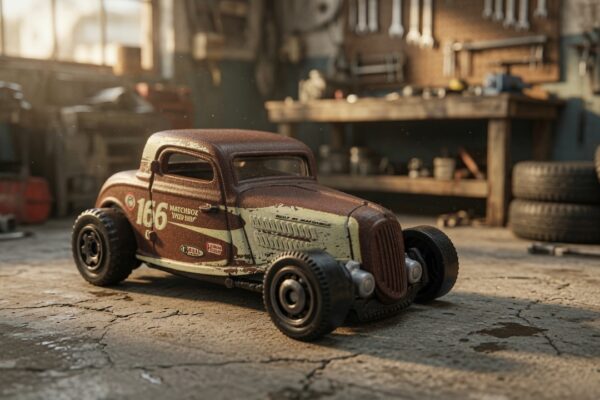
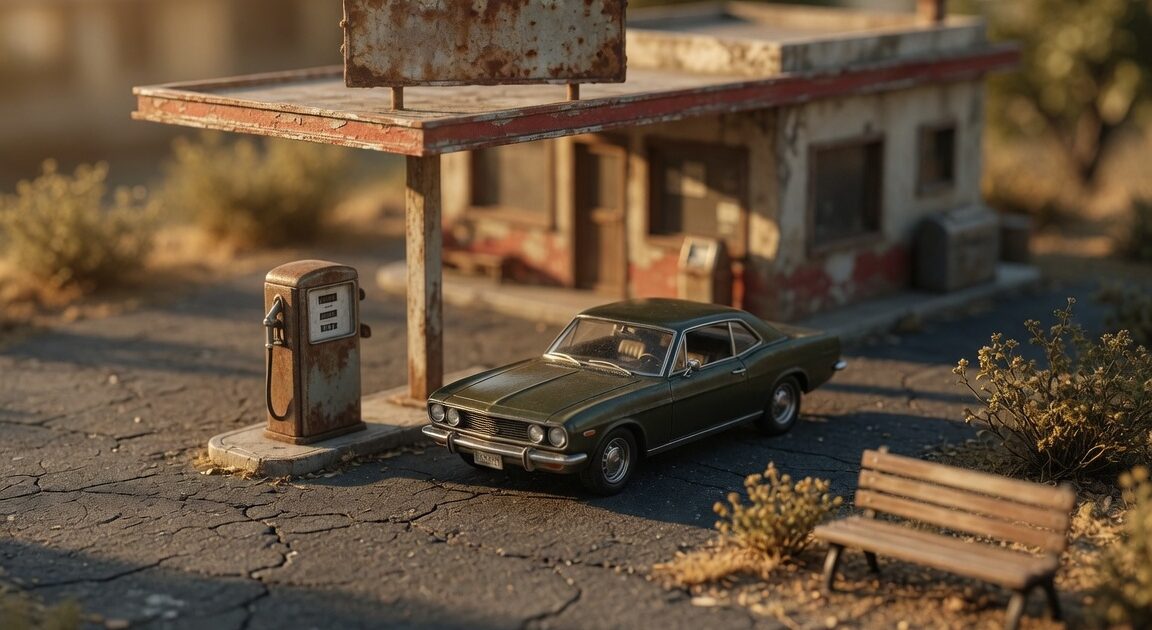
A good diorama does something a shelf never can. It takes an ordinary little car and turns it into a photo people actually stop and look at twice. The part nobody tells you is that your first one needs neither money nor talent, just one decent idea and the patience to not rush it. Here is how to build a 1:64 diorama from nothing.
Start with one scene
The classic beginner mistake is trying to build a whole city block on day one. Do not. Pick a single, believable setting that suits your cars and commit to it. A gas station. A back-alley garage. A wet street corner under one streetlight. One convincing scene beats a sprawling, half-finished one every single time, and it is far less likely to end up in a drawer unfinished.
Cheap materials that actually work
You do not need a hobby-shop spending spree. Most of a good first diorama comes from things you already have or can buy for pocket change.
- Foam board, PVC foam board or MDF for a base that will not warp.
- Printed asphalt and grass textures, or hobby cardstock kits, glued down flat.
- Sand and baking soda mixed into a 50/50 blend of white glue and water for ground texture.
- Cheap acrylic paint for weathering, plus odds and ends from the recycling bin for props.
Half the fun is the moment you realize a bottle cap, a coffee stirrer and a bit of gray paint can become a believable oil drum or a leaning signpost. Once you start seeing junk that way, you never quite stop.
The model-train trick
This is the tip that saves beginners hours of frustration, so I will not bury it. Finding trees, figures and tiny street details in true 1:64 is nearly impossible, and what you do find is expensive. So borrow from the model railway world instead. Scenery made for HO scale trains, around 1:87, is cheap, sold everywhere, and close enough that trees, shrubs and bushes read perfectly next to your cars. A single bag of model-train trees off eBay will furnish several dioramas for the price of a coffee.
Build a backdrop
The thing that quietly separates a good diorama photo from a great one is what sits behind the car. A flat wall of clutter from your room ruins the illusion instantly. The cheap fix is a backdrop. Print a blurred photo of a sky, a brick wall or a tree line, mount it on a piece of foam board, and stand it behind the scene. Even a plain painted card in the right color does the job. Suddenly your little corner of asphalt looks like it belongs somewhere.
Getting the scale right
Here is where good intentions go wrong. Everything in the scene has to read as 1:64, so keep one of your cars sitting beside you the entire time you build, as a constant size check. A door that is a touch too tall or a curb that is a shade too low will quietly break the illusion, and the worst part is you will feel that something is off long before you can point to what it is.
Weathering without overdoing it
A brand-new diorama can look too clean, like a showroom that has never seen weather. A little grime fixes that, but restraint is everything. A thin wash of watered-down dark paint settles into corners and panel lines and instantly adds age. Dry-brushing a lighter shade over raised edges brings out texture. Weathering powders or a scrape of soft pastel make convincing dust and dirt. Build it up slowly, because you can always add more, and you cannot easily take it back off.
Beginner mistakes to avoid
A few traps catch almost everyone the first time. Using too much glue, so the ground texture clumps and shines. Mixing scales, so a too-big figure makes the car look like a toy again. Cramming in so many props that the eye has nowhere to rest. And rushing the paint before the glue underneath has fully dried. Slow down, let each layer set, and the result looks twice as good for the same effort.
Lighting and photographing it
All that work pays off in the photo, and lighting does most of the heavy lifting. Soft, directional light is the goal. A window in the afternoon, or a cheap LED panel set off to one side, throws the kind of shadows that make a small scene feel real. Skip the on-camera flash, which flattens everything. Get your phone or camera down low, right to the car’s eye level, tap to focus on the car, and shoot a little wider than feels natural so the scene has room to breathe. That low angle is the whole difference between a snapshot of a toy and a photo of a place. For more display ideas, see the collecting guide, and browse our diorama builds when you want a push.