In our Renault diecast guide I listed the Alpine A110 as one of the Majorette models worth seeking out. This is that car, and now I can say why properly.
It is small, it is blue, and it beat machinery with twice its power for most of a decade.
Light, small, rear-engined
The A110 was built on a backbone chassis with a fibreglass body, which made it extraordinarily light at a time when rivals were still using steel.
The engine sat behind the rear axle. That layout is usually a problem, because it makes a car want to swap ends, and in the A110 it became an advantage: all that weight over the driven wheels meant traction on loose surfaces that nothing else could match.
On gravel and snow, that combination beat more powerful cars repeatedly. The A110 won rallies outright against factory teams with far bigger budgets.
It is a useful reminder that power is only one variable. The A110 won by weighing almost nothing and putting what weight it had in the right place, which is a less glamorous advantage than horsepower and a more durable one.
Why Alpine and not Renault
Worth clearing up because the badging confuses people.
Alpine was a separate company, founded by a Renault dealer who built sports cars using Renault mechanical parts. Renault supplied the hardware, Alpine built the cars, and eventually Renault absorbed the operation entirely.
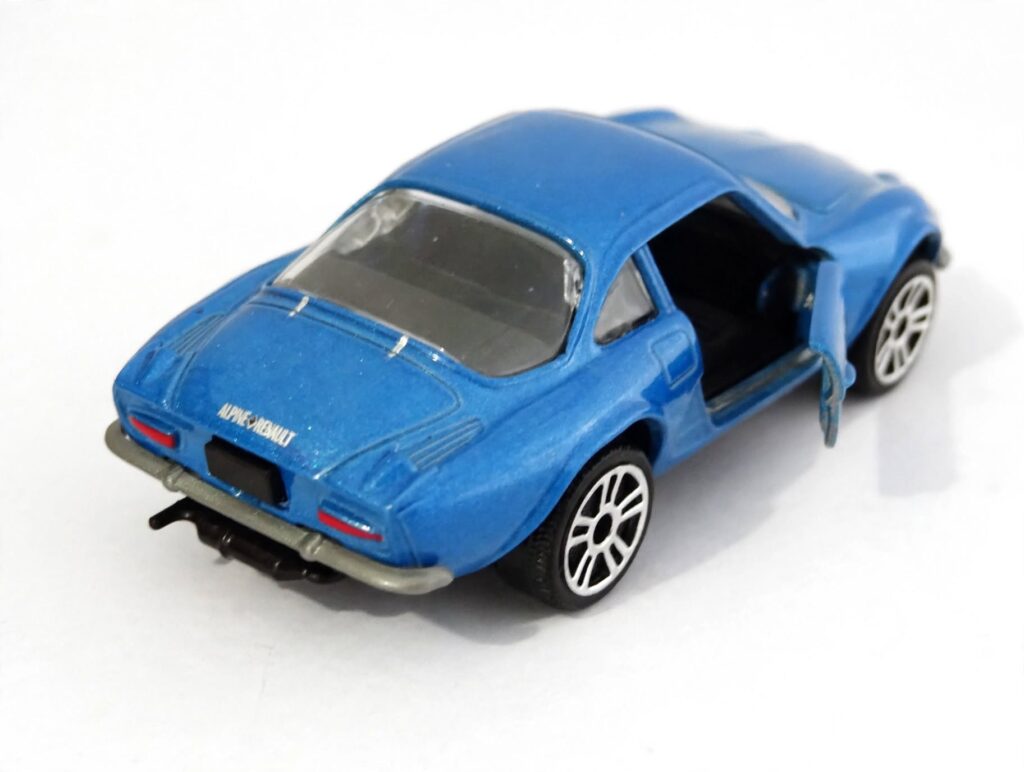
That is why the tailgate on this casting reads ALPINE RENAULT rather than one or the other. It is accurate to the period, and it marks the moment when the two were formally joined.
Blue, and only blue
French racing blue, and it is not a styling choice.
International motorsport once assigned colours by nationality: British racing green, Italian red, French blue. Those conventions faded when sponsorship arrived, but the associations stuck.
An A110 in any other colour looks wrong to anyone who knows the car. Majorette made the obvious and correct decision, and it is one of the few castings where I would argue the colour is not optional.
The rally lamps and the bumper
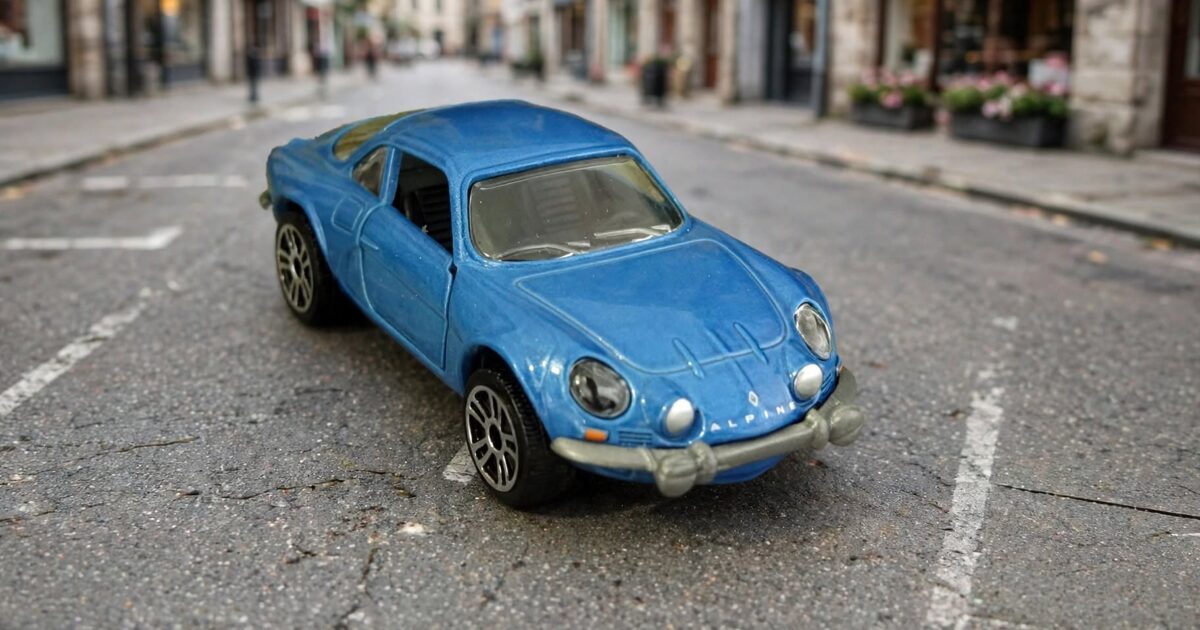
The front carries four auxiliary lamps mounted on the bumper, two larger and two smaller, which is the period rally setup.
Those lamps are the detail that turns this from a small French coupé into a competition car. They are also the most fragile part of the casting, projecting forward of everything else with nothing protecting them.
The thin chrome bumper runs beneath them, and on the rear there is a matching one with the exhaust visible underneath.
Look closely at the bonnet too. There are moulded louvre lines running back from the nose, which on the real car vented the luggage area ahead of the cabin. It is a small detail and it is the kind of thing a manufacturer only includes if somebody looked at reference photographs rather than a silhouette.
Opening doors, and what they cost
This casting has opening doors, which Majorette does on a lot of its range, and it is a genuine trade-off.
What you gain is play value and a visible interior with seats and a dashboard.
What you lose is panel fit. A door that opens needs clearance, so the shut lines are wider than on a fixed-body casting, and the door often sits slightly proud of the flank. On a car as small and smooth as an A110, those gaps are more noticeable than they would be on a larger body.
You also gain a failure point. Hinges loosen with use, and a door that no longer closes flush is permanent.
Whether that trade is worth it depends on whether you open them. I do not, so I would rather have the tighter body.
Original or revival? Check the listing
Alpine relaunched the A110 as a modern car, and sellers use the same name for both.
They are easy to separate once you look. The original is narrow and upright with round headlights set into the nose and a short, almost vertical tail. The modern car is wider and lower, with complex headlight units and a much smoother overall surface.
The modern one also carries only ALPINE badging, without the Renault script.
If a listing says A110 and shows a sleek modern coupé, that is the revival. Both are worth owning and they are not the same object.
Homologation and why it suits a shelf
The A110 belongs with the other cars built to satisfy rulebooks rather than customers, which is a theme I keep returning to because it produces the most interesting vehicles.
Put it next to a Ford Escort, a Renault 5 Turbo or a Mini and you have a shelf about regulation shaping design. All small, all purposeful, all beating things they had no business beating.
That group costs very little to assemble and it says more than a row of supercars.
The A110 is also the one that explains the others fastest, because its advantage is visible. You can see that it is tiny. You cannot see that an Escort is light or that a Mini handles well, but a car this small next to anything else makes the argument on its own.
Would I buy it again?
Yes, and I would look for a fixed-body version if one exists, because the opening doors cost more in panel fit than they return.
Everything else is right: the correct blue, the rally lamps, the period badging, and a shape that looks fast standing still despite being tiny.
If you own one Alpine, make it this one rather than the revival. The modern car is better in every measurable way and the original is the one that earned the name.