Put this next to any modern 1:64 car on your shelf and something looks wrong. The Porsche is small. Not slightly smaller, properly small, the kind of difference that makes people ask if it came from a cheaper set.
It did not come from one. The 550 Spyder is the one on the shelf that is honest about its size, and every other car around it is quietly cheating.
Why the Maisto Porsche 550 Spyder looks so small
Here is the thing nobody tells you when you start collecting. The scale printed on the package is a guideline, not a promise. Brands build to a package size: a casting has to fill the blister, sit on the peg and feel like a toy in a child’s hand, so a small real car gets scaled up and a huge real car gets scaled down until they both land around three inches.
The real 550 was a tiny car. Low, short, built around a four cylinder engine and almost nothing else. Maisto left it tiny. The result is a model that is probably closer to true 1:64 than most of what sits beside it, and it pays for that honesty by looking undersized on the shelf.
There is nowhere to hide on this casting
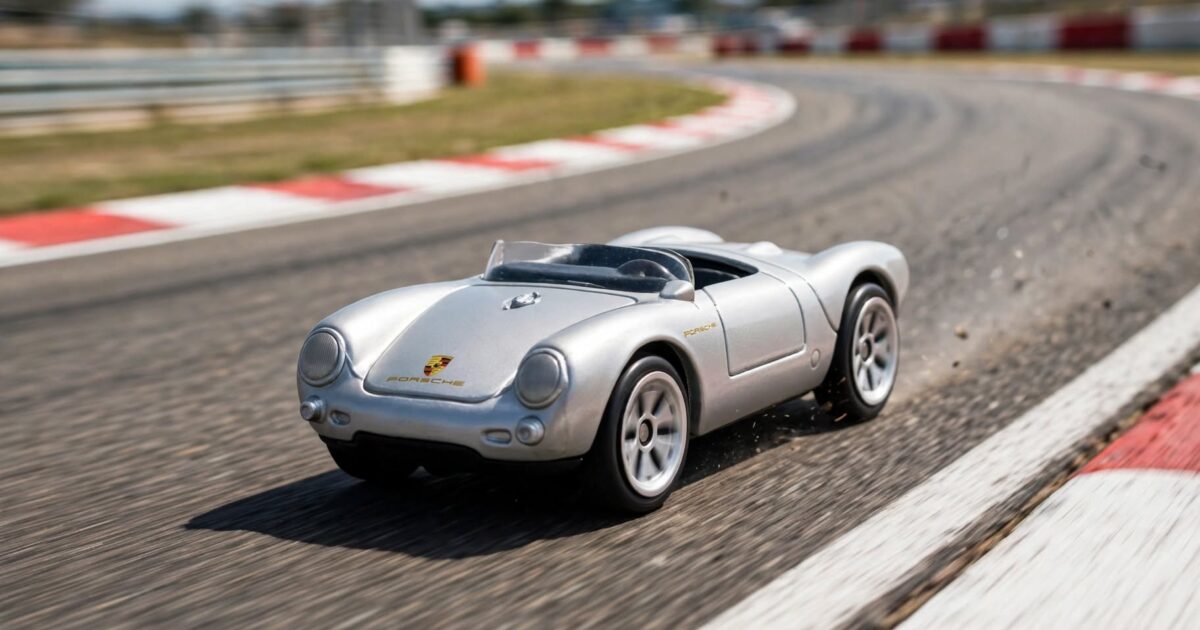
No bumpers. No grille. No badges beyond a small crest on the nose. No wing, no stripes, no sponsor panel, no chrome trim running down the flank. The 550 is a shape and nothing else, which means the mold has to carry the entire car.
It mostly holds up. The front fenders rise into two soft peaks with the headlights sunk into them, the body pinches in at the doors and swells again over the rear wheels, and the tail drops away in one curve. Those are the lines that matter, and all of them are present and reasonably crisp.
Silver paint with a warm cast
The color is a silver that leans warm, closer to champagne than to the cold grey you get on modern German cars. In the photos it picks up whatever is around it, so on a white surface it reads almost gold at the edges.
Coverage on mine is even over the long front clam, which is the hardest surface on this body because there is nothing to break it up. There is a small rubbed area near the nose, the sort of wear a loose car picks up over the years.
The rear deck grilles are the best detail
Behind the seats, two rectangular grilles sit in the rear deck, picked out in a lighter finish so the slats read individually. On the real car that is where the air went in to cool the engine, and it is the only visual complication anywhere on the body.
Maisto could have cast them as flat rectangles and moved on. They did not. At this size those two little grids do a lot of work, because they give the eye something to land on halfway down a body that is otherwise one long curve.
Cream wheels on a 1950s Porsche racer
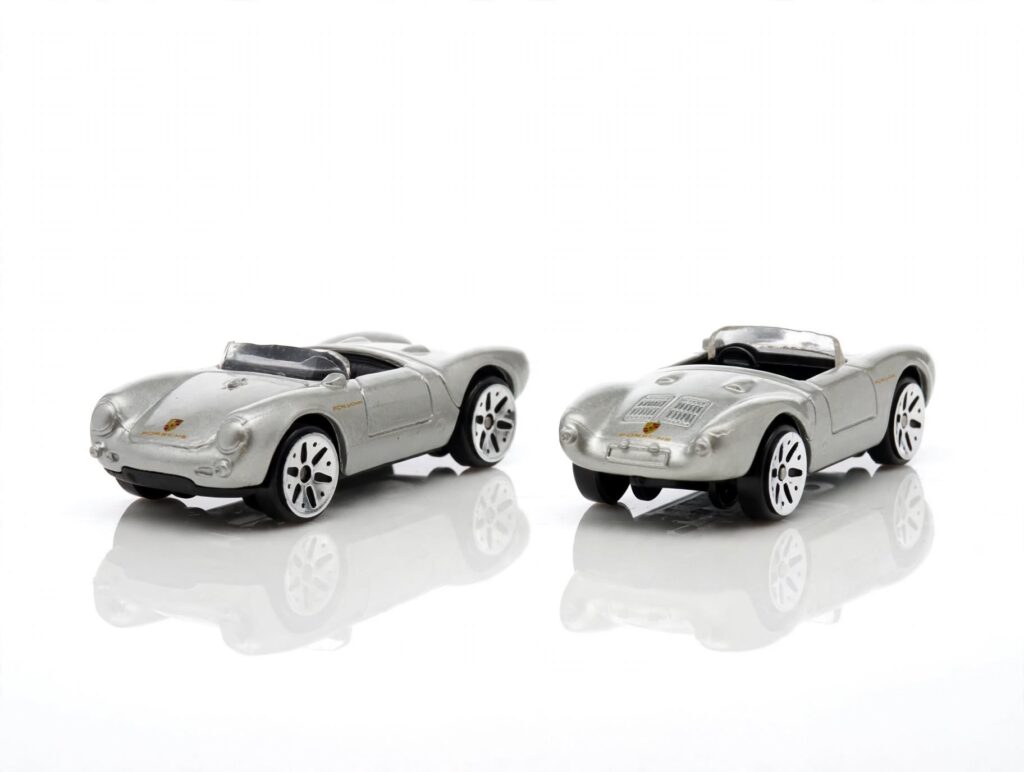
The wheels are off white discs with dark spoke cutouts, and they are correct for the period. Fifties racing Porsches ran painted steel wheels, often in a cream or silver that matched the body, and the casting copies that instead of reaching for modern chrome.
They are also the right diameter. Oversized wheels would have wrecked this car completely, since the whole point of the shape is how low and small it sits. The tires are plain black with no tread, which suits a car this old.
The stance is flat, with the body sitting close to the surface and very little gap above the tires. That is accurate. These cars were built low because they were built light, and a raised ride height would have turned the model into a different vehicle entirely.
What the open cockpit shows you
The windscreen is a thin clear piece that wraps slightly around the front of the cockpit, and behind it there is a black interior with a seat and a dash. It is simple, because the real thing was simple too.
Because the body is open, you look straight down into the tub from any high angle. That means the interior has to be there, and here it is. Nothing painted, nothing detailed, but the shapes are right and the opening is correctly small.
One thing I would change. The windscreen on my example has picked up some cloudiness, and on a car with this little going on, a scuffed screen is the first flaw anybody notices. If you are buying one loose, hold it up to the light and look through that piece before you pay.
Where the 550 Spyder fits in a 1:64 collection
It fills a gap most shelves have, which is the 1950s European racing car. Plenty of collectors own modern supercars and American muscle and almost nothing from the decade when racing cars were light instead of powerful.
If you are curious about how the 1:64 standard came to be so loose in the first place, I covered the basics in my piece on what a Hot Wheels car actually is. The short version is that the standard describes a size of toy instead of a strict mathematical ratio, which is how two cars of wildly different real lengths end up the same size on the peg.
What the little Porsche is good for
Two things. First, it photographs beautifully in a scene, because its size reads as a small car instead of as a cheap one once there is a road and some scenery around it. My diorama guide covers how to build that.
Second, it keeps me honest. Every time I pick up some modern casting that feels satisfyingly chunky in the hand, the Porsche sitting next to it reminds me that the chunkiness is a decision somebody made at the factory, and not the car.