Some cars get customised. This one got customised so consistently, by so many people, for so long, that the modified version became more famous than the factory car.
Say 1949 Mercury to anyone who knows custom culture and they picture a chopped roof, a filled grille and a body sitting on the ground. Almost nobody pictures what Mercury actually sold.
Why this car and not another
Timing and shape.
The 1949 Mercury arrived with slab sides and almost no ornamentation, at a moment when American cars were still covered in separate fenders and chrome spears. That smooth body was a blank surface, and blank surfaces invite modification.
It was also cheap and plentiful within a few years of being new, which is the other half of every custom scene. You cannot build a culture around a car nobody can afford to cut up.
The result became the template: chop the roof, lower the body, remove the badges, and let the shape do the work.
What is unusual is how long it held. Most custom fashions last a few years and then look dated. The lead sled formula has survived for seventy years essentially unchanged, which suggests the original builders found something close to the correct answer on the first attempt.
What a chopped top actually is
The term gets used loosely, so here is what it means.
Chopping means cutting a horizontal section out of the roof pillars and welding the roof back down lower. The glass gets shorter, the pillars get more raked, and the whole car looks longer because the cabin is smaller relative to the body.
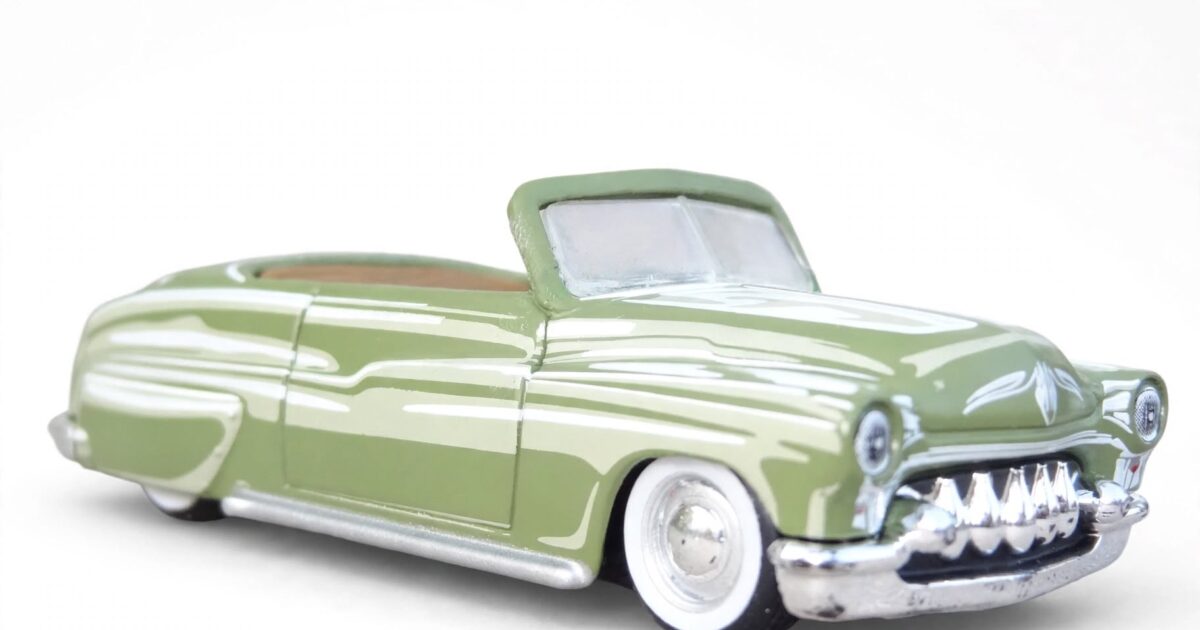
On this casting you can see it in the windscreen, which is a narrow horizontal slot rather than an upright pane. Compare it to any factory car from the same years and the difference is obvious.
It is the single modification that defines the style, and it is why these cars are called lead sleds: the original bodywork was reshaped using lead filler.
Chopping is also irreversible and difficult, which is part of why it carried status. Anyone could lower a car on its springs. Cutting the roof off, shortening the pillars and getting the glass to fit again took real skill, and a bad chop is obvious forever.
Frenched headlights and the filled grille
Two more pieces of the vocabulary, both visible here.
Frenching means recessing a light into the bodywork so the rim disappears and the lens sits in a tunnel. On the casting the headlights sit deep in moulded recesses with a formed lip around them, which is exactly right.
The grille is the other signature. Customisers removed the factory grille and substituted something simpler, often a row of chrome teeth. That is what the vertical chrome elements across the opening are referencing.
Together those two changes remove most of what identified the car as a Mercury, which was the entire point.
Mint green and whitewalls
The colour is period-correct in a way that matters.
Custom cars of this era ran soft pastels: mint green, pale yellow, powder blue. Those colours came from the paint available and from a culture that valued a smooth finish over a loud one.
The whitewall tyres complete it. White band, chrome centre cap, no visible modern alloy anywhere. Put a dark wheel on this car and the whole period reference collapses.
Maisto also kept the car low, which on this subject is not a liberty. A lead sled that sits at factory height is just an old Mercury.
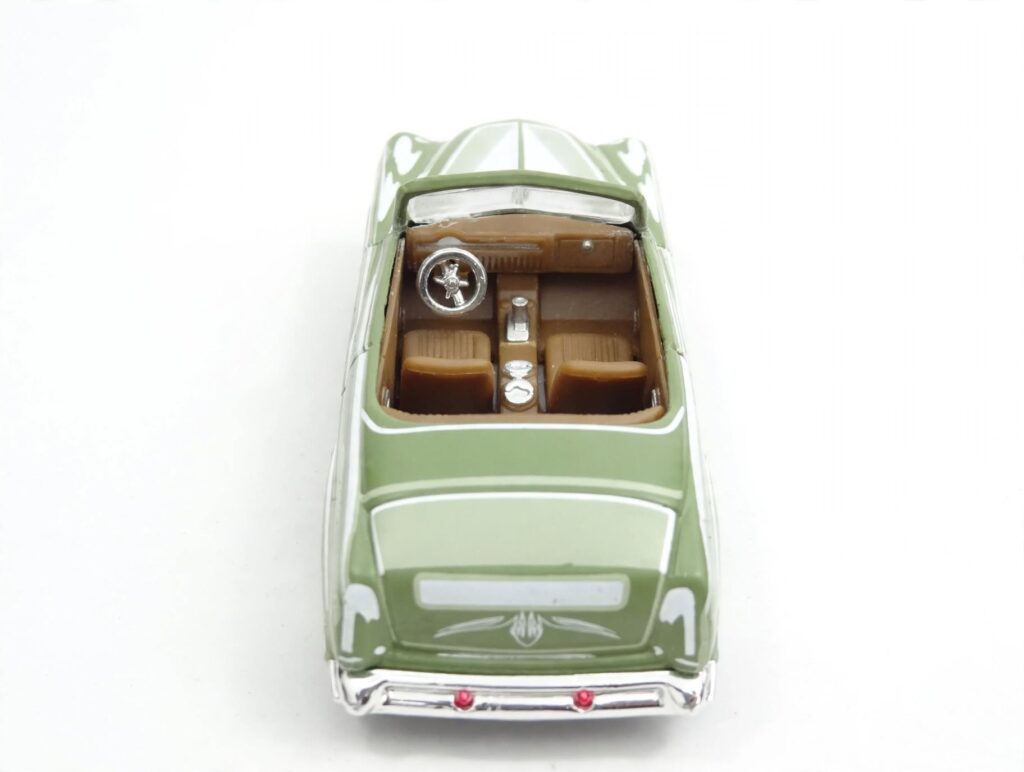
The interior you can actually see
The top is down, and the cabin is tan plastic with visible seats, a dashboard and a steering wheel.
That contrast between a pale green body and a tan interior is period-correct and it is also the sort of combination no manufacturer would approve now. Modern interiors are black, grey or black.
Open cars give a casting somewhere for the eye to rest, and on a body this smooth that matters. There is very little surface detail elsewhere, because the whole aesthetic is about removing detail.
That creates an odd problem for a manufacturer. A custom car is defined by what is absent, and absence is hard to sell on a peg. It is probably why most custom castings get loud paint instead: the body alone does not shout, so the colour has to. Maisto resisted that here, and the car is better for it.
Where Maisto sits on classic subjects
Consistent with what I have found elsewhere in their range: good subject selection, careful bodywork, ordinary accessories.
The strength here is that they built the custom rather than the stock car. A factory 1949 Mercury would be a historically accurate and far less interesting object, and Maisto chose the version that people actually care about.
The chrome is properly finished rather than painted, which on a car with this much brightwork is the difference between convincing and cheap.
Buying a loose lead sled
The chrome first. Front and rear bumpers, the grille teeth, the side trim, all separate bright parts on a car that sits low. They scrape and they bend.
Then the windscreen frame, which on a chopped car is thin and low and completely exposed with the top down.
Then the whitewalls. White tyre faces pick up dirt and scuffing more than any other finish, and a grey whitewall ruins the period look.
Pale green hides fine scratching reasonably and shows chips clearly. Check the wing edges and the lower body where it sits close to the surface.
My honest take
A casting of the modified version rather than the factory car, which is the right choice, with a correct chop, frenched lights and a period colour.
It is also a useful object to own if you want to understand custom vocabulary, because every term is visible on it at once. For the price of a coffee you get a working glossary.