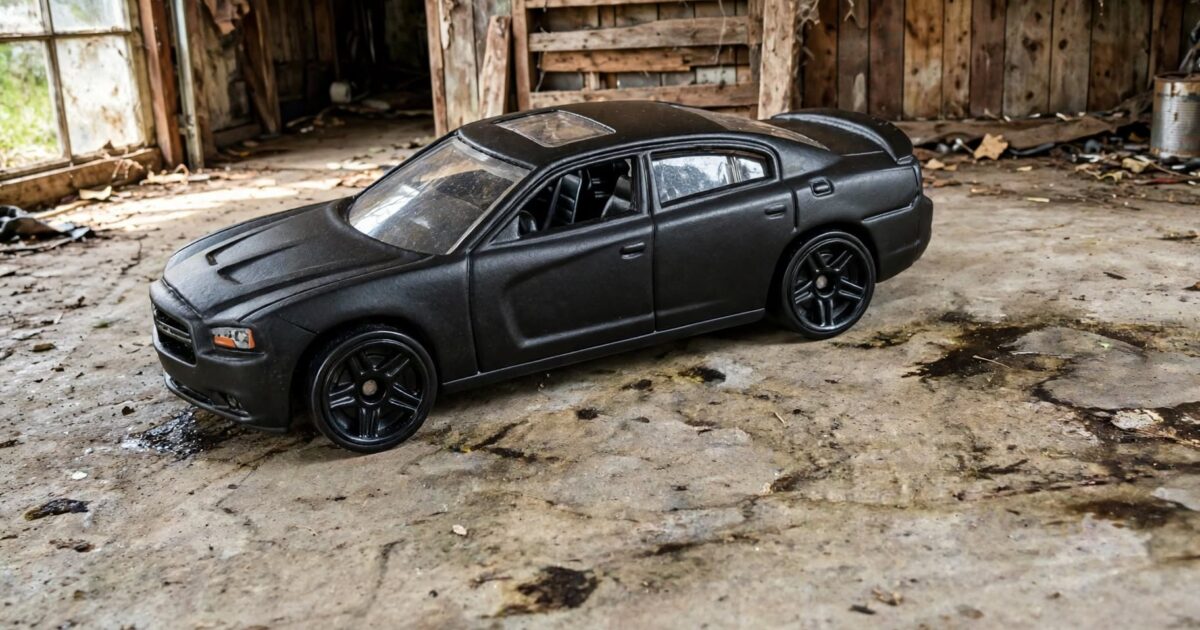
Matte black, no graphics, black wheels, black glass. A modern four door Charger that looks like it is trying not to be noticed, which is funny given that it comes from the loudest licence in the diecast business.
This is the Hot Wheels Fast & Furious Dodge Charger, the matte black one from the vault heist in Fast Five, and the film connection explains almost everything about it.
The Charger name on four doors
Purists never forgave Dodge for this. The Charger was a two door coupe for its entire classic run, and reviving the name on a four door sedan in the mid 2000s was treated as heresy by people who grew up with the 1969 car.
Time has softened that. The modern Charger has been around long enough now to have its own identity, helped by the fact that it kept rear wheel drive and large engines when almost every other American sedan gave up on both.
The 2011 facelift is the one that fixed the styling. It brought back the scalloped body side, a reference to the original car, and sharpened the front end. Before that, the modern Charger looked generic. After it, it looked like a Charger again.
What the casting gets right
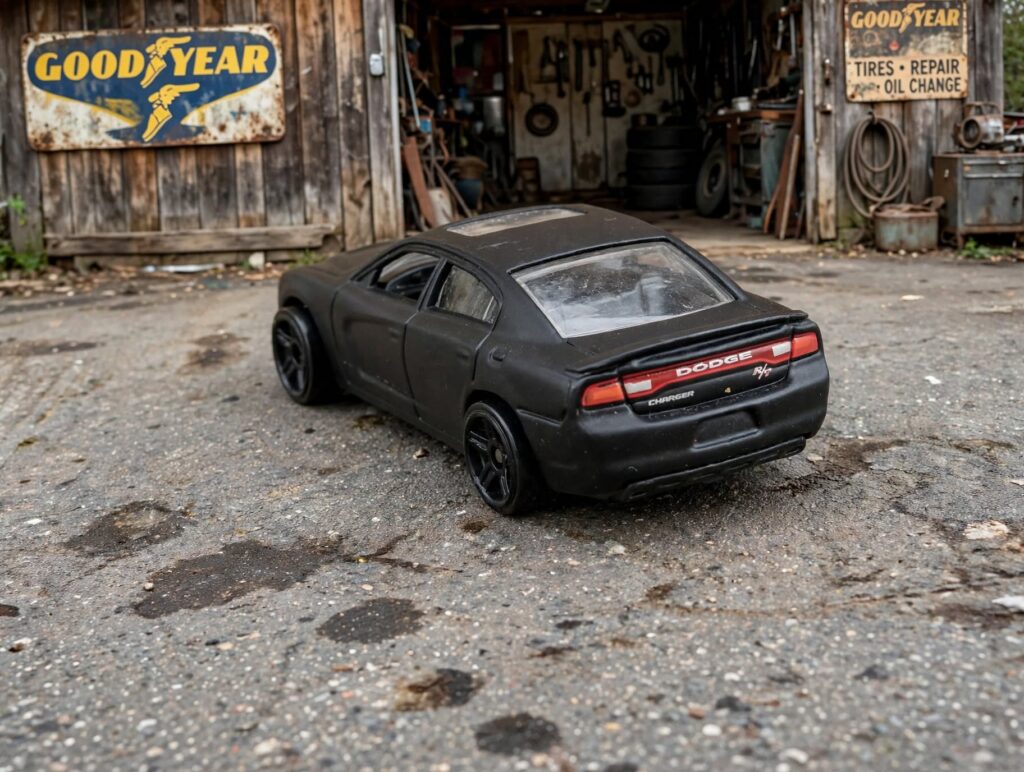
The scallop is there, moulded into the doors and rear quarter as a shallow recess. That is the detail that connects this car to its ancestors and the one a lazy casting would have flattened.
The front carries a crosshair grille blacked out against the body, with the headlight units moulded above it. The rear has a small integrated spoiler on the boot lid.
Proportionally it reads correctly: long, wide and slightly heavy, which is what the real car is.
Matte paint and how it behaves
This finish is unusual in this scale and it is worth knowing how it differs.
Matte shows fingerprints where gloss shows scratches. Handle a matte car with slightly oily hands and you get marks that sit on the surface and are difficult to remove without affecting the finish.
It also cannot be polished. A scuff on gloss paint can sometimes be improved. A scuff on matte leaves a shiny patch, which is worse than the original damage and permanent.
Against that, matte photographs beautifully. It gives you the shape without reflections competing, which is exactly the opposite problem from the gloss black cars I have complained about elsewhere.
The Fast Five vault heist car
In Fast Five the crew steals four police Chargers in Rio so they can move around without being recognised, then turns two of them into the matte black cars used to drag a bank vault through the streets. Dom drives one of them.
There is a well known inconsistency behind that. The cars are introduced as 2011 police Chargers and the matte black heist cars are actually 2010 Charger SRT-8s, so the film quietly swaps one model for another between scenes.
For a collector that matters because sellers describe this casting by whichever year suits them. Judge it by the body rather than by the listing, and expect to see it called both a 2010 and a 2011 depending on who is writing.
The upside is that the cars are usually well chosen and the deco is restrained, because the reference is a specific vehicle rather than a designer’s invention.
The downside is demand. Film tie-ins attract buyers who are not diecast collectors at all and who want one specific car, which clears pegs fast and pushes secondary prices above what the casting alone would justify.
Buy it because you like the car. If you are paying a premium for the licence rather than the model, you are buying someone else’s nostalgia.
Matte, satin and gloss in one collection
Mixing finishes on a shelf is harder than mixing colours, and most people discover this by accident.
Gloss cars reflect their surroundings, so a row of them picks up the same highlights and reads as a group. Drop a matte car into the middle and it absorbs where the others reflect, which makes it look like a hole in the line rather than a car.
The fix is to give matte cars either their own group or an end position, where the contrast reads as deliberate.
The same logic applies to photography. Matte and gloss want different lighting, so shooting them together means compromising on one. If you post pictures, shoot matte cars separately.
Which Fast & Furious cars should you collect?
The line is large enough that buying everything is a poor plan, so it helps to decide what you are collecting for.
The Chargers are the obvious starting point, because the model runs through the franchise from the earliest films to the recent ones. Collected together they show the car evolving from a sixties coupe to a modern sedan while keeping the same role.
After that, the Japanese cars from the early films are the ones people chase hardest, which makes them the hardest to find at retail and the most overpriced secondhand.
The ordinary vehicles are the sleeper pick. Every film has cars that nobody remembers, they get made anyway, and they sit on pegs at normal prices.
My advice is to buy the Chargers and ignore the rest unless a specific car means something to you. A shelf of one model across a franchise says more than a random assortment of screen cars.
Buying a loose matte Charger
Handle it as little as possible and inspect it under good light before touching it.
Look for shiny patches on the flat panels. On matte paint those are damage, not highlights, and they are the single most common flaw.
Then the front lower valance, which sits low on a long car and scrapes. Then the boot spoiler, which is moulded but still proud enough to take a knock.
Ask sellers for a photo taken with soft light. Matte hides very little under diffuse light, which makes it one of the easier finishes to assess remotely once you know what to ask for.
Modern sedans on a shelf
I made the case in the Lincoln review that collections lack four door cars, and this is the modern counterpart to that argument.
A shelf with a sixties luxury sedan and a modern performance sedan on it tells you something about how the four door car survived: by becoming either very comfortable or very fast, because ordinary was taken over by other body styles.
Both are cheap, both are ignored, and together they are more interesting than either alone.
Final call
A correctly proportioned casting of the facelift that made the modern Charger work, in a matte finish that photographs well and damages permanently. Worth owning for the body style alone. Do not overpay for the licence, and keep your fingers off the paint.