Purists hated this car before it existed. A Lamborghini with five doors and a boot, built for people who wanted a supercar badge on the school run.
Then it outsold everything else the company made, and the argument ended. Here is the casting, and why it belongs on a shelf even if the real car annoys you.
Why Lamborghini built an SUV at all
The same reason Porsche did, and the answer is volume.
Supercars sell in small numbers to a small audience, and that is a fragile business. Lamborghini spent decades close to collapse for exactly that reason, and the Gallardo was the first car that fixed it by selling in quantity.
The Urus did the same thing again, harder. An SUV reaches buyers who were never going to own a two-seat wedge, and the money it generates funds the cars the purists actually want.
So the car they resent is the one paying for the ones they love.
The same pattern played out at Porsche a decade earlier and the objections were identical. Those objections ended the moment the money arrived, which tells you something about how much of car enthusiasm is taste and how much is affordability.
The shape fights itself, and that is the point
An Urus is trying to be two incompatible things: tall enough to be an SUV and low enough to read as a Lamborghini.
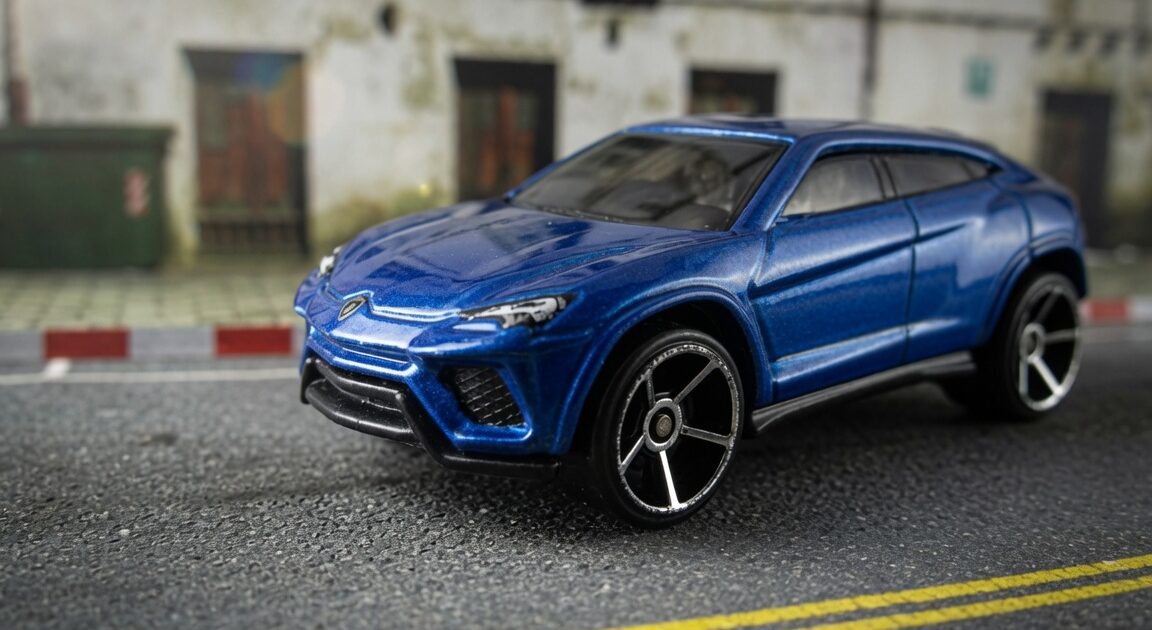
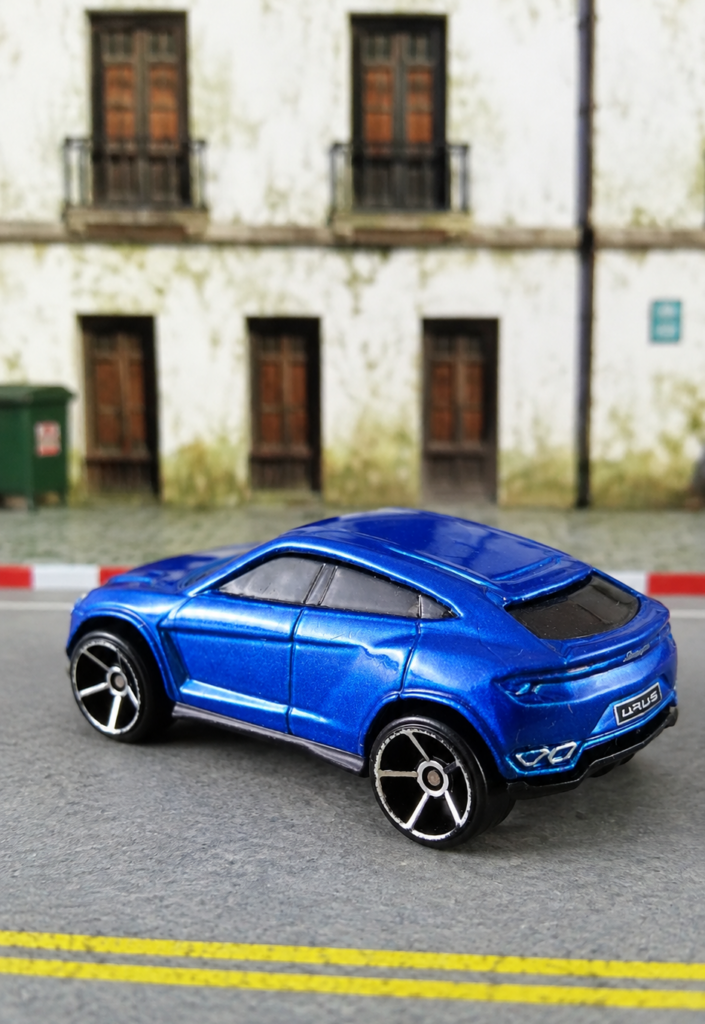
The resolution is the roofline, which drops steeply toward the tail like a coupe while the body underneath stays SUV-height. That creates the heavy rear shoulder you can see on the casting, where the glass narrows and the metal around it swells.
Below the beltline it is pure Lamborghini. Hard angular creases, a hexagonal theme repeated in the vents and the exhaust outlets, and almost no curved surface anywhere.
What the casting gets right
The angular language survives scaling, which is the main thing. Hard edges read at 7 cm and soft surfacing does not, so a car built from creases is a good candidate for 1:64.
The front is the strongest part. There is a deep black lower bumper section with the Y-shaped intakes moulded in as actual recesses, and a mesh insert that catches shadow. On a lesser casting that whole area would be printed flat.
At the rear, the hexagonal exhaust outlets are picked out in silver and the URUS lettering sits on the diffuser where it belongs. The Lamborghini script on the tailgate is small and legible.
The wheels are large five-spokes with a white outer edge, which suits a car that in reality runs enormous rims.
Where the casting gives ground is the glazing. The windows are dark enough that the interior is essentially invisible, which on a tall vehicle with a lot of glass area throws away a surface you could have been looking into. Clear or lightly tinted glass would have shown a cabin and made the greenhouse read as glass rather than as a dark shape.
Blue metallic and no graphics at all
No stripes, no flames, no sponsor decals. A solid blue metallic with a strong flake, and the only printing is badging.
That restraint is correct. The body already has an enormous amount of moulded detail competing for attention, and adding graphics would bury it.
Blue is also a smart colour choice for this casting. The flake catches the hard creases and shows where the surfaces change direction, which is exactly what you want on a shape built from planes. A flat colour would have collapsed it into a silhouette.
The exposed lower bumper
This is the thing to check before buying loose, and it is specific to this casting.
That deep black front section sits below the body line and projects forward, which makes it the first point of contact in any impact and the part that drags on any surface.
Look at it straight on for scraping, and from underneath for cracks where it meets the base. A damaged lower bumper changes the whole face of the car, because it is the deepest shadow at the front and the thing that makes the nose read correctly.
The rear diffuser has the same exposure at the other end, though it takes fewer knocks.
Super SUVs as a collecting category
Barely anybody collects these, which is the usual combination of cheap and interesting.
The category exists properly now: every performance manufacturer has one, they all solve the same problem of marrying height to a sporting identity, and they all do it differently. Collected together they make an argument about what happened to the car industry in the last fifteen years.
It is also a category that is easy to find. Unlike the sports cars these companies make, SUV castings sit on pegs because collectors skip them.
That will not hold forever. Categories nobody collects tend to stay cheap until the decade they belong to becomes nostalgic, and then they do not. Buying the unfashionable thing while it is unfashionable is the only reliable advantage available in this hobby.
Where it goes on the shelf
Not with the supercars, which is the instinct and the wrong one. Next to a Gallardo or an Aventador the Urus just looks like the odd one out.
Put it with other modern SUVs and it reads as the most extreme member of a group, which is what it is. It also works in a street diorama for the same reason a sedan does: scenes need vehicles that look like somebody drives them daily.
Our Lamborghini guide covers how the brand got from wedges to this.
Would I recommend it?
Yes, and more readily than I expected to. Proper moulded intakes, a colour that shows off the creases, and badging done cleanly with no graphics cluttering it.
The car itself is the one that made the rest of the range viable, which is a better story than most supercars carry. Check the lower bumper before you pay, because that is where this casting gets hurt.