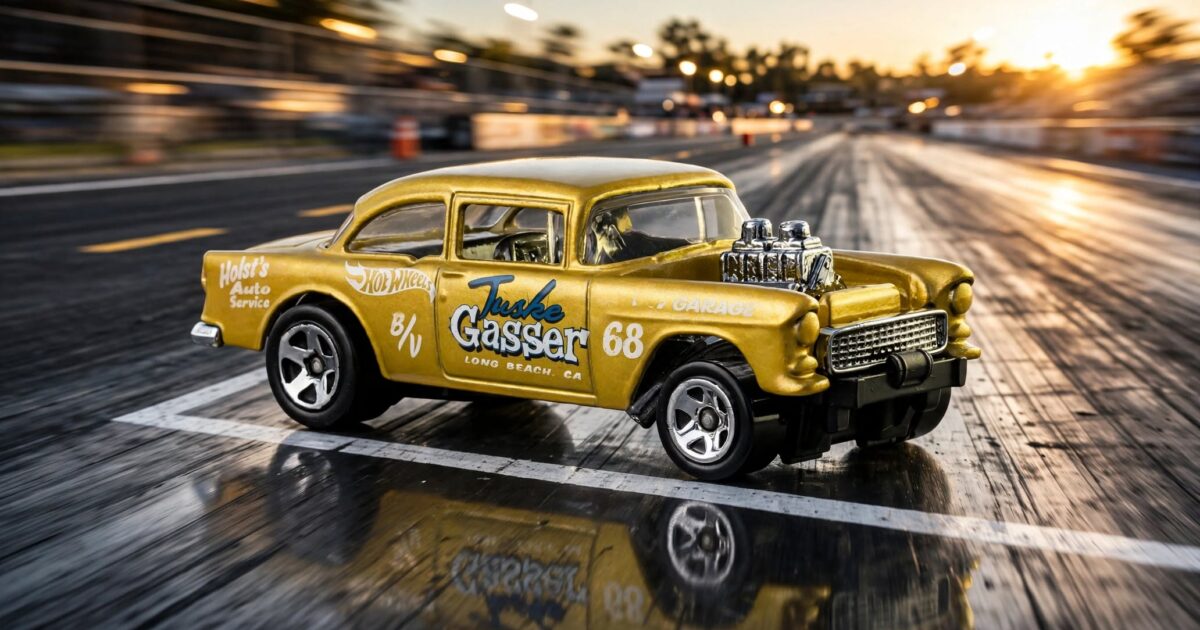
Ask a room full of collectors to name the best Hot Wheels casting of the last fifteen years and this one comes up every time. Subject, tooling and stance all line up, which almost never happens at this price. Mine is the gold car with the Gasser lettering on the door and it is one of the few I will not trade.
What is a gasser, and why is the nose up in the air?
Worth knowing, because the styling only makes sense once you do. Gassers were drag cars from the fifties and sixties running under rules that required a straight front axle and pump fuel. Raising the front end shifted weight onto the rear tyres under acceleration and gave the suspension room to work, so racers jacked their cars up at the nose.
The stance was an engineering consequence first. It became a look afterwards, which is how most good looks happen.
Mattel reproduced it faithfully. The front sits noticeably higher than the rear, the front wheels are narrow, the rear tyres are enormous. Sitting still on a shelf the car looks like it is straining against the brakes.
The exposed blown engine
This is the headline feature and it is genuinely well done. A blown small block stands straight up through a hole in the hood, supercharger and a pair of chromed intake stacks included, as a separate chrome piece with real depth. You can see it from every angle.
Very few mainline castings get engine detail in three dimensions. Most of them get a black rectangle and a raised lip, like the Cuda I reviewed a while back. This one got the real thing.
How good is the 1955 Chevy body underneath?
Better than it needs to be. The Bel Air side spear is there, along with the hooded headlights, the eggcrate grille and the pointed rear fenders. The proportions stay close enough to the real car that it reads as accurate even though the ride height is nothing like stock.
The rear tyres deserve a note. Wide, deep, no tread, plenty of sidewall, and they fill the arches completely. On mine they are the usual black plastic with a rubber look instead of real rubber, which is the line between mainline and premium.
The gold paint and the Gasser door lettering
The gold has a heavy flake and it changes with the light. Warm light pushes it toward bronze, daylight brings it up bright. If you photograph your collection that variability is a gift, because you can shoot the same car twice and get two different moods.
The lettering is period drag racing: a hand painted style script on the door, a race number behind it, a town and state underneath, a service company name on the rear quarter and a class designation near the rear wheel. Exactly the sort of thing someone would have brushed on at a strip in 1965. No modern sponsor logos anywhere, which is the part I appreciate most.
Mainline or premium? How to tell from a photo
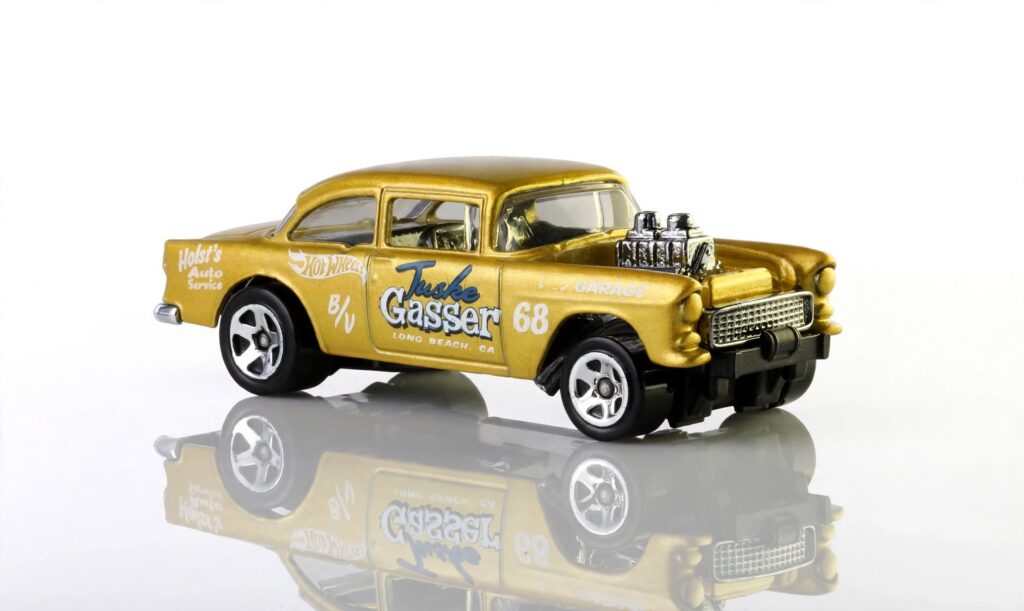
This casting exists at several quality levels because it has been released so many times, and knowing which one you are looking at changes what you should pay.
Mainline releases use a plastic base and plastic wheels with a rubber look finish. Premium releases usually add a metal base, real rubber tyres and fancier wheels, and they cost real money on the secondary market.
Fastest test from a listing photo: look at the tyre sidewall. Real rubber has visible depth and a slightly matte, uneven surface. Plastic looks uniform and glossy. If there is no photo of the base, ask for one, because that settles it in a second.
Buying a loose gasser
Start with the engine. It is the highest point on the car and a separate piece, so it takes every impact. Look from the front and confirm the stacks are straight and all present.
Then the stance. Damage to the front suspension moulding shows up as a car that no longer sits nose high. Put it on a flat surface, crouch, and look from the side. If the rake is gone, something underneath is bent.
Then the usual. Door lettering for tampo wear, the big flat hood and roof for scratches, the front bumper for chips. Gold metallic hides fine scratches well, so use a strong light instead of trusting a phone photo.
Why this casting gets hoarded
Worth understanding before you start, because it will happen to you. Mattel has released this body in an enormous number of colours and liveries, and each one looks different enough that owning several feels reasonable in the moment.
Then you have eleven gassers and one of everything else.
The habit that saved my shelf was deciding in advance what the casting is for. Mine is there to represent drag racing, and one car does that. A second one would say nothing the first does not already say.
If you do want a run of them, at least make the run mean something. All one colour family, or all one era of livery, or one from each year. A random pile of gassers in different colours is just what happens when nobody decides anything.
Verdict
The rare mainline car that would still be excellent at three times the money. Right stance, a properly detailed blower, and vintage drag lettering that shows somebody did research. In gold it is one of the best looking things you can put on a shelf for pocket change.
Buy one. Then try very hard not to buy nine, because this casting has swallowed entire collections.