Ask somebody to name muscle car brands and you will get Chevrolet, Ford, Dodge, Plymouth and Pontiac. Mercury almost never comes up, and that is a gap in most people’s knowledge rather than a gap in the history.
Mercury and where it sat
Mercury was Ford’s middle division, positioned above Ford and below Lincoln. The job was to sell slightly more upmarket versions of Ford products to buyers who wanted something a step up without going all the way.
During the muscle era that produced an odd situation. Mercury had access to the same engines and platforms as Ford, so the performance was there, but the marketing was aimed at a more conservative buyer.
The Cyclone was the result: a genuine muscle car wearing a badge that nobody associated with speed. It competed in NASCAR and it won, and it is still the car most people have never heard of.
The fastback shape
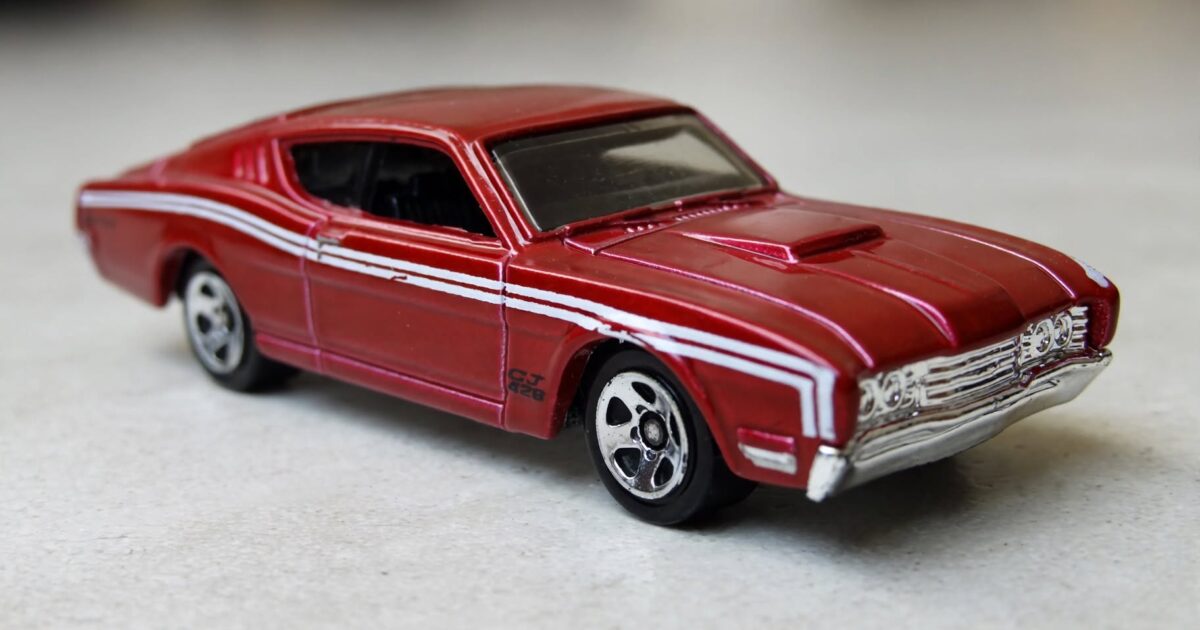
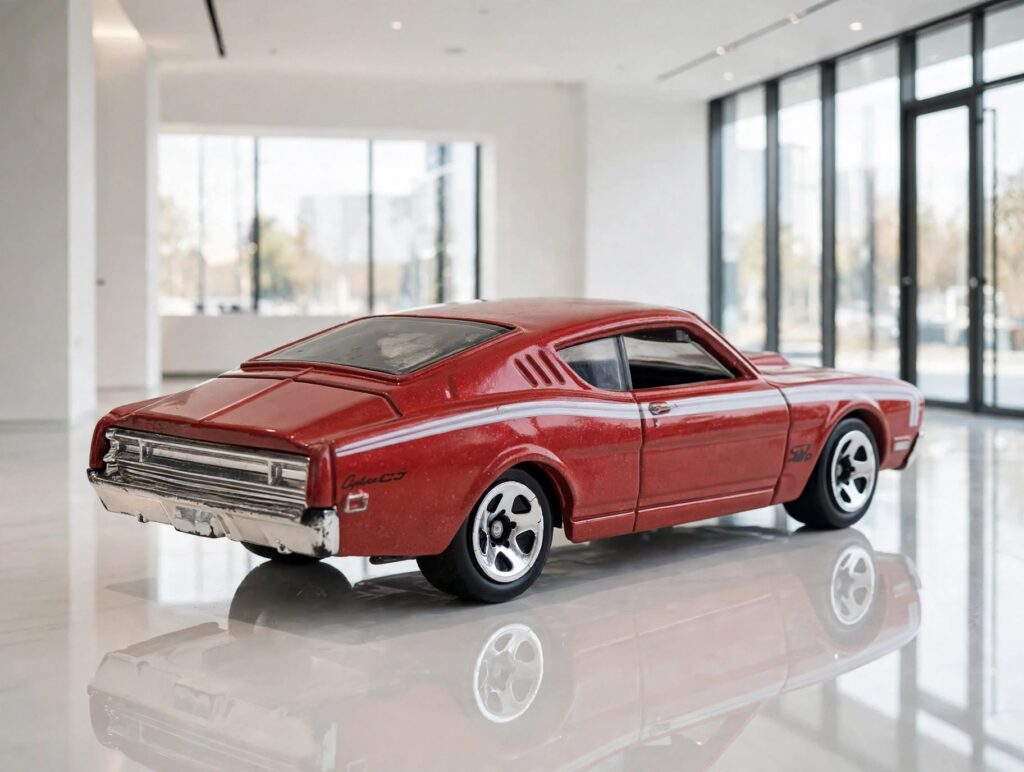
The body is a long fastback with the roofline running in an almost unbroken line from the windscreen to the tail.
That shape existed for aerodynamic reasons as much as styling ones. Manufacturers racing on the big ovals discovered that a sloping rear worked better than a formal roof, and the road cars followed because the rules required it.
On the casting the roofline is the strongest feature. It reads correctly from a three quarter view, which is where fastbacks either work or collapse, and the rear quarter panels flow into the tail without the flat spot that cheaper castings develop.
Teal with yellow and green flames
The colour is a deep teal, and the flames are a yellow to green gradient with black outlines running from the front wheel arch back along the lower body and across the bonnet.
The gradient is the interesting part. Most flame decos at this price use flat colour, and a graduated fill needs more printing passes. Here the licks shift from yellow at the leading edge toward green as they taper, which is how a hand painted flame job would be laid out.
The black outline does the same job it does on every good flame deco: it keeps each lick legible against a body colour that would otherwise swallow it.
The bonnet carries a scoop moulded into the panel, and the wheels are black with green outer rings picking up the flame colour.
Collecting the forgotten divisions
Mercury belongs to a group of badges that no longer exist: Oldsmobile, Pontiac, Plymouth and several others that got absorbed or shut down as manufacturers consolidated.
Those brands made genuinely good cars and almost nobody collects them, which is the familiar combination. Castings sit on shelves, prices stay low, and the resulting display looks nothing like everybody else’s.
A shelf of dead divisions is one of the more interesting themes available and one of the cheapest to assemble. Start with a Cyclone and a Cougar and you already have half of Mercury’s performance output.
Graduated flames and why they are rare
Most flame decos in this scale use flat colour because each additional colour costs a printing pass, and mainline castings are built to a tight budget.
A graduated fill needs the colours laid over each other with enough precision that the transition looks continuous. Get the registration slightly wrong and you see a hard edge where the gradient should be.
When you find a casting with graduated flames, look closely at where the yellow meets the green. If the transition is smooth across every lick, somebody set the tooling up carefully. If some licks shift cleanly and others jump, the registration drifted during the run.
Buying a loose Cyclone
The flames cross the bonnet crown, which is the highest point of a long nose and the place handling wear concentrates. Check there first.
Then the bonnet scoop, which is raised and takes knocks.
Then the chrome front bumper, a separate piece at the end of a long overhang.
Teal metallic hides fine scratches well and shows chips as dark marks. Inspect the wing edges, the roof rail and the boot lip rather than the flat panels. Roll it for a bent axle, which shows clearly on a car this long.
Aero fastbacks of the late sixties
The Cyclone belongs to a specific moment when American manufacturers were shaping road cars around racing regulations.
The same thinking produced the Torino Talladega at Ford, the Charger Daytona and the Superbird at Chrysler, and this car at Mercury. All of them exist because a rulebook required road versions of the racing bodywork.
Collected together they make a coherent group that explains itself. Four cars, one regulation, four different interpretations of the same aerodynamic problem.
So is it worth having?
Yes, and particularly if your muscle shelf is all Chevrolet and Mopar. A graduated flame job, a properly resolved fastback roofline and a badge that gives you something to explain. Cheap because nobody is looking for it. Check the bonnet before you pay.