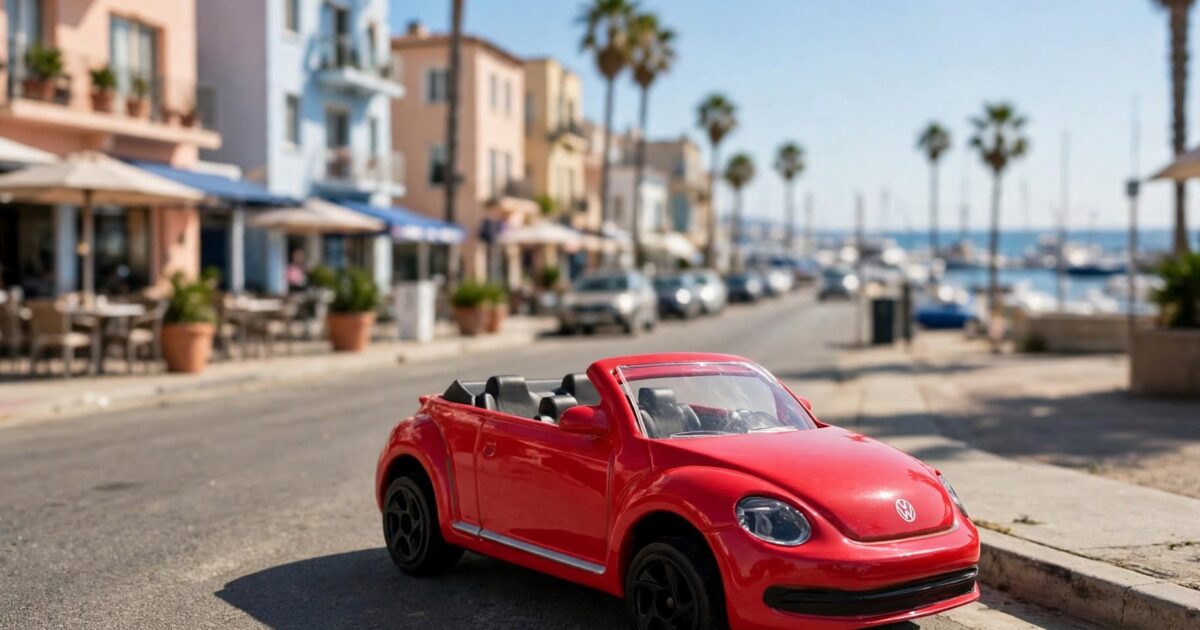
Careful with this one when you are searching. There are two Beetle convertibles in most collections and they are completely different cars: the classic air cooled Karmann cabriolet, and this, the modern front engined one built decades later.
Same name, same silhouette family, nothing else in common.
The modern Beetle and what it was trying to do
Volkswagen revived the Beetle name on a car that shared nothing mechanical with the original. Front engine, front wheel drive, built on the same underpinnings as the Golf of its era.
What it borrowed was the outline. A domed roof, round headlights, arched wings and a nose that curves down instead of ending in a face.
Later generations toned the roundness down and made the car look lower and more aggressive, which is the version here. You can see it in the proportions: the roof is flatter than on the first revival and the body sides are more upright.
What Majorette does well
Majorette is a French brand with a long history, and their approach is closer to realism than to fantasy.
The ride height on this casting is correct. No lowering, no rake, no oversized wheels. It sits the way the real car sits, which sounds like a small thing and completely changes how a model reads.
The VW roundel is printed on the bonnet, cleanly and at the right size. Licensed detail like that is the fastest way to judge whether a manufacturer had access to the real car or was working from photographs.
Along the sills there is a fine chrome strip, and the door mirrors are moulded separately rather than being lumps on the body.
Open top, visible interior
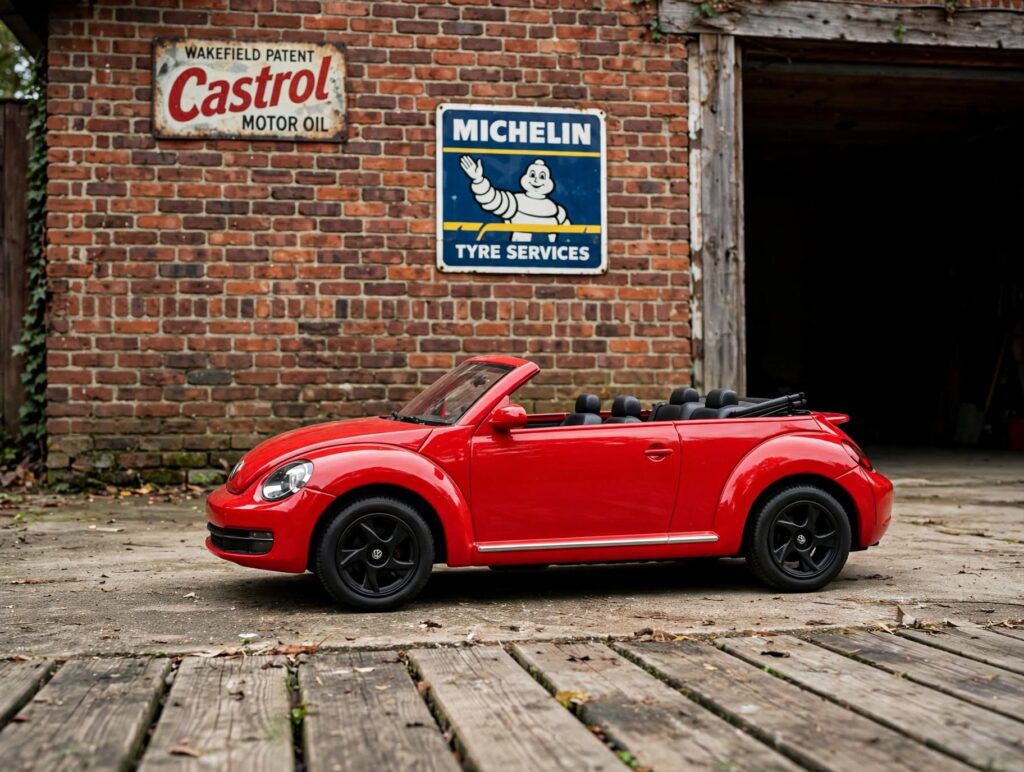
The roof is down and stowed behind the rear seats, leaving the cabin open. Inside you can see seats, a dashboard shape and a centre console in dark grey.
On a small car the interior occupies a large proportion of what you see, so getting it wrong is costly. Here it is simple but correct, with no obvious omissions.
What it does not have is the thick folded top roll that the classic cabriolet shows off. Modern convertible mechanisms pack away much more tidily, so the rear deck stays flat. That is accurate, and it is one more way to tell the two Beetles apart in a photo.
Where Majorette fits in the market
Between the supermarket mainlines and the premium brands, closer to Welly and Bburago than to Greenlight.
The strength is subject selection. Majorette covers European everyday cars that the American brands ignore entirely, which is exactly the gap most collections have. Our guide to Majorette diecast worth collecting goes into the range.
The weakness is the same as every brand in this bracket: plastic tyres and wheels that are competent rather than considered. Here the black wheels suit the red body well enough, which is better luck than most.
Retro revivals and how they age
The modern Beetle belongs to a wave of cars built on nostalgia, alongside the revived Mini, the Fiat 500 and the PT Cruiser.
They share a problem. A car designed to evoke another car has a fixed reference point, so its success depends entirely on how well it flatters the original rather than on being good in itself.
Some managed it. The Mini kept enough of the proportions to work. This Beetle is more debated, because the original’s shape came from having the engine in the back, and putting it in the front changes the weight distribution of the whole silhouette.
For a collector the interesting part is that both cars exist in 1:64 for pocket money, so you can hold the argument in your hands instead of reading about it.
Buying a loose modern Beetle
The open cabin comes first. Look straight down into it under good light for dust and scratching, because there is no glass protecting any of it.
Then the VW roundel on the bonnet. Small printed badges sit at the front where fingers land and they wear early. A Beetle without a clean badge looks unlicensed.
Then the sill chrome, which is a thin strip at the lowest point of the body and gets rubbed.
Red shows chips clearly against bare metal, so check the arch edges and the nose rather than the flat panels. And roll it for a bent axle.
Two Beetles, two eras
If you own both the classic and the modern, display them together. The comparison is one of the clearest design lessons available in 1:64.
The original was shaped by engineering constraints: rear engine, air cooling, cheap manufacturing. The modern one was shaped by wanting to look like the original while being mechanically ordinary underneath.
One is a solution. The other is a reference to a solution. Side by side, you can see the difference in how the surfaces resolve, and it costs almost nothing to demonstrate. Our piece on the Beetle covers the real cars.
Bottom line
An accurate, sensibly proportioned casting of the modern Beetle convertible, with clean licensed detail and a correct ride height. Ordinary wheels, as usual at this price. Worth owning mainly as the counterpart to the classic car, where the pair says more than either does alone.