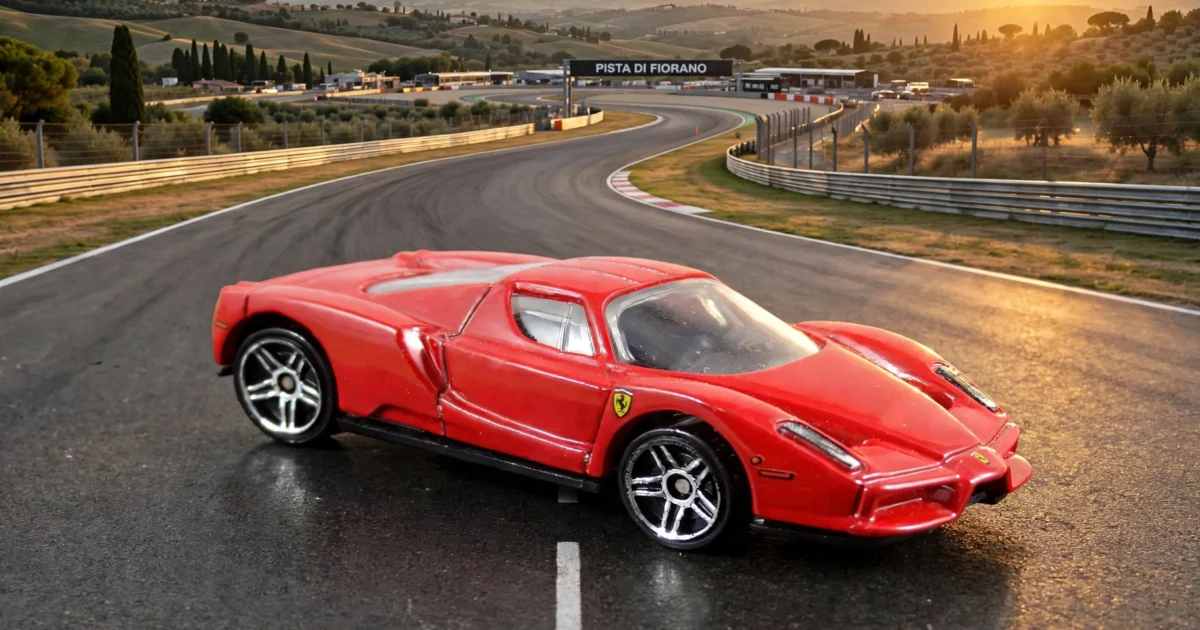
There is a whole category of Hot Wheels castings that new collectors cannot buy new at any price, and Ferraris are the biggest example. Mattel held the licence for years, made some excellent cars with it, and then the licence went elsewhere. Everything on the secondhand market is what is left.
My Enzo is a 2003 First Editions car, which puts it near the start of that run.
Why the Enzo is difficult to model
The real car is aggressively strange. A pointed Formula 1 style nose, a cab-forward greenhouse, huge scalloped sides feeding air to the rear, and a tail that just stops. It was designed around aerodynamics with very little interest in looking conventionally pretty.
Shrinking that is harder than shrinking a muscle car. A Charger is basically a long box and forgives simplification. The Enzo is all transitions, and if you soften them the car stops being an Enzo and becomes a generic red wedge.
This casting holds most of them. The nose comes to an actual point, the side scallop behind the door is a real recess with depth, and the cabin sits far enough forward to read correctly from a three quarter view.
First Editions and what that meant
First Editions was the line where Mattel put its new castings for the year, so a car appearing there is the debut of that tool. That makes First Editions releases interesting to collectors who care about a casting’s history instead of just its colour.
It also means the tooling on an early car is the original, before any of the cost reductions that tend to arrive in later years. On popular castings Mattel often cast the hood shut, swaps a metal base for plastic, or softens panel lines to save money. An early example gives you the tool as designed.
Casting detail and the wheels
The Ferrari shield is printed on the front fender in yellow, small and clean, which is the sort of thing that goes wrong easily at this size. The side intakes ahead of the rear wheels are picked out in dark mesh, and there are matching vents on the rear deck over the engine.
The wheels are a fine multi spoke chrome design that suits the car. Ferrari castings tend to get more considered wheel choices than the average mainline release, probably because a licensed supercar with the wrong wheels looks obviously wrong.
My example has a visible mark on the door line and some wear along the sharp edges of the nose, which is what happens to a car that is over twenty years old and was never kept in a case.
Why you cannot buy new Hot Wheels Ferraris
This is the part that surprises people who are new to collecting. Licensing in diecast is not permanent. A manufacturer negotiates the right to reproduce a car brand, and when that agreement ends, production stops and the castings are retired.
Ferrari left the Hot Wheels line for exactly this reason, so every Hot Wheels Ferrari you see is secondhand stock from the years Mattel held the rights. That is why prices on some of them behave differently from the rest of the mainline range.
It also creates a specific risk. Cars that cannot be reissued attract fakes and repaints more than cars you can buy for a dollar at any supermarket.
Collecting Hot Wheels Ferraris now
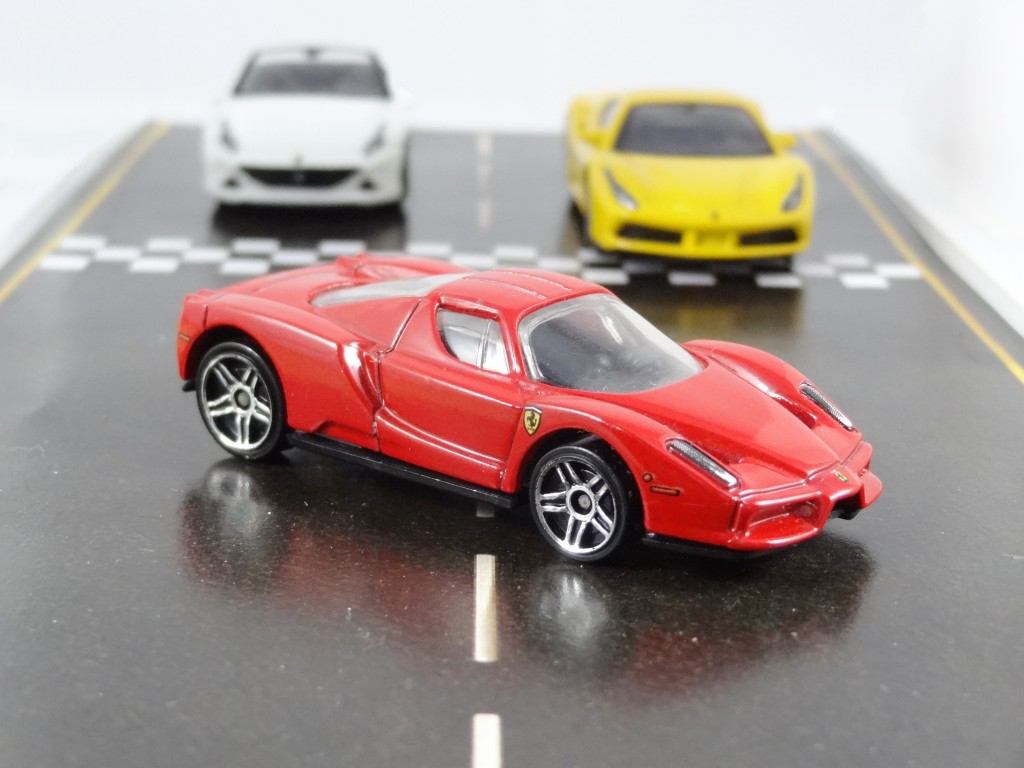
If this one gets you interested, the rest of the range is a finite pool. Mattel produced Ferraris across mainline releases, multi packs and premium lines during the years it held the licence, so there is plenty out there and no more coming.
My suggestion is to pick a theme instead of buying everything red you see. All road cars, or all racing versions, or one car per decade of Ferrari history. A themed group of five looks considered. Twenty unrelated Ferraris look like a bin.
Prices vary enormously and mostly track how many were made, so common mainline cars stay cheap while premium and chase versions do not. Check completed sales before agreeing to anything.
How to spot a repainted Hot Wheels Ferrari
Start with the nose. It is the furthest forward point, it is sharp, and it takes every impact. Chips and flattening there are extremely common on loose examples.
Then the Ferrari shield on the fender. Small tampo wears fast, and a car missing its shield loses the detail that makes it obviously licensed.
Then look hard at the paint quality. Original Hot Wheels red is even and slightly deep. A repaint often looks flat, or shows a thicker edge where the paint meets the base. If a seller is asking above normal money, ask for a photo of the base and one straight down onto the roof.
Roll it for a bent axle and check the side scallop for cracking, since it is the thinnest section of the body.
Is it worth collecting?
For a supercar shelf, yes. It is a well handled casting of a car that resists being simplified, and it carries a bit of hobby history because of the licensing situation.
I would not buy it expecting an investment. Retired licences make cars harder to find, and harder to find is not the same as valuable. Plenty of Hot Wheels Ferraris still sell for very little because Mattel made a lot of them.
The short version
A sharp casting of a difficult shape, from the year the tool debuted, in a line you cannot buy new anymore. Check the nose and the fender shield before paying, be careful about repaints, and enjoy it as an object instead of as an asset.