Most models I own are a shape with some decoration on it. This one is the opposite. Strip the markings off this Defender and you have a green utility vehicle that nobody would look at twice. Leave them on and you have a specific vehicle, doing a specific job, in a specific country, at a specific moment in time.
Service vehicles work differently from everything else on a collector’s shelf, and this Welly Land Rover Defender 90 is a good example of why.
What the Guardia Civil livery puts on this Defender
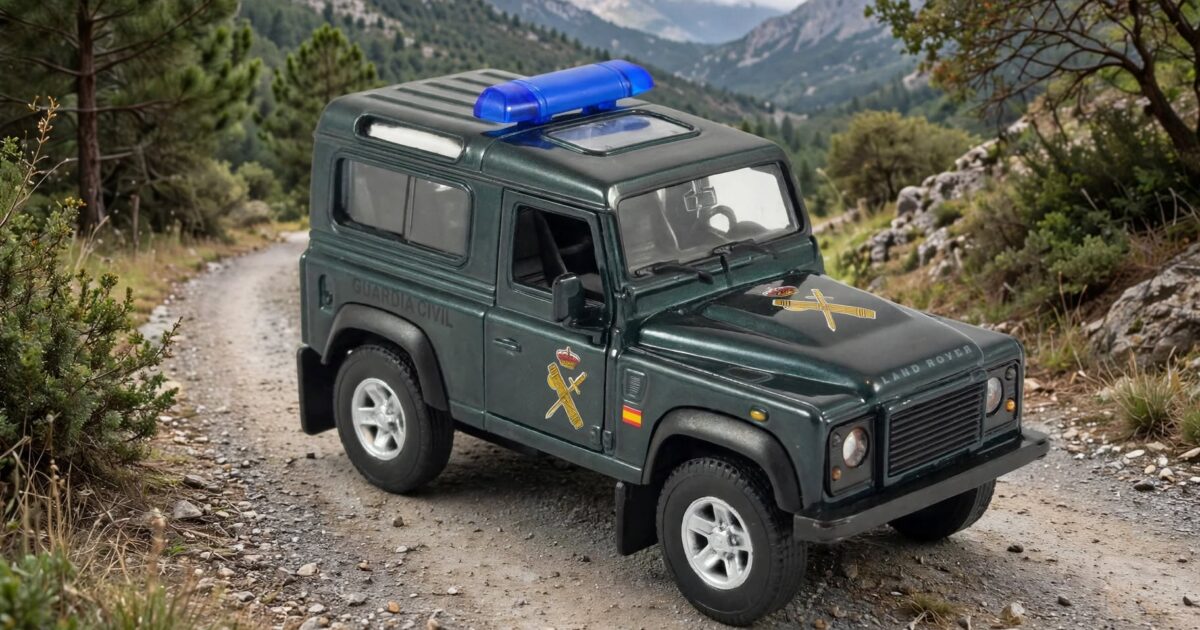
The body is a dark metallic green, close to the shade the force actually uses. On each front door there is a crest with a crown above crossed sword and fasces, printed in gold, and the same emblem appears again on the hood. Along the lower body, behind the door, the words Guardia Civil run in dark lettering that only shows up when the light hits it.
A small Spanish flag sits on the front wing ahead of the door. On the roof there is a translucent blue light bar, and an antenna rises from the cowl beside the windscreen.
Why service vehicles are a category of their own
Here is what separates them. A sports car in a collection represents a model. A police vehicle represents an institution, a uniform, a set of rules about what color that force paints its cars and where the crest goes on the door.
That makes them date stamps. Forces change liveries, replace fleets and retire vehicles, so a model like this records a combination that existed for a limited window and then stopped existing. Collectors who chase service vehicles are really collecting that window of time, not the Land Rover underneath it.
It also makes them easy to get wrong. Put the crest in the wrong place and people who see these vehicles every week will notice immediately.
Scale and size: this is a 1:32 model
Say it up front, because it matters a lot here. This is not a 1:64 car. At 1:32 it is roughly twice the length of a mainline casting and it will not share a shelf or a diorama with them without looking enormous.
What the extra size buys is detail that simply cannot exist at smaller scales. The door handles are separate pieces. The windscreen has wipers. The roof has gutters and vents cast into it.
The wheels are a fair copy of the five spoke alloys these vehicles ran, with proper chunky tires that have a tread pattern deep enough to catch shadow. The ride height is factory correct, so there is daylight under the body and the suspension area is visible from the side.
The details Welly included and the ones it skipped
Included: a spare wheel mounted on the rear door with its own carrier, rubber style mud flaps front and rear, a tow hitch, a step bumper, red reflectors at the corners and a Land Rover badge on the tailgate.
Skipped: the interior is one color throughout, so the seats, dash and door cards all read as the same dark grey plastic. There is a steering wheel and a full dashboard shape, which is more than most models give you, but nothing is painted. At this size that absence is visible, because the windows are big and you spend a lot of time looking through them.
Opening doors on the Defender 90
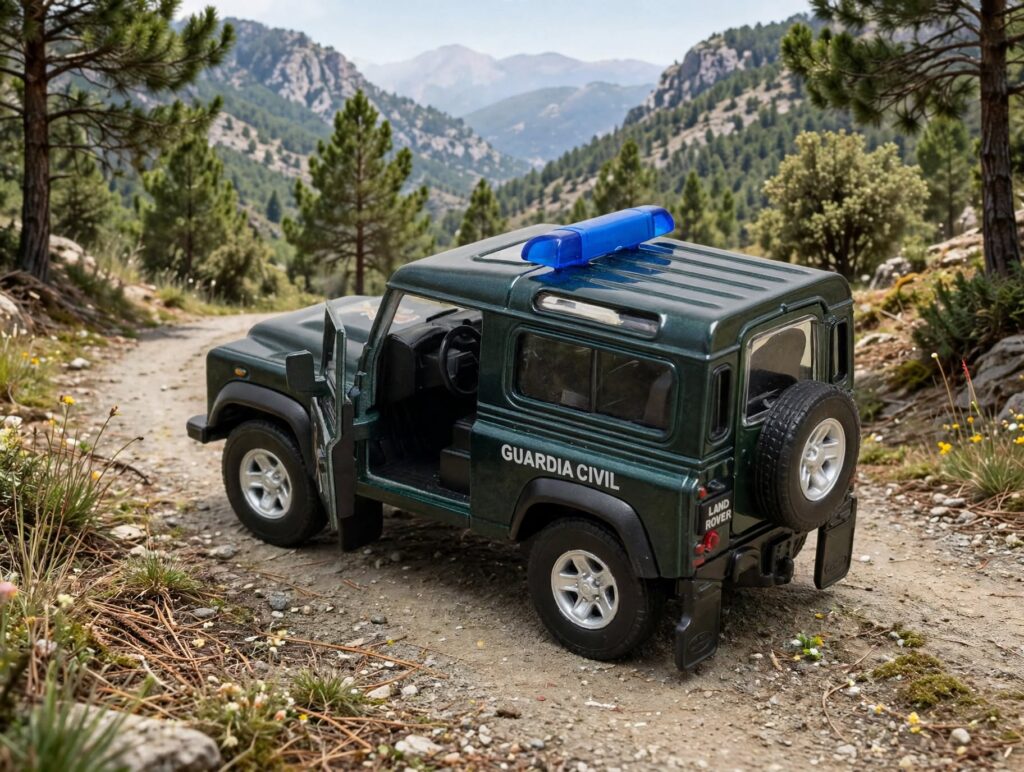
Both front doors open, and the tailgate with the spare wheel swings out too. This is standard for Welly at this scale and it is the main reason people buy these instead of smaller castings.
The hinges are chunky, which is the honest trade. They have to be, because a thin hinge in soft metal would snap the first time a child pulled on a door. I would rather have working doors with visible hardware than a sealed body, but it is a real compromise and you see it every time a door is open.
Light bar, antenna and the fragile bits
The blue light bar is a separate translucent piece sitting in a roof rail, and it is easily the most delicate thing on the whole model. It stands proud of the roof, it is thin, and it is exactly what catches when the vehicle goes into a box with other models.
The antenna has the same problem. Mine is straight, but I have seen plenty of these with a bent or missing one. If you are buying secondhand, check both before anything else, because neither part is replaceable.
The mud flaps are soft plastic and they hang low. Mine have taken a set from sitting in a box and now curl slightly, which bothers me more than it should on a vehicle designed to drive through fields.
Buying police and service models as a collector
It is a focused way to collect, and it solves the problem of not knowing what to buy next. Instead of chasing whatever is new on the peg, you chase a theme: one force, one era, one type of vehicle. My guide to starting a collection covers how to pick a focus early.
If you want service vehicles at smaller scale, one brand has done them for decades while the other mostly ignores them in favor of customs, and I went into that difference in Matchbox versus Hot Wheels.
Who should buy the Guardia Civil Defender
If you collect 1:64 exclusively, skip it. It will not fit anything you own, and it will dominate any display built for smaller cars.
If you collect police and service vehicles, or if you have a soft spot for the old Defender, it earns its place. The casting is accurate, the livery is specific and well printed, and the heft of a 1:32 model in the hand is a different kind of pleasure from the quick satisfaction of a small casting. Just keep it well away from the box where the loose cars live.