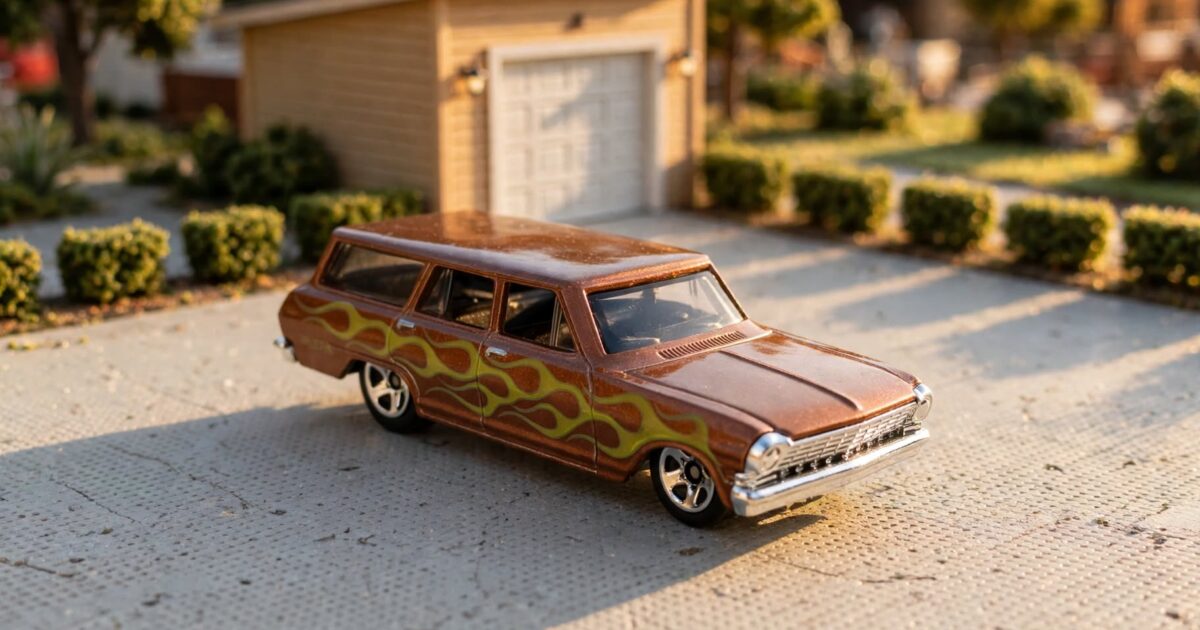
Station wagons are the most underrated body style in diecast. They are long, they have enormous flat sides, and manufacturers barely make them because a wagon is not what a child reaches for on a peg.
Which is exactly why one on your shelf stands out. This is the Nova wagon in copper metallic with yellow flames down both sides, and it is one of the more unusual things I own.
What a wagon gives a casting that a coupe cannot
Length and surface area. A wagon roof runs almost to the tail, which means the greenhouse is longer, the side glass is bigger and the body side is one continuous canvas from front wheel to rear bumper.
For a deco artist that is a gift. Flames need room to develop, and on a coupe they run out of car before they finish. Here they start at the front wheel arch and travel the full length of the body, tapering as they go, with space to actually form the licks properly.
The flat roof also gives the model a visual weight that coupes lack. Sitting on a shelf, a wagon reads as substantial in a way a low sleek car does not.
Copper metallic and yellow flames
The colour combination is unusual and it took me a while to decide whether I liked it. Copper is not a colour most castings wear, and against yellow it could easily have turned muddy.
It does not, because the flames have a thin outline that separates them from the body. Without that line the two colours would blur into each other at a distance. With it, the flames read clean from across a room.
The flames also run at the correct height, low on the body and following the line of the sills rather than climbing up the doors. Hot rod flames traditionally hug the lower body, and getting that wrong is one of the commonest mistakes in toy car deco.
Chrome and the glass
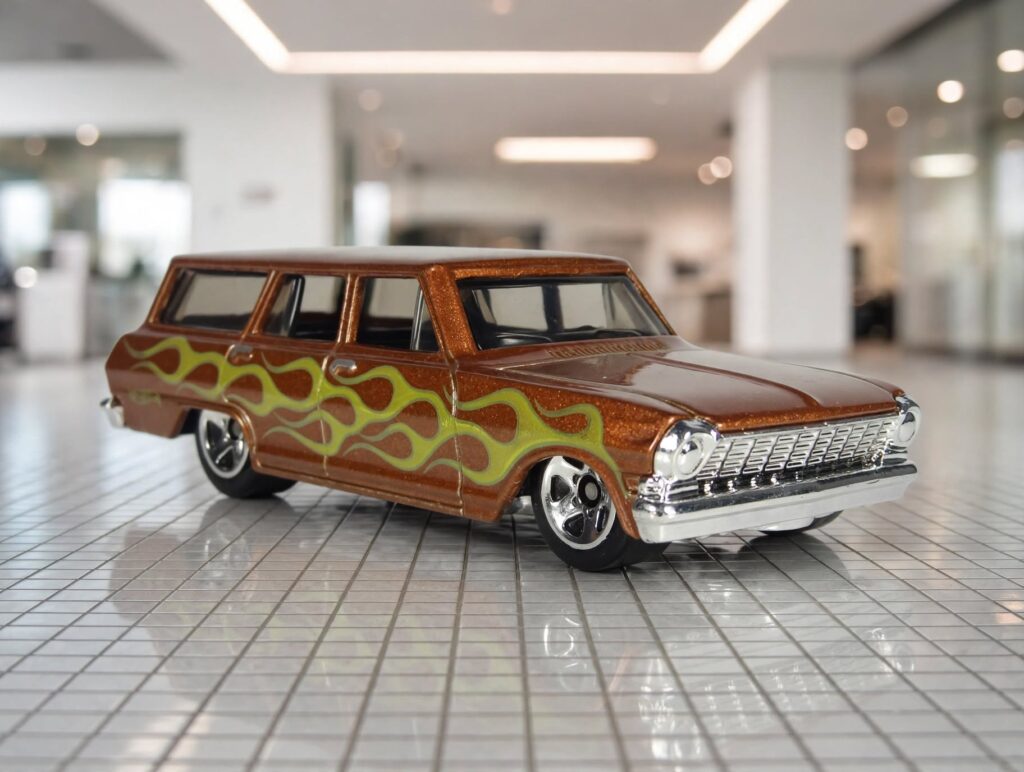
The front carries a wide chrome bumper with a mesh grille above it, both properly finished rather than painted silver. On a body this plain the chrome does most of the work.
The glazing is tinted almost black, which is the one decision I would question. A wagon has an enormous amount of glass, and making all of it opaque throws away the airiness that defines the body style. Clear glass would have shown an interior across the full length of the car.
Against that, dark glass does make the flames pop. It is a trade and I understand the reasoning, though I would have chosen differently.
Why nobody makes wagons
Worth explaining, because it affects what you can collect. Mainline diecast is designed to sell to children, and children want sports cars, trucks and fantasy vehicles. A wagon is the car their parents drove.
So wagons appear rarely, usually as custom or hot rod versions like this one, which is the manufacturer’s way of making the shape acceptable. A stock family wagon in a plain colour would sit on pegs forever.
The result for collectors is that wagon castings are scarce without being valuable. Few are made, and few people chase them, so they are cheap and hard to find at the same time.
Flames done well and flames done badly
After enough flamed castings you start to notice what separates the good ones.
Height is the first thing. Traditional hot rod flames start low at the front and stay in the lower third of the body. Flames that climb over the doors and onto the roof look wrong to anyone who knows the reference, and manufacturers do it anyway because it fills space.
The second is the outline. A flame with a contrasting border reads cleanly at a distance. One painted flat against the body colour turns into a smear the moment you step back.
The third is how they end. Good flames taper to points that get thinner and further apart as they travel back. Bad ones just stop.
This wagon gets all three right, which is why it survives having a very loud deco on a very ordinary car.
Buying a loose Nova wagon
The flames run along both sides at handling height, which is the worst possible place for tampo. Check both flanks under angled light, and pay attention to where the flames cross the door shut lines.
Then the roof. It is a long flat expanse and it collects scuffs that a curved roof would hide.
Check the chrome bumpers at both ends, and look at the rear tailgate area, which on a wagon is a large vertical surface that takes knocks when the car is set down carelessly.
Copper metallic behaves like gold: it hides fine scratches and shows chips clearly. Inspect edges rather than panels.
Where a wagon belongs on the shelf
Put it at the end of a row. A wagon is longer than the cars around it and lining it up mid row makes the whole shelf look uneven.
It also works well in a diorama, because a scene needs vehicles that suggest ordinary life. A street with three sports cars parked on it looks like a showroom. Add a wagon and it starts looking like a place.
If you build scenes, our diorama guide covers how to set one up.
Would I recommend it?
Yes, and specifically because it is a wagon. The casting is competent, the flame work is well judged, and the copper is an unusual colour that photographs well. What you are really buying is a body style almost nobody else on your shelf will have. The dark glass is the one compromise. Check the flanks before you pay.