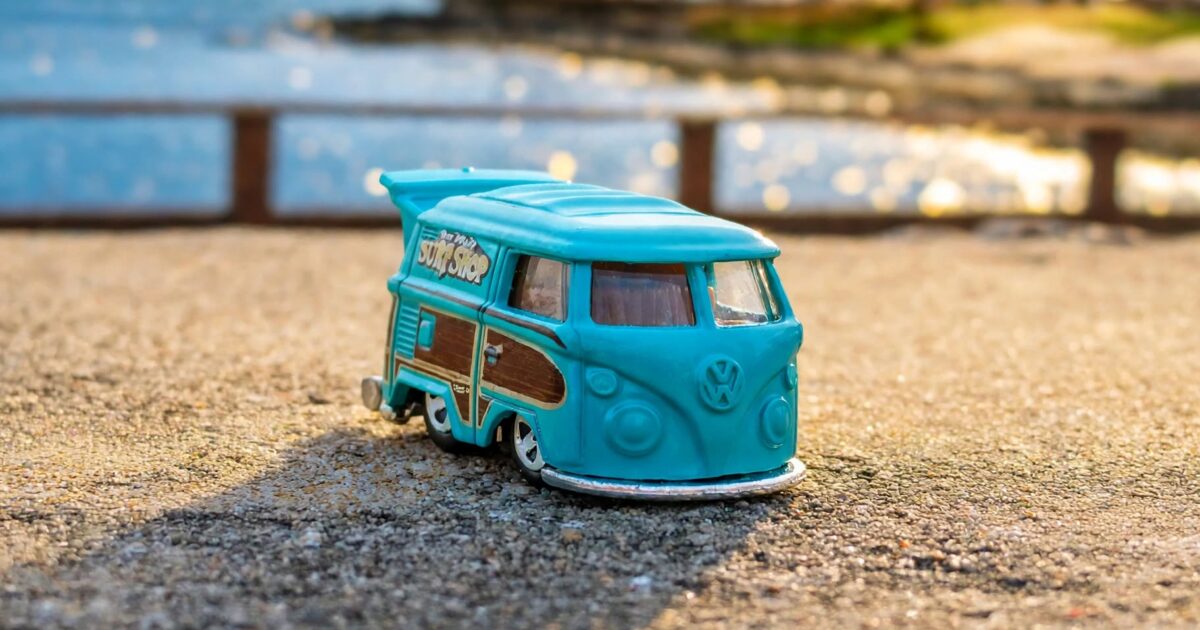
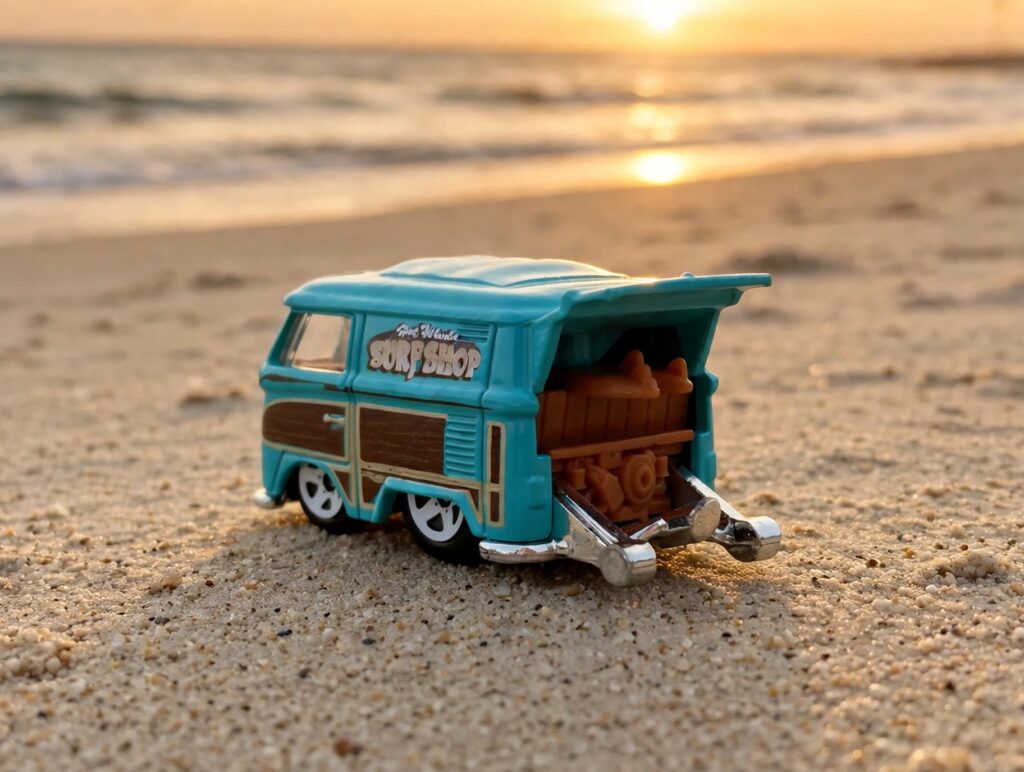
There are brown panels along the side of this turquoise van, printed with a grain pattern meant to read as timber. They are not wood at all. They are ink printed onto painted metal.
That would be unremarkable except for one thing: on the real vehicles this look copies, the wood was not wood either. It was a vinyl sticker printed with a grain pattern and stuck onto steel, sold by the factory as an option. So what you are holding is a printed imitation of a printed imitation of a material that stopped being used before most of these vehicles were built.
Where the fake wood came from
Early estate cars really did have timber framing, because that was how you built a body onto a chassis before pressed steel took over. When steel won, the wood disappeared, and the look stayed, because buyers had decided it meant something: holidays, space, family, and the beach.
So manufacturers printed it. Vinyl panels with a grain pattern were applied to the flanks of cars that had never seen a carpenter. It is one of the purest examples in the car industry of a decoration surviving the function that created it.
The same thing happens everywhere once you start looking. Vinyl roofs imitating folding fabric tops on cars with fixed steel roofs. Plastic trim moulded to look like brushed aluminium. A grille pressed into a panel on an electric car that needs no air at all.
What the Hot Wheels Kool Kombi does with it
The panels run along the lower half of each side, outlined with a thin gold pinstripe and broken by a door shape with its own handle. Above them, in a loose hand painted script, the van says Surf Shop.
The printing on mine is sharp, and the grain pattern is fine enough that it reads as timber at arm’s length instead of turning into a brown smear. That is not easy at this size, and it is the single most technically impressive thing on the casting.
The body is deliberately too short
Look at the proportions. The real vehicle is a long box with a cab stuck on the front. This one has been compressed, the body shortened, the roof lowered, the whole thing squeezed into something stubbier and rounder than any van that ever left a factory.
That is a choice, not an error. Hot Wheels does this regularly, pulling a vehicle toward caricature to make it read instantly from across a room. The split between faithful castings and this kind of reinterpretation is the thing to understand about the brand, and I covered it in what a Hot Wheels car actually is.
Turquoise, chrome and a very low stance
The body colour is a soft turquoise, flat instead of glossy, which suits a vehicle pretending to have spent its life near salt water. Across the nose there is a cast VW roundel, and below it a bright chrome bumper that wraps around the lower corners.
The van sits on the floor. There is almost no gap between the body and the surface, and the front wheels are partly swallowed by the arches. A real one sitting that low would not clear a kerb, which is exactly the point.
The wheels are white with fine spokes and a chrome centre, and are small enough to disappear under the body. Oversized wheels would have fought the compressed proportions, and whoever specified these understood that.
The roof and the board
On top there is a raised section running back from the cab, shaped to carry a board. It is cast as part of the body, so nothing comes loose and nothing gets lost in a carpet, which is a sensible decision on a toy.
I have mixed feelings. A separate board would have looked better and given the van a second colour up high. A cast one survives being owned by a child. Hot Wheels picked survival, and I cannot argue with it.
Through the windscreen there is a small interior with a bench and a wheel, and the glass is clear with a light tint. The cab is tiny, since the compression took most of it away.
Where this sits on a shelf of Volkswagens
This is the brand with the most reinterpreted shapes in the hobby. Beetles, vans, convertibles, the lot, produced by every maker and customised in every direction, largely because the originals stayed in production so long that there is no single correct version to copy.
The full story of why that happened is on my Beetle page. A van like this one belongs to the same family and the same logic: take a shape everybody recognises, then do whatever you like to it.
What to check before buying one
The front bumper first. It is a thin chrome piece hanging below the nose on a vehicle that sits almost on the ground, so it takes every knock the model ever receives.
Then look at the woodgrain. Printing that fine can scuff, and once a patch has rubbed through to the turquoise, there is no fixing it. On a casting where the graphics are the entire appeal, a damaged panel takes most of the value with it.
The third thing is the roof section, since it is the highest point and it is where a van stacked under others in a box will take the weight.
What the little Kombi is really selling
Not a van. It is selling an idea about a particular kind of life, built out of three signals: a beach colour, a board on the roof and some wood that was never wood.
None of those signals is honest, and that is fine because none of them were honest on the real vehicles either. The whole look was always a costume. What makes this casting good is that it wears the costume without the slightest apology, right down to printing a fake material onto metal and expecting you to enjoy the joke.