This thing is tiny. Roughly two thirds the length of most cars in the same case, which you do not appreciate until you put it beside a Charger and it looks like the Charger’s luggage.
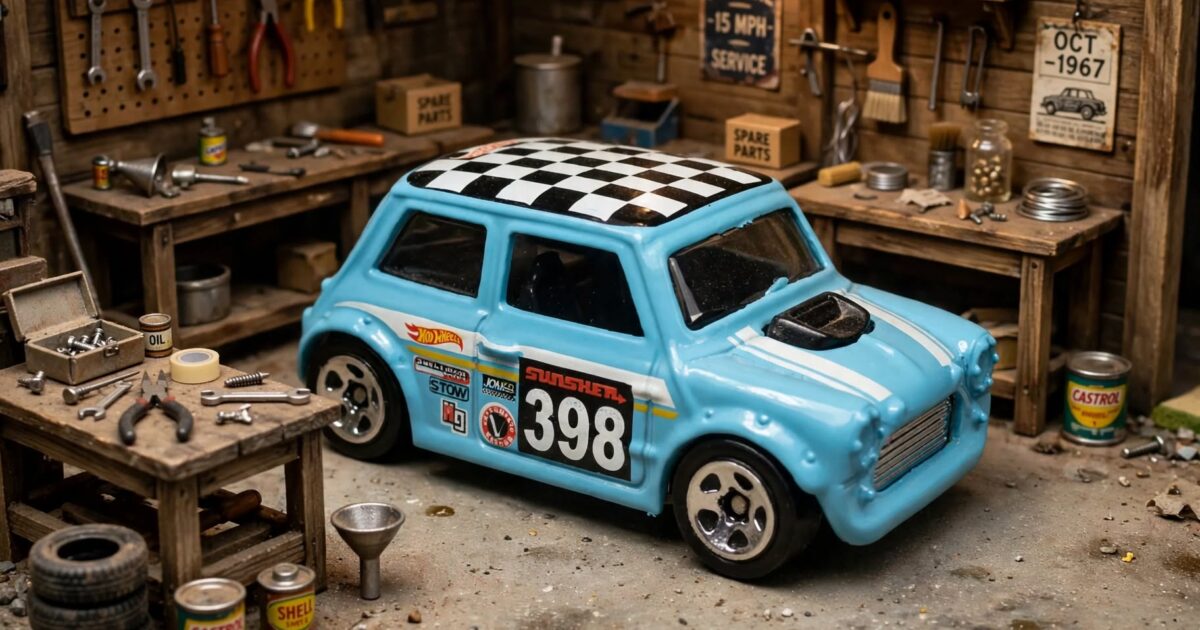
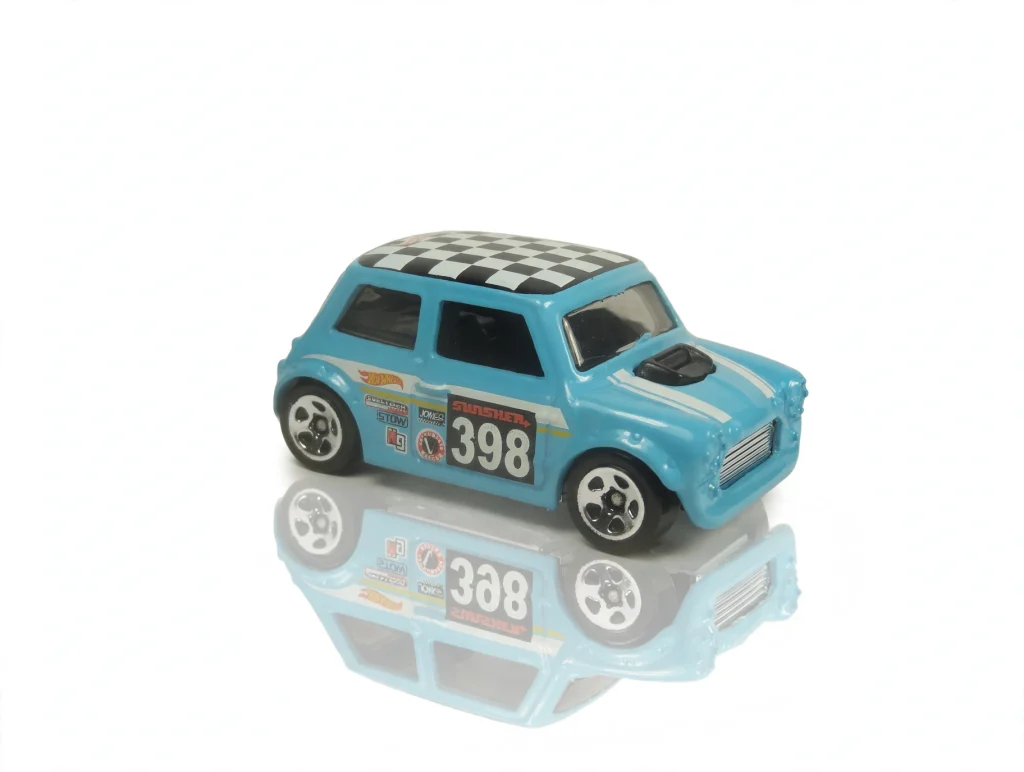
Light blue, black and white checkered roof, number 398 on the door. It is charming, and underneath the charm it is a properly good piece of tooling, which is a harder trick at this size than at any other.
The Mini as a racing car
The classic Mini punched enormously above its weight. Front wheel drive, hardly any weight to move around, and a wheel jammed into each far corner, which gave it grip and agility that more powerful cars could not match on anything tight.
It beat machinery with several times its output on rallies and circuits, so racing liveries suit it naturally. This release is drawing on that: the number board, the sponsor decals, the checkered roof, the bonnet stripes. It is an invented livery instead of a copy of a specific car, and the vocabulary is right.
Small bodies leave nowhere to hide
There is very little surface area on a Mini, so every detail gets scrutinised, and every proportional error is obvious. Most manufacturers get this wrong.
Mattel did not. The round headlights are recessed with chrome surrounds, the oval grille has fine horizontal bars, the door hinges are moulded into the body sides the way they sit on the real car, and the roof gutters run along the edges. That last one is the detail I always check on a Mini and almost nobody bothers with it.
The bonnet carries a black scoop as a separate raised feature offset to one side, copying period competition cars that needed more airflow. It also gives the top of the car something to look at, which matters when the bonnet is this short.
Wheels that do not ruin the proportions
White lipped five spokes that fill the arches without being pushed up a size. On a car this small, oversized wheels would wreck it in about a second, and Mattel has form for exactly that mistake on other castings.
Somebody made a deliberate choice to leave them alone here and the car is much better for it.
How much tampo fits on a Mini
More than you would think. The roof is a full black and white checkerboard. The bonnet has twin white stripes running front to back beside the scoop. The door carries a large number board with 398 in white on black, an arrow graphic above it, and a cluster of small square sponsor decals ahead of it. A Hot Wheels flame sits just behind the front wheel arch.
Getting all of that to register cleanly on a body this size is the real achievement. Look closely at the small decals: the lettering inside them is actually readable, which is not always true on castings twice the size.
Is the Hot Wheels Morris Mini worth collecting?
Yes, and it is one of the better value cars in the range purely on detail per dollar.
It also solves something practical. Small castings slot into gaps in a display where a full size car will not fit, so a Mini can fill an awkward corner and look deliberate instead of crammed. I have three shelves where that is the only reason a particular car is where it is.
The people who should hesitate are those who dislike invented liveries. If you want a Mini reproducing a specific historic entry, this is not it. It is a scheme assembled from period parts.
Buying a loose Morris Mini
The roof first. The checkerboard is the biggest piece of tampo on the car and it sits on the highest, most exposed surface, so wear shows there first and shows obviously. A checkerboard with worn squares looks far worse than a plain roof with identical damage.
Then the bonnet scoop, a raised feature that takes knocks. Then the small side decals, which are fine printing and scuff easily, and the chrome around the grille and bumper.
Because the car is so short, a bent axle is more visible than on a long car. Roll it and watch. And light blue shows dirt, so a car looking slightly grey in photos is probably just dirty, though it is fair to ask.
Displaying and photographing something this small
The Mini disappears in a row of larger cars. Either give it its own group with other small castings or put it at the front where the size difference reads as a deliberate contrast.
For photos, get the camera down to bumper height and fill the frame. Shooting a Mini from the same distance you would shoot a Charger just makes it look like you made a mistake.
Mini saloon, Mini van, or a Cooper?
Mattel has made more than one Mini and people mix them up constantly in listings.
The saloon has rear side windows and reads as the racer. The panel van has a solid rear side and reads as a delivery vehicle somebody modified. They are different tools and neither is a variant of the other.
If you are only buying one, take the saloon in a racing livery like this one, because it connects to the competition history that makes the Mini interesting in the first place. The van is the better piece of comedy and the worse piece of history.
If you buy two, buy one of each and stand them together. The contrast between the number board on this car and a distressed graphic scheme on a van makes both of them look better than either does alone.
Verdict
A small car carrying a surprising amount of detail, from readable sponsor decals to properly moulded door hinges. Costs almost nothing, fills display space other cars cannot, and points at one of the great giant killing stories in motorsport.
Check the roof tampo before buying loose. Everything else about this one is easy.