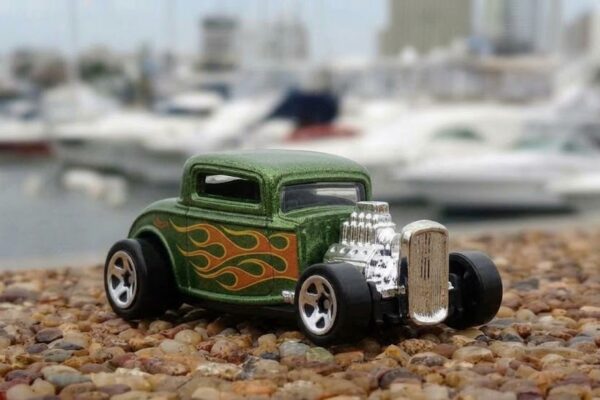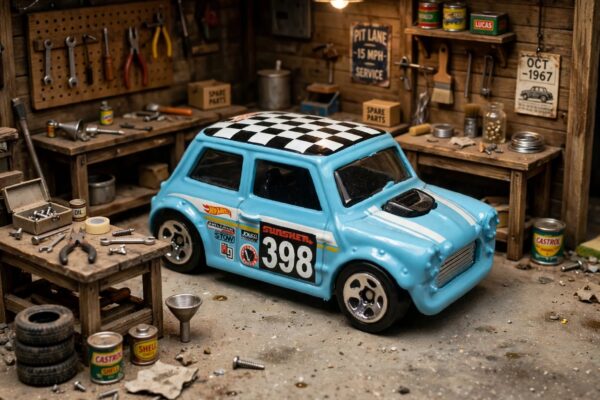
Flames belong on old cars. That is the unwritten rule, and it exists because flame jobs come from hot rod culture, which is about pre-war bodies and post-war ingenuity.
So a modern Challenger covered in flames should look wrong. It does not, and working out why took me longer than I expected.
The Challenger as a deliberate throwback
Here is the answer. The modern Challenger is not really a modern car. Dodge designed it as a direct reference to the 1970 original, with the same long flat flanks, the same squared off roofline and the same blunt nose.
Everything that makes a body suitable for flames is present. There is a long uninterrupted side, a clear horizontal line to run them along, and enough length for the licks to develop and taper properly.
Put the same deco on a car with complex surfacing and it falls apart, because flames need a flat canvas. The Challenger provides one, which is why this works when it should not.
The deco in detail
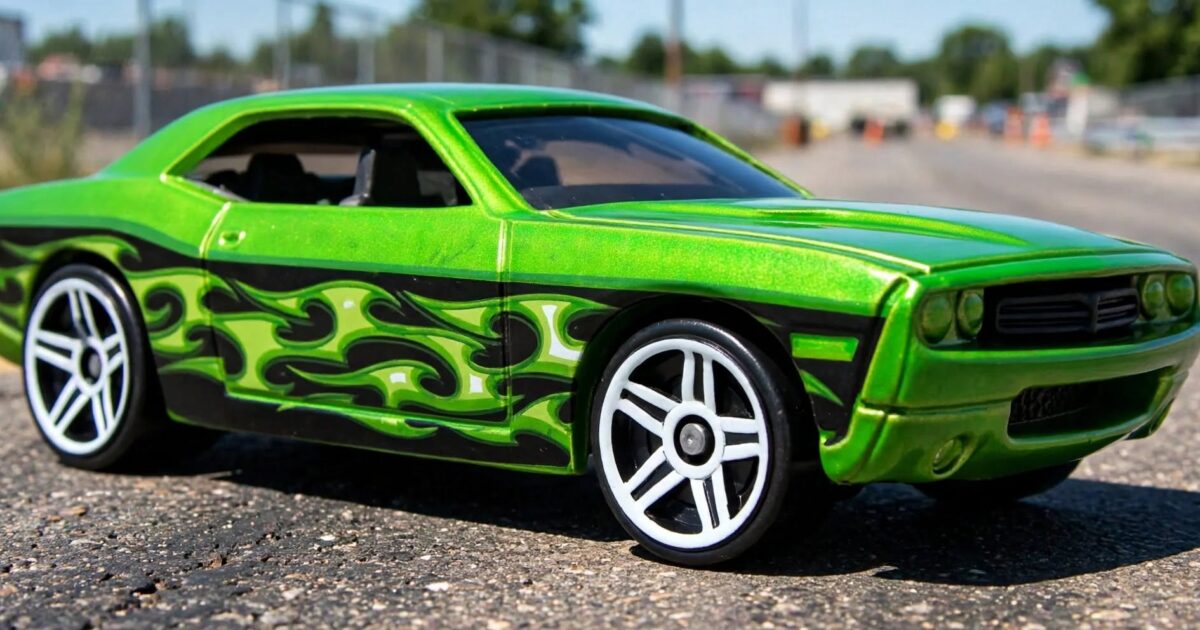
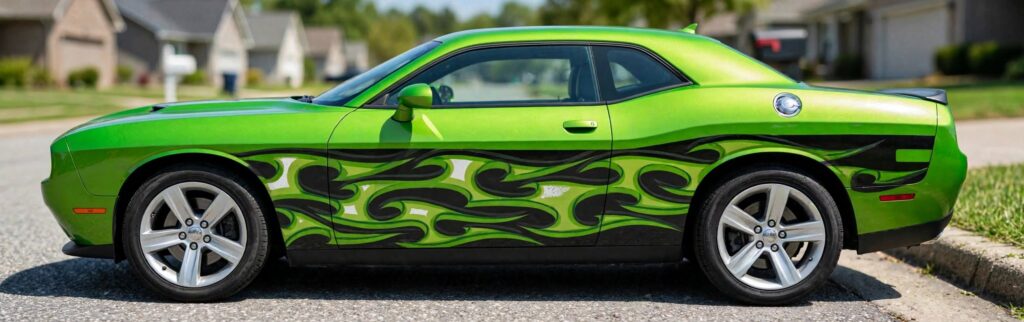
Pale green flames with a black outline, running from the front wheel arch back along the lower body, tapering into separate licks over the rear quarter. The darker green metallic underneath shows through between them.
Green on green is the difficult version of this deco, and it only survives because of the outline. Two tones of the same colour blur together at any distance, so without a black border the licks would dissolve into a smear halfway down the car.
Compare it to a flame job that uses a contrasting colour and you can see the compromise. The high contrast versions read from further away. This one asks you to come closer, and rewards you when you do, because the black outline gives each lick a defined edge that a contrasting colour would not need.
The flames also stay low, hugging the sill line and never climbing onto the doors or the roof. That is the traditional placement and the one most manufacturers get wrong.
The wheels are chrome five spokes with a white outer edge, and they stay out of the argument entirely. On a car where the body already has two shades of green fighting for attention, neutral wheels are the right call. Adding a third colour down there would have finished the job of making the whole thing illegible.
SRT8 and what the badge meant
SRT was Chrysler’s performance division, and an SRT8 Challenger was the version with the large displacement engine and the hardware to go with it.
On the casting the relevant details are the bonnet, which carries raised sections and vents, and the stance, which sits lower and wider than a base car would. There is a rear spoiler on the boot lid moulded as part of the body.
None of it is as visually dramatic as the differences on the Camaro ZL1, because Dodge kept the Challenger looking deliberately simple across the range. That is consistent with the original car, which also relied on proportion rather than addenda.
Retro design and how it ages
Worth thinking about if you collect modern cars. A vehicle designed to look like an older one occupies a strange position: it never looked contemporary, so it never looks dated either.
The Challenger has aged better than most of its rivals for exactly that reason. It was already referencing 1970 when it launched, so time passing does not affect it the way it affects a car that was chasing the present.
For a shelf that means it sits comfortably next to both eras. Put it beside a ’70 Challenger and they rhyme. Put it beside modern cars and it holds its own.
Challenger, Charger and Chrysler’s retro decade
The Challenger did not arrive alone. Chrysler spent a period deliberately mining its own past, and the modern Charger, the Challenger and the PT Cruiser all came out of the same thinking.
The Challenger is the one that worked best, because the original it references was a clean simple shape that translates easily. The Charger had a harder job, since the 1969 car was a two door and the modern one is not.
For a collector that makes an interesting shelf: the modern retro cars lined up next to the originals they reference. You can see which references were literal, which were loose, and which were mostly marketing.
It also costs very little, because both the modern and the classic castings are mainline cars in most releases.
Buying a loose Challenger SRT8
Flames sit at handling height along both flanks, which is the worst place for tampo. Check both sides under angled light, paying attention to where the flames cross the door shut line.
Then the rear spoiler, which stands proud of the boot and takes knocks.
Green metallic hides fine scratches reasonably well and shows chips clearly as dark marks. Inspect the wing edges, the nose and the boot lip rather than the flat panels.
Then the white wheel edges, which scuff easily and show every mark against the chrome.
Modern cars that suit old decoration
The Challenger belongs to a small group where retro styling makes traditional hot rod deco viable. Most modern bodies do not, and manufacturers apply flames to them anyway with predictable results.
If you want to test a casting before buying, look at the side profile. A long flat flank with a straight sill line will carry flames. A car with sculpted doors and a rising shoulder line will not, no matter how good the printing is.
Would I buy it again?
Yes, and mostly because it answers a question I had not thought to ask. Flames on a modern car should fail and this one does not, because the car underneath was designed in 1970 in everything but manufacturing date. The green on green is the harder version of the deco and the black outline carries it. Buy it for the shape, and appreciate the printing once it is in your hand. but manufacturing date. Well placed deco, matching wheels, and a shape that earns it.