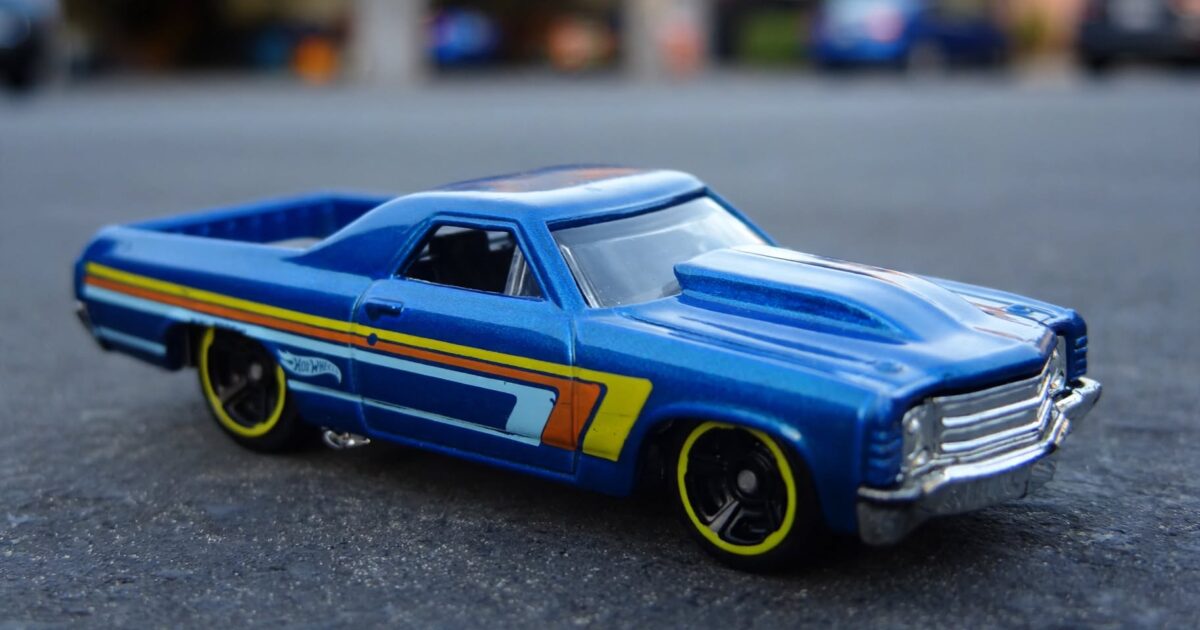
The El Camino answers a question almost nobody was asking: what if a car had a cargo bed instead of a back seat and a boot?
Chevrolet built them for decades anyway, and the shape they produced sits in a category of one on most shelves.
Coupe utility and where it came from
The idea started in Australia, where manufacturers had been building car based pickups since the thirties for buyers who needed to carry things during the week and look respectable on Sunday.
American manufacturers picked it up much later. The El Camino shares its platform and its front end with the Chevelle of the same years, so mechanically and visually it is a muscle car from the windscreen forward.
Behind that it becomes something else entirely. The roof stops, the bed begins, and the proportions go somewhere no ordinary car goes.
Why the long body helps a casting
An El Camino is longer than the coupe it is based on, with a completely flat flank from the front wheel to the tail.
That gives a deco artist room that a normal car does not. Here the stripe package runs the full length of the body: a wide pale blue band bordered in orange and yellow, starting at the front wheel arch and travelling all the way to the rear.
On a coupe that stripe would run out of car halfway through. Here it develops properly and tapers where it should.
The bed is open and hollow with ribbing moulded into the inner walls, which matters if you build scenes. An open bed you can load is worth more than a solid one.
Blue metallic with a raised bonnet
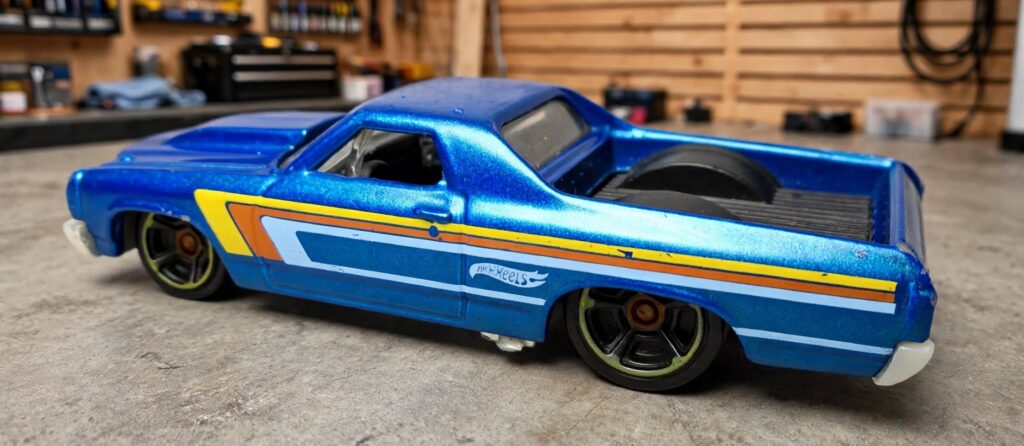
The body colour is a strong blue metallic with a heavy flake that shifts noticeably between warm and cool light.
The bonnet carries a large raised section running down the centre, which on the real car housed the induction hardware on performance versions. It gives the nose something to look at and breaks up what would be a very long flat panel.
The wheels are black with yellow outer rings, picking up the yellow in the stripe. That is the same trick I have praised elsewhere and it works here too. Somebody chose those wheels deliberately rather than pulling the nearest set.
The front end is chrome with a fine grille pattern and a wraparound bumper, correct for the period.
Utes and coupe pickups in a collection
This body style is rare in 1:64 and rarer still done well. Manufacturers make sports cars and proper trucks, and the thing in between gets ignored because it fits neither category cleanly.
That is exactly why it earns a place. An El Camino on a shelf of muscle cars breaks the rhythm without leaving the era, and it prompts questions from people who have never seen one.
If you like the format, the Ford Ranchero is the obvious companion, and the Australian utes are a whole category of their own worth exploring.
El Camino or Ranchero?
Ford built the Ranchero first and Chevrolet answered with the El Camino, which is the usual pattern in this industry.
The two are easy to tell apart once you know where to look. The El Camino shares its front end with the Chevelle of the same year, so it carries Chevrolet styling cues. The Ranchero follows Ford intermediates and wears Ford faces.
Both are worth owning if you like the format, and together they make a small coherent group. Sellers mix the names up regularly, so read the grille rather than the listing title.
Buying a loose El Camino
The stripe runs the full length of both flanks at handling height, so check both sides under angled light and pay attention to where it crosses the door shut line.
Then the bed. Look inside for damage and check the top edges of the bed sides, which are thin and exposed.
Then the chrome front bumper, which is a separate piece at the furthest forward point of a long car.
Blue metallic hides fine scratching and shows chips clearly. Inspect the wing edges and the tailgate corners rather than the flat panels. And roll it, because a long car shows a bent axle obviously.
The Chevelle connection
From the windscreen forward, this is a Chevelle. Same platform, same front end, same bonnet.
That matters when you are buying, because sellers who know cars will describe an El Camino accurately and sellers who do not will call it a Chevelle pickup or a Chevrolet ute.
It also makes for a good pairing on a shelf. An El Camino next to a Chevelle of the same year shows you exactly where one car stops being the other, and the transition point is more abrupt than you expect.
If you already own a Chevelle from these years, this is the natural second purchase.
Loading the bed for photos
This is the practical advantage of the body style and most people ignore it.
An empty bed makes the El Camino look like a car with a hole in it. Put something in there, even a couple of crates or a spare wheel, and it becomes a vehicle with a purpose.
Shoot it low and from the front three quarter so the bed is visible but not dominant. Straight from the side the proportions look strange, which is fair, because they are.
Final thoughts
A body style almost nobody else on your shelf will have, with a stripe package that uses the length properly and wheels chosen to match it. The open bed is the feature worth having. Check the stripes and the bed edges before you pay.