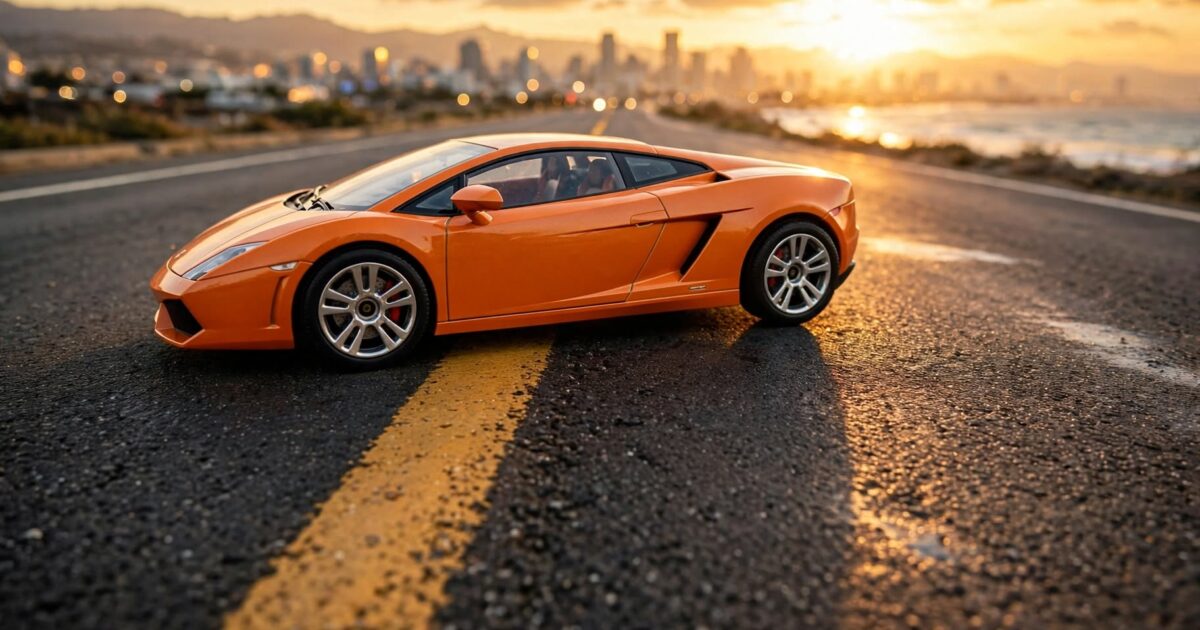
Metallic orange, which is the colour Lamborghini is supposed to be. Not red, not yellow, but that specific burnt orange that the brand has been selling since the seventies.
The Gallardo is also the car that changed the company, and that story is more interesting than the wedge shape suggests.
The Lamborghini you could actually use
Before the Gallardo, Lamborghini made a small number of very extreme cars. Difficult to drive, difficult to see out of, and built in numbers that kept the company permanently close to collapse.
The Gallardo was the smaller, more usable car aimed at people who wanted a supercar they could drive regularly. It sold in numbers the company had never achieved before, and that volume is what made everything after it possible.
Purists were suspicious at the time, on the grounds that a Lamborghini should be impractical. The counterargument is that a company which goes out of business makes no cars at all.
Wedges and what they demand from a casting
The Gallardo is built from flat planes meeting at hard angles. There is very little curvature anywhere on it.
That sounds easy and is not. Flat surfaces show every imperfection in the tooling, and the angles between them have to be crisp, because a softened edge on a wedge turns the whole car into a blob.
This casting holds the edges. The shoulder line running from the headlight to the rear haunch is sharp, and the side intake ahead of the rear wheel is a proper angular recess rather than a rounded scoop.
The nose is low and flat with the headlight units set into angled housings, and the whole front reads correctly from a three quarter view.
Metallic orange and why the colour matters
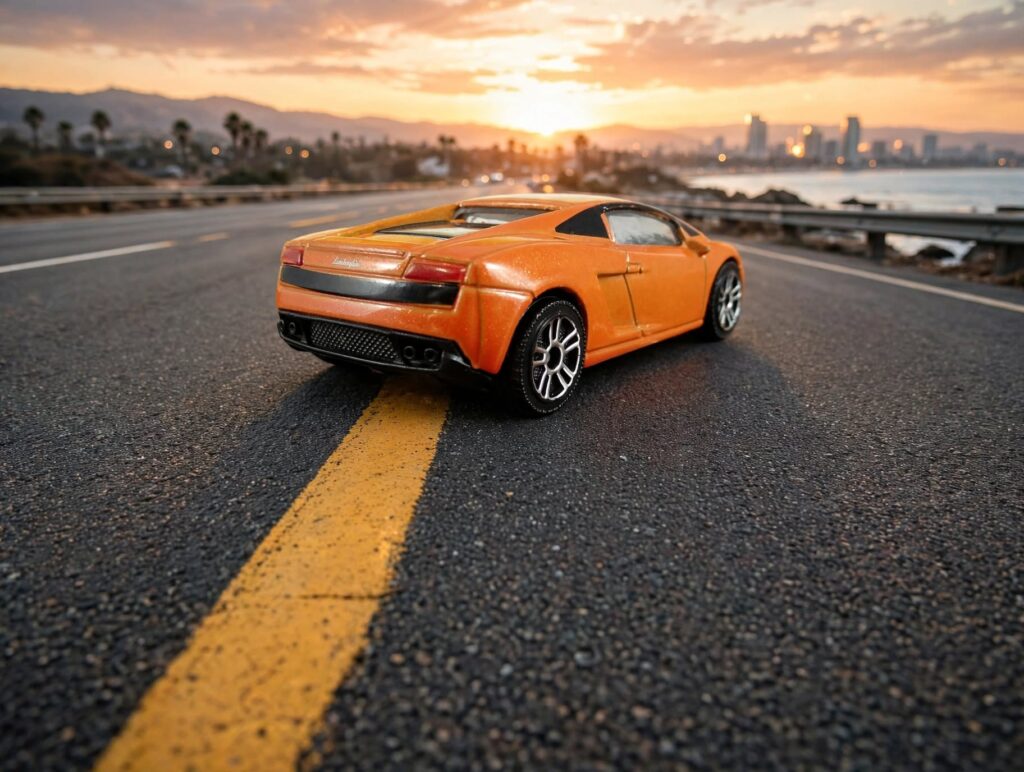
Colour choice on a supercar casting is not a small decision. Most manufacturers reach for red or yellow because they photograph well and because children like them.
Orange is the more interesting call and the more accurate one for this brand. It also does something useful on a wedge: the metallic flake catches the flat panels at different angles, so the body shows its shape as the light moves. A flat colour would have made the car read as a single silhouette.
The wheels are fine multi spoke in chrome, which suits a supercar better than it suits the vintage cars where I have complained about the same choice.
Supercars and the problem with them
Every collection has too many. They are the default thing for manufacturers to make, they sell, and they end up occupying a shelf where every car is low, wide, exotic and ultimately similar.
The Gallardo survives that better than most because of what it represents. It is not the most extreme Lamborghini and it is the most consequential one, which gives it something to say beyond being fast.
If you are buying one Lamborghini, there is a reasonable argument for this over the wilder ones. Our piece on Lamborghini covers the broader range.
Building a Lamborghini shelf without repeating yourself
The temptation with this brand is to buy every wedge you see, and after four of them the shelf stops saying anything.
A better approach is one car per era. Something from the original wedge period, something from the nineties, the Gallardo as the car that made the company viable, and one modern flagship. Four cars covering fifty years.
That arrangement shows the design language evolving under pressure, and it means each car earns its place by being different from the others rather than by being another Lamborghini.
It also keeps the cost down, because you are buying four specific cars instead of every colourway of the fashionable one.
Buying a loose Gallardo
The hard edges are the vulnerability. On a car built from planes, every edge is exposed, and a chip on a crisp line is far more visible than the same chip on a curve.
Check the shoulder line along both sides, the leading edge of the nose and the corners of the rear deck under angled light.
Then the side intakes, which are deep angular recesses that collect dust and damage.
Metallic orange hides fine scratching well and shows chips as dark marks. And because the car sits low, turn it over and look at the base and the front valance for scraping.
What Majorette brings to exotics
The same realism they bring to everyday cars, which on a supercar matters less than you might think.
A Lamborghini is already low, wide and extreme, so there is nothing for a manufacturer to exaggerate. The difference between a realistic Gallardo and a customised one is much smaller than the difference between a realistic and a customised Beetle.
What you do get is correct ride height and restrained wheels, which means the car looks like the real thing rather than like a show car. On a subject this familiar, that accuracy is easy to verify and satisfying when it holds up.
In short
Crisp edges on a shape that punishes softness, in the colour Lamborghini should always be, at a price well below the premium brands. It is the sensible Lamborghini, which sounds like faint praise and is the reason the company still exists. Check the shoulder line before you pay.