
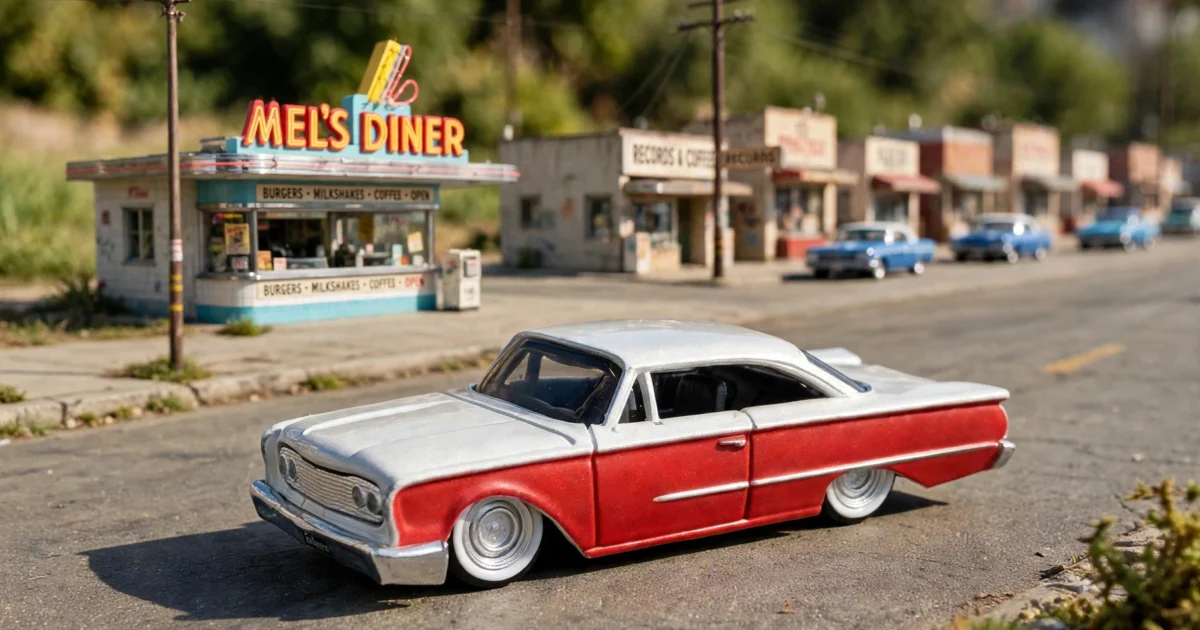
The 1960 Starliner is not a car most people can name, and that is most of its appeal. Ford built a full size two door with a roofline that sweeps back in one unbroken curve, gave it fins that had already started shrinking, and then moved on to other things.
Maisto made it in 1:64, dropped it to the floor and painted it red and white. The result is one of the more unusual things you can put on a shelf.
Why the Starliner shape matters
1960 was a strange year for American design. The tail fin era was ending and nobody had decided what came next, so cars from that single model year look like nothing before or after them.
The Starliner is the clearest example. The roof flows into the rear deck without a break, giving it a genuine fastback profile at a time when most full size Fords were formal and upright. The fins are horizontal blades rather than the vertical spears of a few years earlier, and the body sides are almost flat.
Seen in profile it looks longer and lower than it has any right to. That is exactly the view this casting is built to show off.
The lowered stance and the white steelies
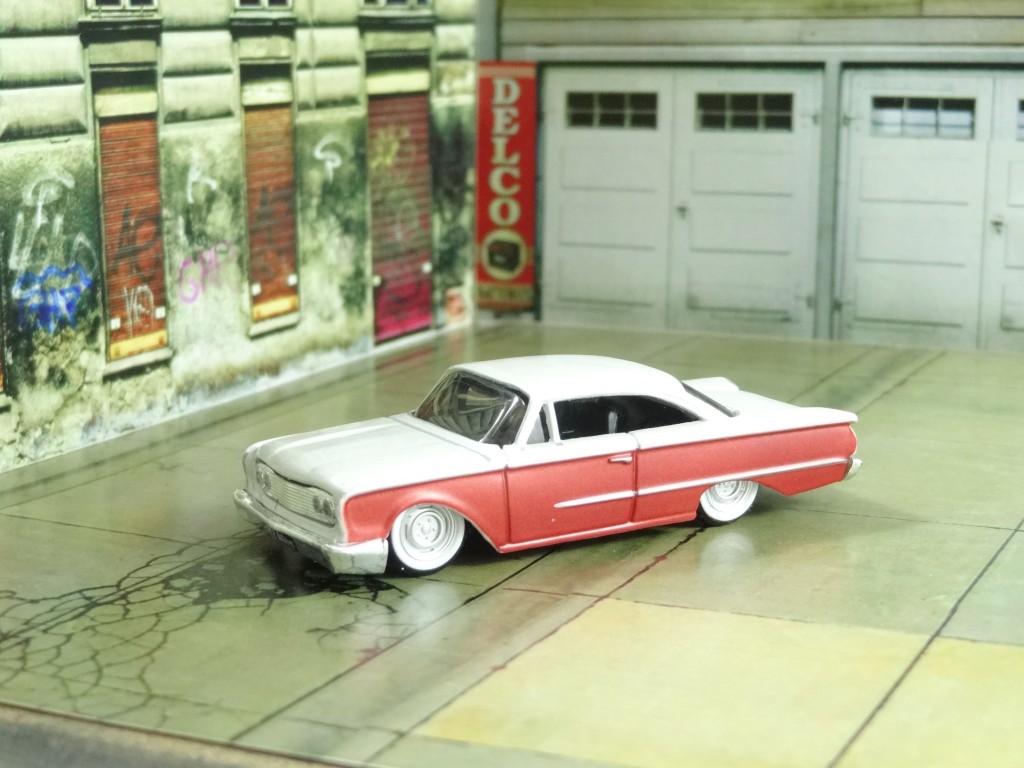
Maisto lowered it hard. The body sits close to the ground with barely any gap above the tyres, and the whole car reads as a mild custom instead of a showroom model.
The wheels are plain white steel style rims with small chrome centre caps, which is the correct choice and a restrained one. A period custom would have run exactly these, and putting modern multi spoke wheels on this body would have destroyed it.
Together the stance and the wheels place the car in a specific culture. This is not a museum piece. It is somebody’s weekend car from a period when lowering a full size Ford was what you did.
Red and white two tone
The colour split follows the body line, with white over the roof, the bonnet and the upper front, and red across the lower flanks and the rear quarters. A thin chrome side spear runs the length of the car, separating the two.
Two tone paint at this scale is difficult, because the transition edge has to be sharp and it has to follow a moulded line exactly. On mine it does, which is more than I expected.
The front carries a wide chrome bumper and a full width grille with the headlights set into it, all picked out properly. Chrome is doing a lot of work on this car and it holds up.
Building a shelf around 1960 to 1962
The Starliner works best with company from its own narrow window, and that window is more interesting than the muscle car years everyone collects.
These are the cars caught between eras. Fins shrinking, rooflines flattening, chrome still everywhere but starting to be applied with restraint. Nothing had settled yet, so almost every manufacturer was guessing in a different direction.
The practical advantage is price. Nobody is competing with you for early sixties full size cars the way they compete for Chargers and Camaros, so you can assemble a genuinely unusual shelf for very little. It also makes each car look better, because they explain each other.
How Maisto sits against Hot Wheels and Greenlight
Maisto occupies the middle ground and it is worth knowing what that means before you buy.
Against a mainline Hot Wheels you get more realistic proportions, better chrome and usually a subject nobody else bothers with. Against a premium car from Greenlight or a similar maker you get plastic tyres instead of rubber and less interior detail.
The price sits in the middle too. For collectors who want variety without paying premium money on every car, that middle ground is genuinely useful, and Maisto covers a lot of ground the big two ignore.
Checking the paint transition and the chrome
Two tone paint has one weak point and it is the seam. Run your eye along the chrome spear where the red meets the white, on both sides. Separate paint passes chip at the transition, and against white it shows from across a room.
The wide front bumper is next. It is the furthest forward point on a car that sits very low, which is an unfortunate combination. Look at it straight on for bends and scraping.
Then turn the car over. Lowered models collect damage underneath that never appears in a listing photo, so check the base and the lower rocker edges for the grinding you get from a carpet.
Last, the fin tips at the rear. They are the thinnest painted edges on the body and they chip early.
Using it in a street diorama
This is where the car earns its keep. Photographed in a garage or a street scene it stops reading as a toy immediately, because the ride height and the wheel choice are both plausible.
Keep the camera low and shoot the profile. The full length of that roofline is the whole reason to own this casting, and a three quarter view compresses it. This is one of the rare cars where the straight side view is the strong angle and the front three quarter is the weak one.
Would I buy another?
An unusual subject, correctly lowered, on period appropriate wheels, with two tone paint that holds its edges. It will not out-detail a premium model and it does something more useful, which is put a shape on your shelf that nobody else has. Check the chrome and the paint transition before buying.