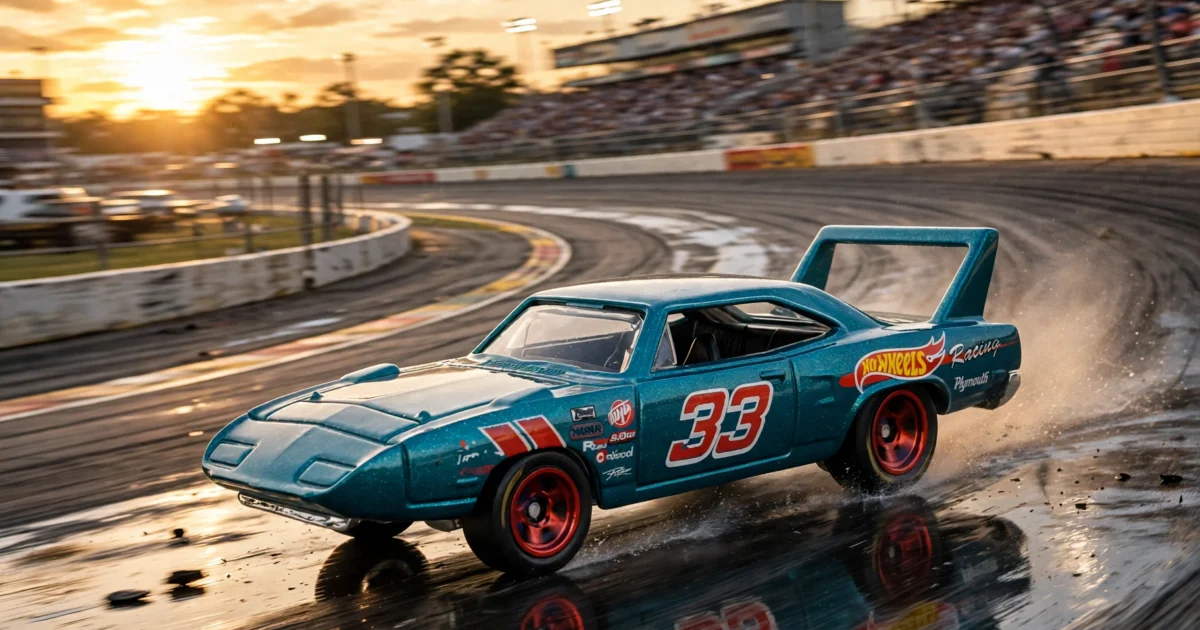
Nobody warns you about the storage problem. The Superbird does not fit in standard protector cases designed for normal height cars, you cannot stack anything on it, and crammed between two other cars it loses its entire effect.
Buy one anyway. Just plan the shelf space first, which is advice I wish somebody had given me.
Why the nose cone and the wing exist
One of the great stories in American motorsport. By the end of the sixties, teams racing on the big ovals worked out that aerodynamics mattered more than horsepower, and Chrysler responded by building road cars with an extended nose cone and an enormous rear wing purely so the racing versions would be legal.
The rules required a number of them to be sold to the public, so dealers ended up with these things sitting on lots. They were reportedly hard to shift and some got converted back to standard bodywork by owners who found them embarrassing.
Today they are among the most valuable American cars of the era. Unsellable oddity to blue chip collectible in fifty years, and that arc is a big part of why the shape carries so much weight.
How the casting handles the nose cone
The cone is the harder of the two features. It has to taper from the full width of the body down to a point without looking like a wedge glued on the front.
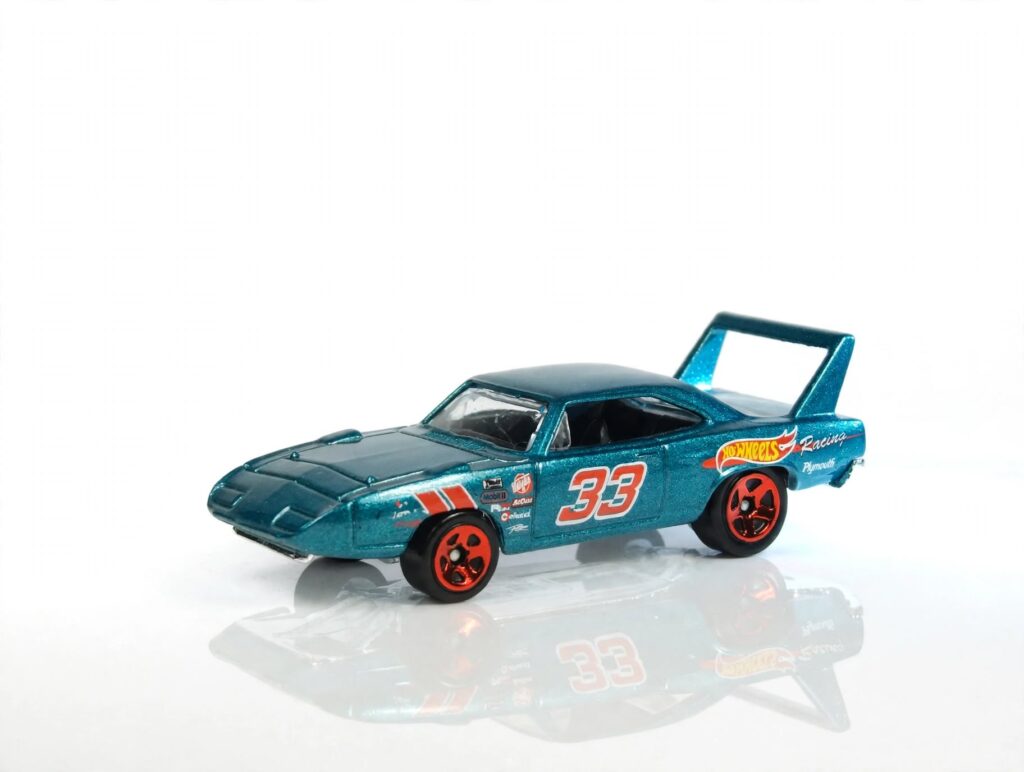
This one is properly integrated, with a visible seam line where it would meet the body on the real car and small pop up headlight bulges on top. Sit it next to a standard Road Runner and the transition looks like it belongs.
The wing, and why it needs careful handling
A separate piece standing on two vertical uprights above the deck. Structurally it is the most exposed part of any car in my case, and bent, snapped and reglued wings are everywhere on the secondhand market.
Look at it from directly behind. It should be level, both uprights the same height, no gap and no glue residue where they meet the deck. Then look from the side to check it has not been pushed forward or back.
Superbird or Charger Daytona? Telling them apart
These two get confused constantly, including by sellers. They are both winged aero cars from the same corporate family and they are different vehicles.
The Superbird is based on the Plymouth Road Runner. The Daytona is based on the Dodge Charger. The bodies underneath differ, most obviously at the roofline and the rear quarter treatment, and the wing uprights are shaped differently on each.
If a listing says Daytona and the body underneath is clearly a Road Runner, the seller is guessing. Sometimes the price reflects the guess in your favour and sometimes it does not.
The number 33 racing deco
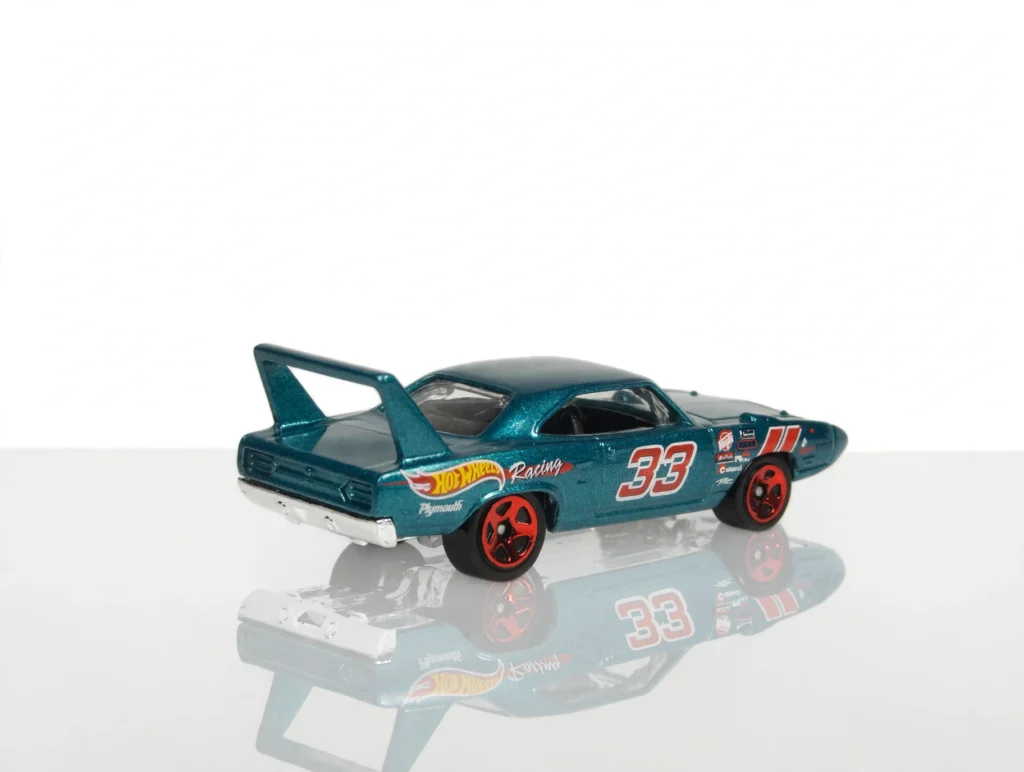
Straightforward stock car livery: a big white outlined 33 on the door, a cluster of small sponsor decals ahead of it, Hot Wheels Racing script on the rear quarter, Plymouth behind that, and twin stripes over the front fender. The red wheels against teal metallic look better than they have any right to.
Look closely at the small decals. Some of them read as crew or driver names, which is the sort of detail that makes an invented livery feel like it was copied off a real entry instead of made up in an afternoon.
The hood is a matte black panel with hood pins picked out, period correct and useful, because it breaks up what would otherwise be an enormous expanse of teal.
Buying a loose Superbird
The wing inspection above is most of the job. After that, the nose cone tip, which is the furthest forward point on the car and eats every impact. Mine has wear at the very tip and along the lower edge of the cone, which seems typical.
Then the door number for tampo wear, the big flat rear deck for scratches, and a roll test. Teal metallic hides fine scratches reasonably well and shows chips clearly, so inspect edges instead of flat panels.
Storing and protecting a winged car
Standard 1:64 protector cases assume a car of normal height. The Superbird is not one, so the wing either fouls the lid or sits under pressure against it, and pressure on that wing over months is how uprights bend.
The options are a taller case if you can find one, an open shelf, or a display box deep enough that nothing rests on the car. I use an open shelf and accept the dusting.
If you post it or carry it to a swap meet, wrap it with support under the wing instead of around it. Tissue packed underneath keeps the uprights from taking the load. Most bent wings I have seen came from transport, not from play, which is a frustrating way to damage a car you were being careful with.
Verdict
A faithful small scale version of one of the most extreme production cars ever built, in a clean stock car livery and a colour combination that works. Cheap, easy to find, and it does something no other casting in your case can do.
Check the wing, give it room at the end of a row, and shoot it from low so the wing breaks the horizon line.