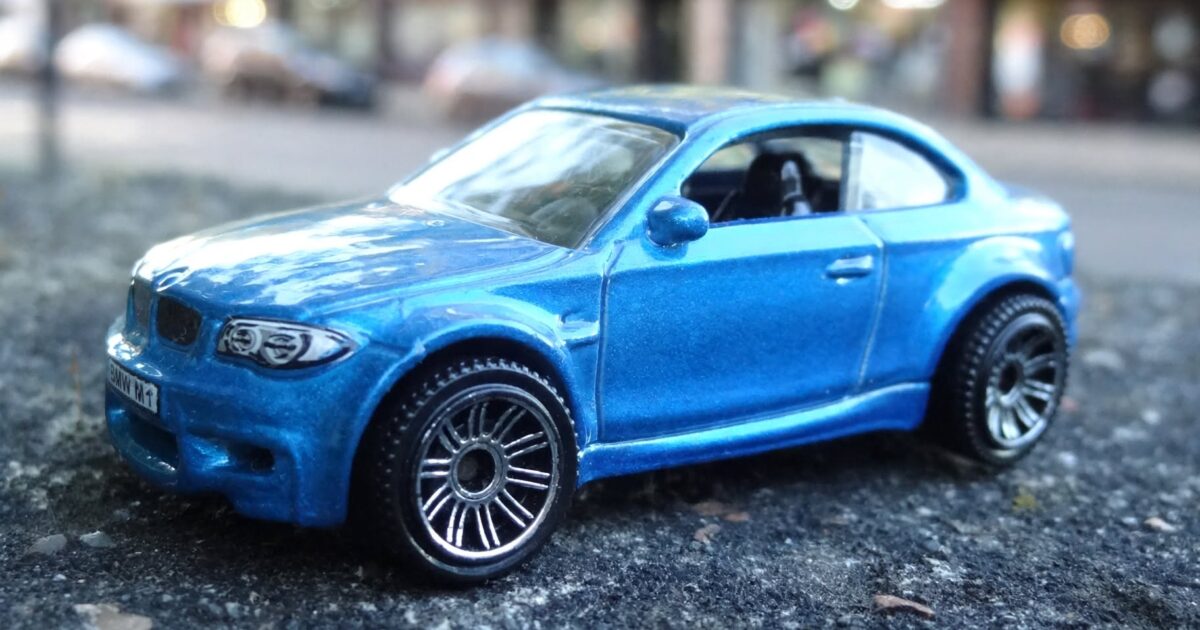
Hold this one up to a window and look through it. The windscreen, the roof rail, the side glass and the rear hatch are all one clear part, moulded as a single piece and dropped into the body from above. That is how most castings at this price are built, and on the great majority of them you never once notice it.
You notice here, because the real car is already mostly glass. The Z4 M Coupe took a roadster and gave it a long glass hatch running from the roof to the tail, so a model built around one big transparent part lands unusually close to the truth of the thing.
What the Hot Wheels BMW Z4 M Coupe looks like in the hand
Dark metallic blue, deep enough to go almost black in the shade, with a fine flake that lifts in direct light. The body is long at the front and short at the back, with the cabin pushed well behind the middle.
A race number 44 sits in a white square on each door and again on the hood. Diagonal stripes in pale blue, white and red cross the door behind it, BMW Motorsport runs along the rocker, and above the door number there is small lettering naming the car. It is a factory style motorsport package, with no invented sponsors and no made up team names anywhere on the body.
The one piece glass canopy and what it costs
The upside is the look. Light passes through the whole cabin, so from the side you can see the roll structure inside and the shape of the seat, and the car never reads as a solid lump of blue.
The downside is that a single clear part cannot be two colors. The window surrounds, the pillars and the frames are all the same transparent plastic, so where the real car has black trim this one has nothing. On a body with this much glass area, that absence is the main thing separating it from a premium casting.
Vents cut through the hood
There are two real openings in the hood, cut all the way through, with the interior visible underneath. Not printed shapes, not shallow recesses. Holes.
They line up with the engine bay, so what you see through them is the underside of the glass and some interior structure instead of a plain white gap. From a high front angle it looks convincing.
That is tooling money spent in a sensible place. A long flat hood is the hardest surface on any car to keep interesting, and two cut vents break it up and give the front end some depth.
The rear wing and the front splitter
The wing is a flat blade on two uprights, painted body color, standing clear of the hatch. It is thin enough to read as a real aerodynamic part instead of a painted slab, which is far from always the case at this size.
The splitter at the front is a separate piece extending past the bumper, and on my example it has lost some of its finish along the leading edge. That is the most exposed part of any race casting. If you buy one loose, check the splitter before anything else, because a chipped or bent one is permanent.
Wheels, arches and ride height
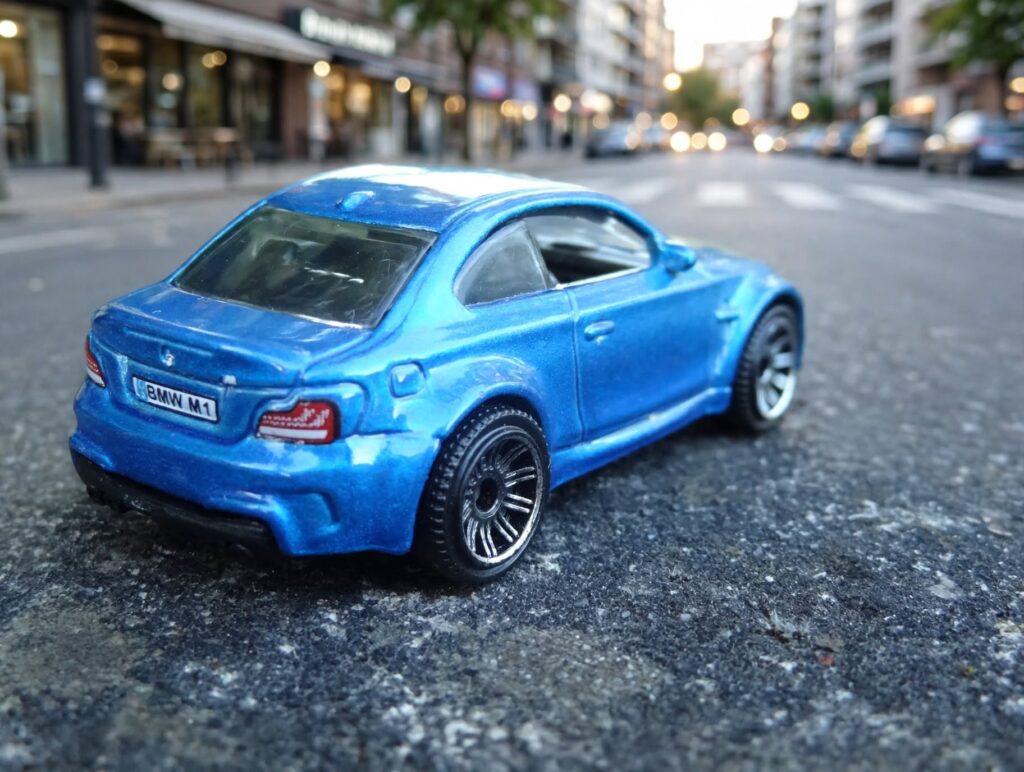
The wheels are silver multi spoke designs with a deep dish, and they sit flush with the arches. The flares are cast proud of the doors with a visible step, and the sills between them are pulled in tight, which exaggerates the width exactly the way a real GT car does.
The tires are plain black with a smooth shoulder. On a GT car I would have liked some tread detail, since even slicks have a visible sidewall shape, but this is the usual compromise at this level and it only shows in close photographs.
The car sits very low. The splitter is close to the surface and the gap above the tires is minimal, so this is a shelf and photo car, and not something to go running across a carpet.
Should you pay extra for a blue liveried BMW
Somebody will eventually offer you one of these at a premium because it looks special on the card. Metallic paint and a full motorsport livery do not make a casting rare on their own, and plenty of cars wearing both are perfectly ordinary mainline releases.
If you want to know what actually makes a car scarce, the difference comes down to specific production markers, and I laid those out in Treasure Hunt versus Super Treasure Hunt. None of those markers apply to a standard liveried race car.
Race castings in a mainline range
A mainline range has to cover everything: road cars, trucks, fantasy castings and race cars. The race cars are the ones that most often end up with the best tampo work, because a full livery gives the printing department something to do beyond dropping a logo on a door and calling it finished.
That is part of why they photograph well and part of why people assume they are premium. For a broader look at what a mainline release actually is, I wrote what a Hot Wheels car actually is.
What keeps the number 44 car in rotation
It gets picked up more often than almost anything else I own, and I think the glass is the reason. A casting you can see through simply has more going on than one you cannot, and this one rewards being turned over slowly in the hand next to a window.
The things it lacks are real. No black window trim anywhere, no separate headlight lenses, and a front splitter that will not survive a single drop onto a hard floor. For what it is, the shape is right, the livery is clean and the hood vents are a small piece of generosity I did not expect at this price.