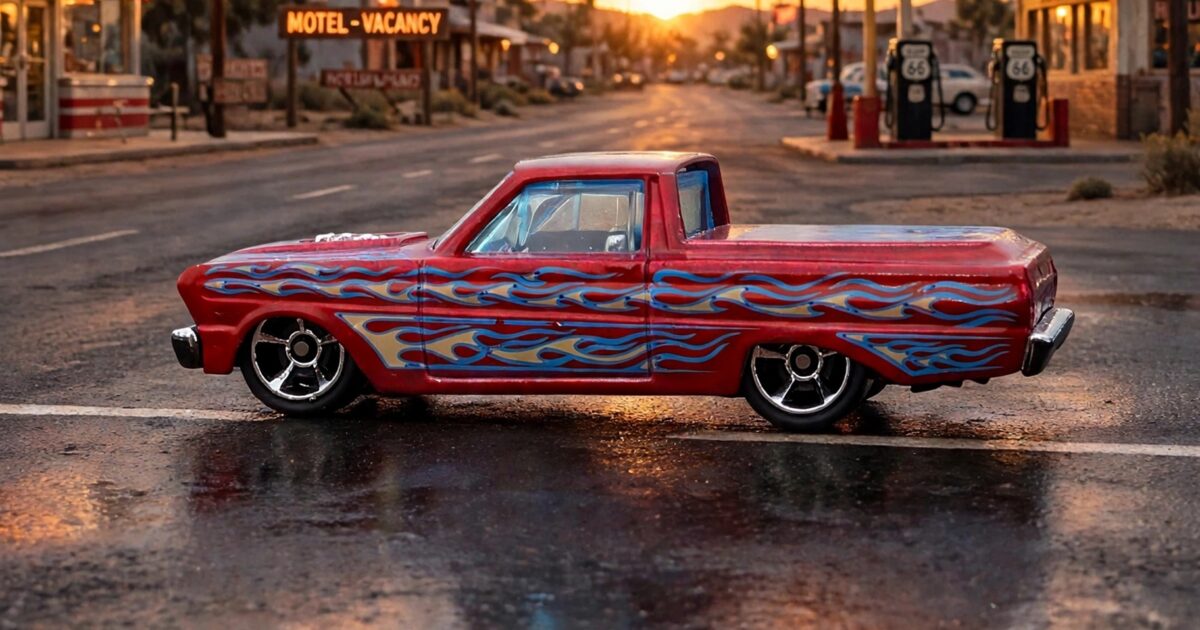
Every custom car is a list of decisions, and most people only read half of them. The engine is exposed, the body is on the ground, there are flames licking down the flanks. Those are the loud choices and they are easy to see.
Now look at the bumpers. Full chrome, front and rear, exactly as the factory fitted them. The grille is standard. The trim along the lower body is still there. On a vehicle this heavily modified, somebody made a deliberate decision to leave those alone, and that decision tells you more than the flames do.
What the Hot Wheels ’65 Ford Ranchero is
A car with a load bed instead of a back seat, which was a whole category once and barely exists now. The front half is a mid sixties saloon, the rear half is an open box, and the roofline runs back to a cab wall in one continuous line.
The body is a deep maroon with a metallic flake. Blue and cream flames run from the front wheel back along the doors and onto the bed sides. At the front, a chrome engine pushes up through the hood.
Through the side glass there is a grey interior with a bench and a wheel, visible but undetailed. The glass itself is lightly tinted, which keeps the cabin from reading as a hole in the middle of a long body.
Why de-chroming is usually the first thing to go
In most custom traditions, bright trim is the enemy. Bumpers get removed or tucked, badges get shaved, door handles disappear, and the body becomes one clean surface with nothing interrupting it. Smoothness is the goal.
This car does the opposite. It keeps every piece of brightwork the factory supplied and then adds a blown engine and a floor scraping ride height on top. The effect is a vehicle that looks like it was modified in stages by somebody who liked the original and refused to cut it up.
There is a type of owner behind that, and most collectors have met one. The person who wants the car faster and lower but would never take a grinder to original trim.
The flames are blue, and that is unusual
Flame graphics almost always imitate fire as people picture it, in yellow, orange and red. These are blue and cream, which reads as a hotter flame, the colour at the base of a gas burner.
It also solves a practical problem on a maroon body. Orange flames on dark red would have muddled together into a single warm mass at any distance. Cool colours against a warm body separate cleanly, and from across a room this car reads instantly.
The outline work is what makes them. Each flame has a thin cream edge around a blue core, which is how a real painter builds the effect, and at this size that second colour is what stops the whole graphic from turning into a smear.
The bed and what it does to the proportions
A load bed behind a car cabin produces a very long flat side, and that is the hardest surface to make interesting on any vehicle. The flames exist partly to solve that, running the full length and giving the eye a path to follow from the front wheel to the tail.
Without them the car would be a maroon slab with a greenhouse at one end. With them the length becomes an asset, because there is enough room for the graphic to develop properly instead of being squeezed onto a door.
Chrome wheels and the stance
The wheels are chrome five spoke designs, filling the arches with almost no gap above the tires, and the car sits level and very low.
That choice matters on a vehicle with this much factory brightwork. Black wheels would have fought the bumpers and the trim. Chrome wheels agree with them, so the whole lower edge of the car has a consistent bright line running around it, and the maroon sits above it like a body on a tray.
The tires are smooth with no tread cut into them, which is normal at this price and suits a car that would be running street slicks anyway.
Where the Ranchero fits in the Ford story
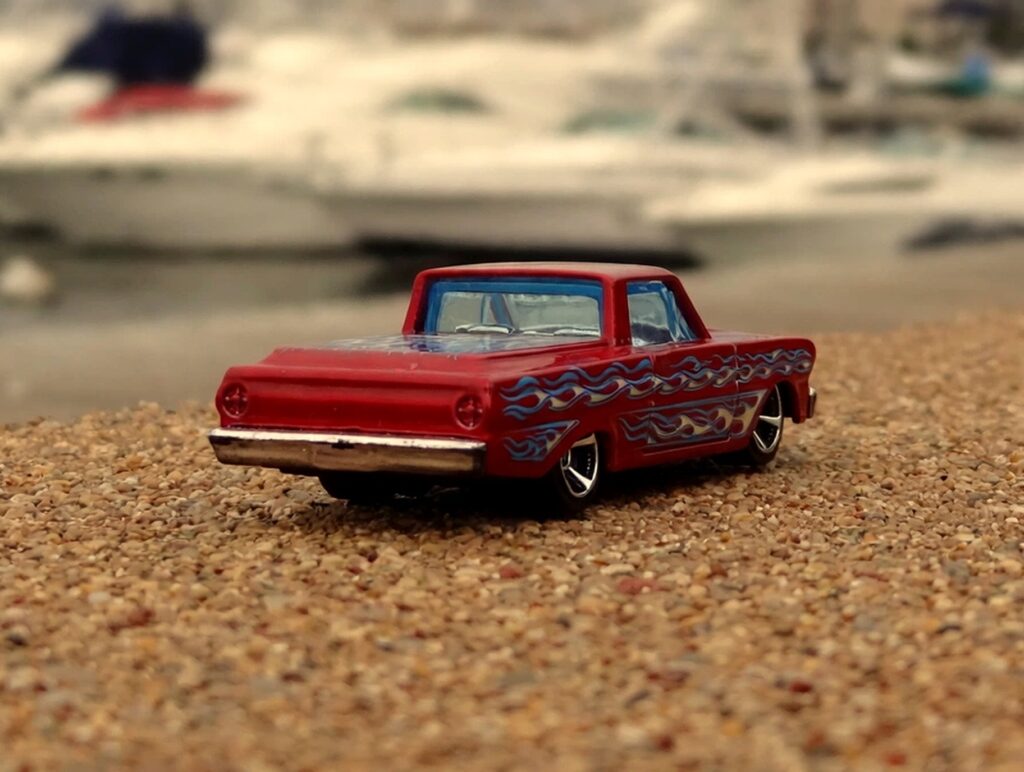
This is one of the odder branches of a very long family tree. Ford built cars, trucks, muscle cars and race cars, and somewhere in the middle it kept producing a thing that was both a car and a truck and quite happy being neither.
The wider history, and why this manufacturer has given the hobby more shapes than any other, is on my Ford page.
The category itself died because buyers eventually decided they wanted either a proper car or a proper truck. For about thirty years, though, a surprising number of people wanted exactly this instead.
Is a flamed custom a sensible thing to buy
It depends entirely on why you are buying. As an object to look at and photograph, this is one of the better value castings I own, because the tampo work is doing the job of a much more expensive model.
As something to keep sealed in the hope it appreciates, no. Flamed customs are produced in enormous numbers and almost none of them become scarce. I set out that whole argument in are Hot Wheels a good investment, and nothing about this car changes it.
What the Ranchero keeps
Three things, and they are the reason it works. The bumpers, the grille and the trim, all left exactly as Ford made them.
Strip those away and this becomes a smooth custom like a hundred others, interesting only for its stance and its paint. Leave them on and you get something stranger: a sixties working vehicle that somebody modified hard without ever disrespecting it. The blown engine says one thing, the untouched chrome says another, and the argument between those two is the whole appeal of the thing.