Ask anybody at a toy aisle what brand the little car with the round headlights is, and they will say Mini. They are right, and they are also missing a step. The car was launched as the Morris Mini-Minor, built by a company founded in Oxford before the First World War, and that company’s name is now so thoroughly gone that its most famous product has been promoted into a brand of its own.
There are marques that die quietly. This one was eaten by its own best work.
Morris Motors started in a bicycle shop
William Morris was repairing and selling bicycles in Oxford as a teenager, moved on to motorcycles, and by 1912 was designing a car. The first Morris Oxford appeared the following year with a rounded radiator that got it the nickname Bullnose.
He was not an engineer in the Chapman sense. He was an assembler and a businessman, buying components from suppliers and putting them together efficiently, which turned out to be exactly the skill the British industry needed.
What Morris borrowed from Detroit
Morris visited the United States and came back convinced by what Ford was doing at Highland Park. He applied the same logic at Cowley: standardize, build in volume, cut the price, sell to people who previously could not afford a car at all.
That approach made him enormously rich and made Morris the largest British carmaker of the interwar years. It is also why the British motor industry of that period looks like a smaller, damper version of the American one, which is a connection most people miss. The method came across the Atlantic along with everything else, and my piece on Ford Motors covers where it came from.
The Morris Minor and the first British million
In 1948 the company launched the Minor, designed by a young engineer called Alec Issigonis. It had torsion bar front suspension and rack and pinion steering at a time when small cars had neither, and it handled well enough to embarrass sports cars.
It stayed in production for more than two decades and became the first British car to pass a million units. The wood framed Traveller version is the one people remember, though the van and pickup versions did more actual work, including years of service for the post.
Issigonis and the layout every small car copied
Then in 1959 the same designer produced the Mini, and it is difficult to overstate what it did. The engine sat across the car instead of along it. The gearbox went underneath the engine, sharing its oil. The wheels were pushed into the corners and made tiny, and the result was a car under ten feet long with room for four adults.
Almost every small car built since uses that basic arrangement. Transverse engine, front wheel drive, wheels at the extremities. The drawing was done in a British design office in the fifties and the entire world copied it.
Why the same car was sold as a Morris and an Austin
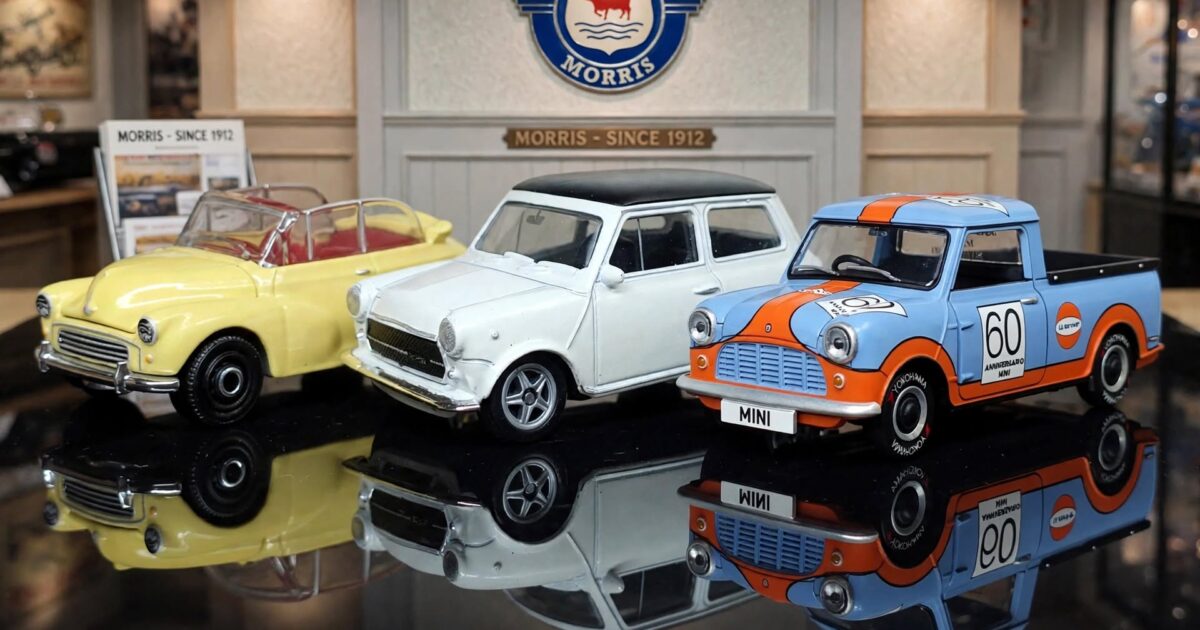
Morris merged with its old rival Austin in 1952 to form the British Motor Corporation, and the merged company kept both dealer networks alive. So the Mini launched twice: as the Morris Mini-Minor and as the Austin Seven, identical cars with different badges and grilles.
This is where the confusion in diecast listings comes from. A classic Mini casting might carry Morris script, Austin script, Cooper badging or nothing at all, depending on which real car the manufacturer referenced. None of them are wrong.
How the Morris name disappeared
BMC became British Motor Holdings, which became British Leyland in 1968, and from there the Morris badge was applied to progressively less interesting cars until it was retired in the mid eighties.
The Mini survived the parent. Decades later BMW ended up with the rights to it, relaunched it as MINI in its own right, and the new cars sell on heritage that belongs, strictly speaking, to a company nobody under sixty remembers. My page on BMW covers that side of the story.
Why the Mini is the most cast small car in the hobby
Count them. Every manufacturer at every price point has done a classic Mini, usually several times, in rally trim, in police markings, in plain colors, as a van, as a pickup, with surfboards on the roof.
The reason is geometry. The Mini is almost a cube with wheels at the corners, which means the proportions survive being shrunk, the shape is cheap to tool, and there is no delicate curve to get wrong. It is also small enough in real life that a 1:64 version comes out genuinely tiny, which makes it stand out in a row of American metal. My review of the Welly classic Mini in police livery goes through what a budget brand does with that shape.
Where Morris fits on a modern shelf
Nowhere obvious, and that is the appeal. A shelf of muscle cars and supercars is a shelf of things built to be looked at. A Morris Minor or a Mini is a thing built to be cheap, and putting one in the middle of that row changes how the whole display reads.
I keep a Minor Traveller next to a Charger for exactly that reason. One is six feet of hood and a big engine. The other is a small car with wood on the outside and a top speed you could argue with. They are the same hobby.
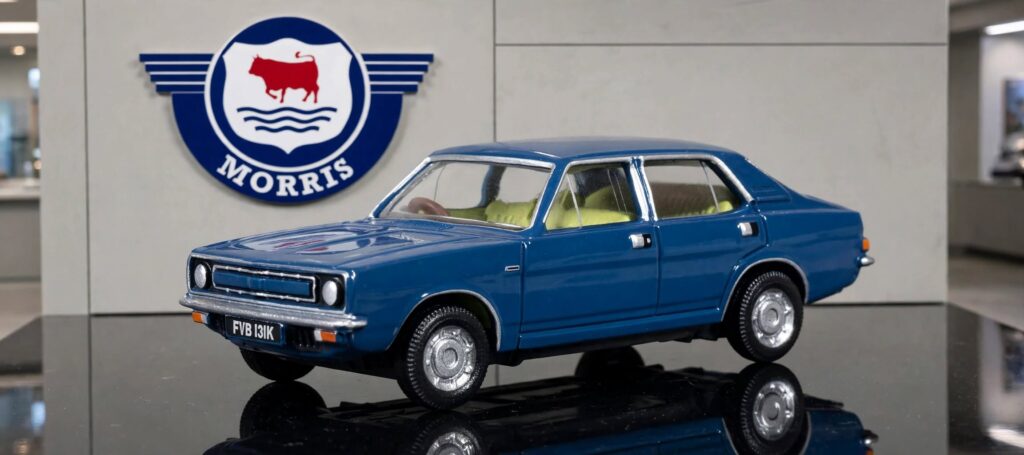
Is Morris the same company as Mini?
Not quite. Morris Motors built and sold the original Mini from 1959 as the Morris Mini-Minor. Mini only became a brand in its own right decades later, under BMW ownership.
Who designed the Morris Minor and the Mini?
Alec Issigonis designed both. The Minor arrived in 1948, the Mini in 1959, and the second car’s engine layout became the template for small cars worldwide.
Why were Austin and Morris selling identical cars?
The two companies merged in 1952 to form the British Motor Corporation but kept both dealer networks, so many models were sold twice with different badges.
When did the Morris brand end?
The badge faded through the British Leyland years and was retired in the mid-eighties, by which time it was being used on fairly ordinary saloons.
Which Morris models exist in 1:64?
The classic Mini in countless versions, plus the Minor saloon, Traveller, van and pickup. The Mini is far more common, since it has been produced by nearly every manufacturer in the hobby.