Every Speedster is an exercise in subtraction. Take a perfectly good 911, cut the windscreen down until it is barely useful, throw away the proper folding roof, cover the back of the cabin with a moulded hump, and then charge more for it than the car you started with.
That is a strange proposition out in the real world, and it makes for an equally strange small model, because this red Maisto has fewer parts in it than almost anything else on my shelf, and it still looks like the most special thing there.
What the Maisto Porsche 911 Speedster actually is
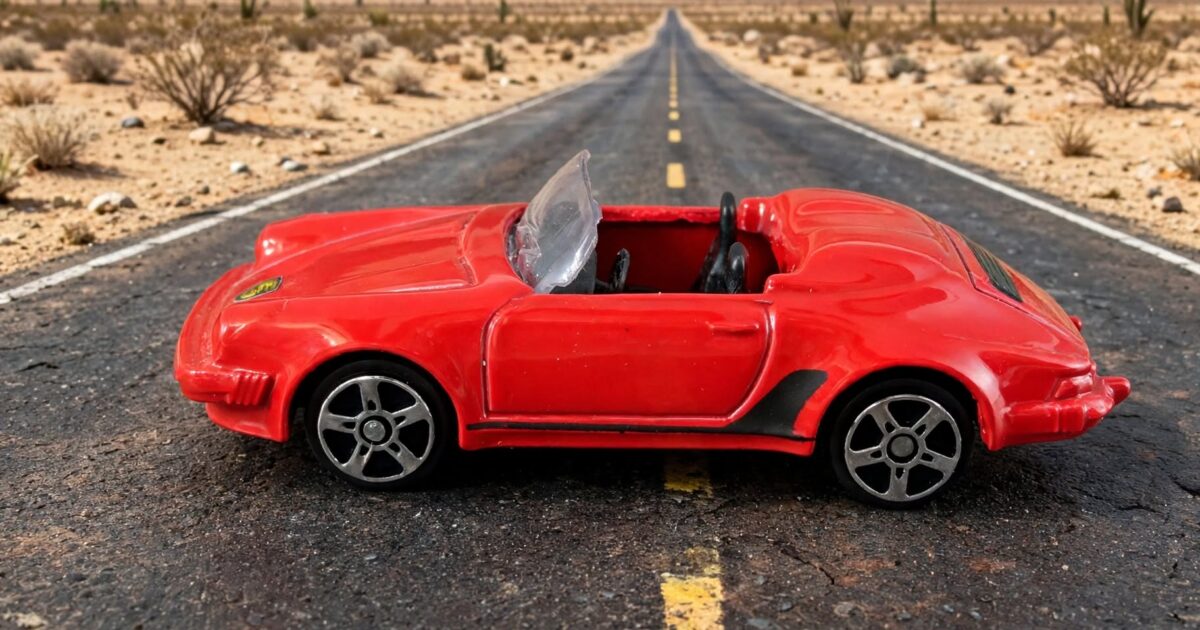
A two seat open car based on the familiar 911 shape, with the roofline removed and the rear deck raised into two humps behind the seats. The body keeps everything that makes a 911 recognizable: the round front wings rising either side of a dropped hood, the long tail, the arches pushed out over the rear wheels.
A small Porsche crest sits on the nose between the wings, printed in colour and sharp on mine. On a body this plain it is the only badge anywhere, and it has to carry the identity on its own.
What it loses is the greenhouse. There is no roof, no rear window, no side glass, just a low wraparound screen and open air behind it.
The double hump behind the seats
This is the feature that separates a Speedster from any other open 911, and the casting gets it right. The deck rises in two rounded mounds, one behind each seat, with a dip between them.
On the real car those cover the folded top. Visually they do something better, because they continue the line of the rear wings forward into the cabin area, so the car reads as one continuous shape from nose to tail instead of a coupe with the roof missing.
The red paint and the black sill
The red is bright and glossy with no orange in it, laid on evenly over a body with a lot of compound curves and almost nowhere to hide a flaw. Along the bottom of the doors there is a black trim strip running between the arches.
That black line matters more than it looks. It cuts the lowest few millimetres off the body, which makes the car appear to sit closer to the ground, and it stops the red from running all the way down to the shadow under the sill.
The wheels are chrome five spoke designs, simple and period correct, filling the arches without stretching them. The car sits low and level, with the nose close to the surface and very little gap over the tires.
The windscreen is the weak point
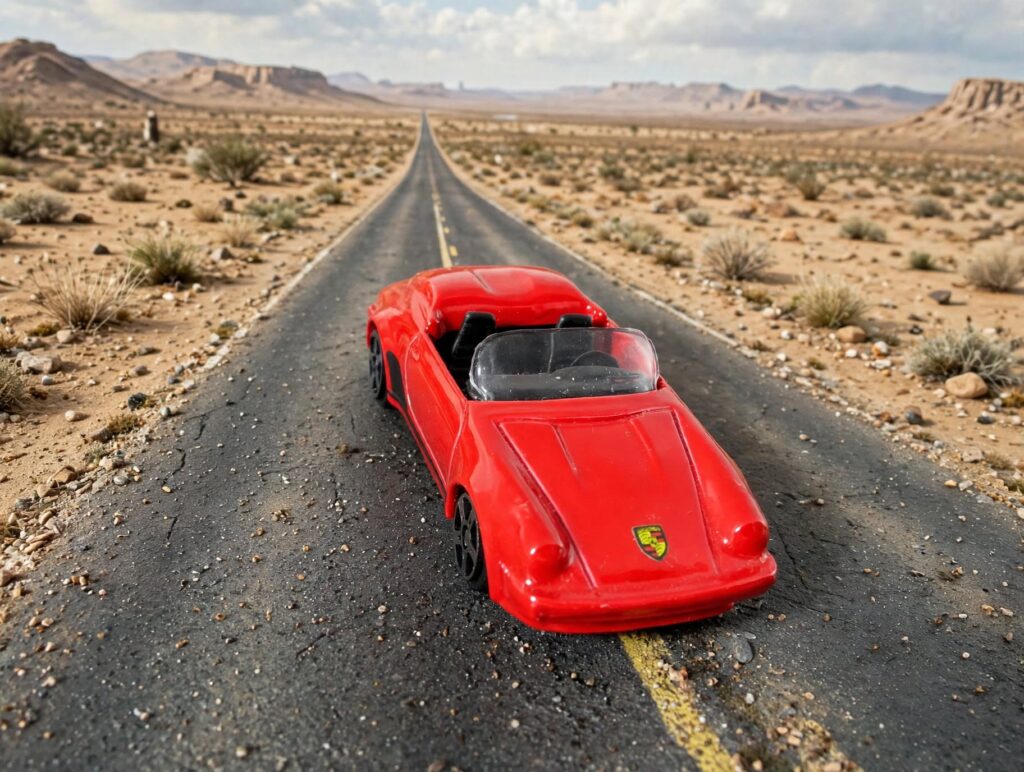
My example has a damaged screen. The clear piece is chipped along the top edge and it sits very slightly proud on one side, and on a car with no roof that single part is the tallest and most exposed thing on the model.
If you are buying one loose, look at the screen before anything else. It cannot be replaced, it cannot be straightened, and on a car this plain elsewhere a bad screen is the first thing anybody notices. Mine was cheap enough that I bought it anyway, and it still bothers me every time I pick it up.
The screen also decides whether the car can live loose in a box with others. Mine cannot, so it sits apart.
What the open cabin shows
Because there is no roof, the interior is permanently on display: two black seats, a steering wheel and a dash, moulded into a tub painted the same red as the body.
That red interior is unusual at this price. Most castings use a single grey or black plastic tub, and painting it to match the body is an extra step most brands would skip. It also means the open cabin reads as part of the car instead of a dark hole in the middle of it, which is the usual failing on convertibles.
Fewer parts, stronger silhouette
Here is the thing I keep coming back to. There is no roof to tool, no rear glass, no side windows, no window surrounds to get wrong. Compared to a coupe, this casting needs less of everything.
And it looks better for it. The profile is a single low curve broken only by the screen and the humps, which is far cleaner than any 911 coupe at this size, where the roof and the rear glass tend to muddle the line. Less to build and a stronger result is a rare combination.
It also explains why open cars turn up so often in cheap ranges. They cost less to produce and they photograph well.
Who should buy a small open Porsche
Anybody building a first shelf could do worse. It is cheap, it is instantly recognizable, and it is from a shape family that has been produced by every brand in the hobby, which means you can compare it against versions from elsewhere later. My starter guide covers how to use a common shape as a reference point.
It also photographs well in a simple setting. A strip of road and an open background is all it needs, since the car has no complicated detail to light. My diorama guide has the basics for that kind of scene.
The least practical Porsche I own
That is the whole appeal. This car gave up weather protection, visibility and luggage space in exchange for a shape, and people paid extra for the privilege.
At full size I have always thought that was slightly mad. At three inches long it costs nothing, there is no weather to worry about, and all that remains of the bargain is the part that mattered in the first place, which is the shape itself. Of every Porsche on my shelf, this is the one I pick up most, and it is the one with the least car in it.