Here is the question this car answers. A mainline diecast costs about a dollar. This one costs around seven. Is it seven times better?
No. Nothing is seven times better than anything. What it is instead is noticeably better in specific ways, and whether that matters depends on what you want from a shelf.
What the 427 S/C actually was
Shelby built competition Cobras with the big 427 engine and then found himself with unsold race cars. The solution was to make them road legal, add the equipment needed for the street, and sell them as the S/C, meaning semi-competition.
So this is a race car with just enough added to make it usable on a road, which is close to the opposite of how performance cars are normally developed. That history explains everything you see: the side exhausts running along the sills, the roll bar behind the seats, the minimal windscreen.
The roll bar matters for identification. It is part of the real car, not an accessory, and its presence is one of the quickest ways to tell an S/C from a standard Cobra in a photo.
The Hobby Shop series and the black deco
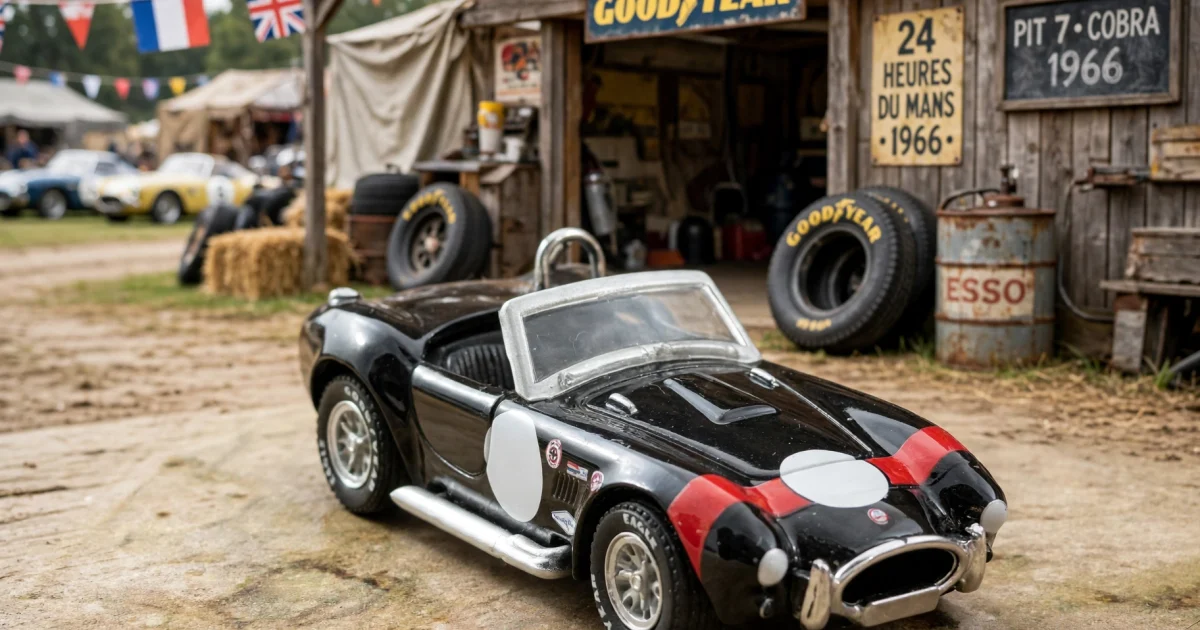
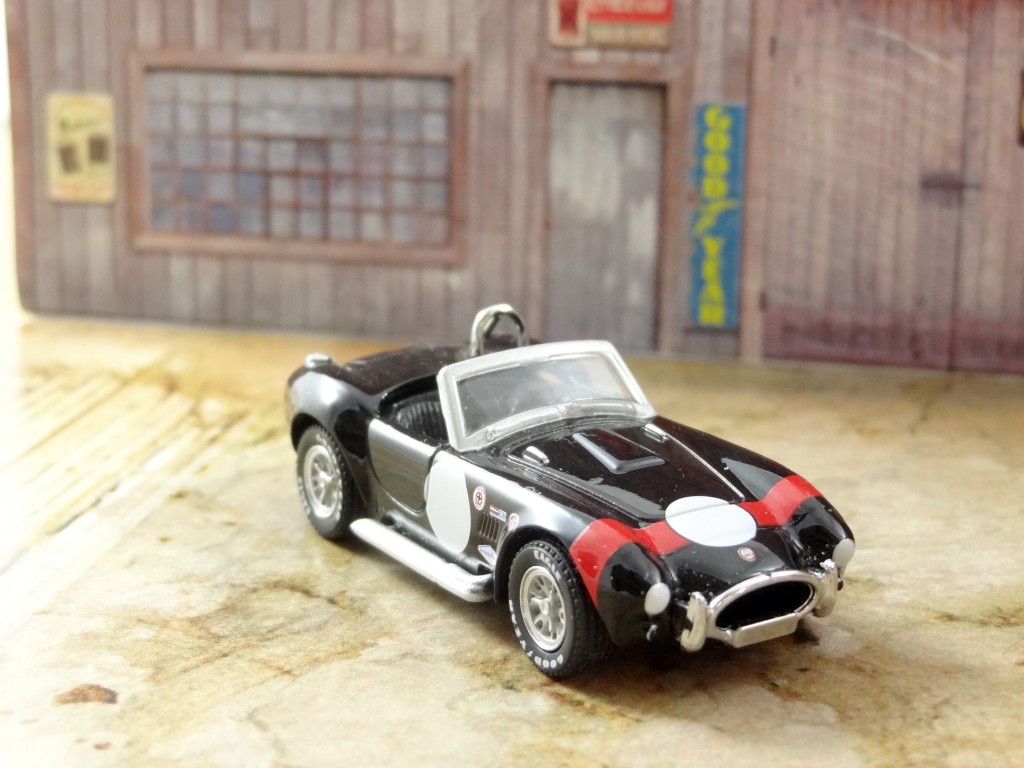
My car is the black one with red stripes over the nose and tail, white number circles on the door and bonnet, and small contingency decals scattered around them. Greenlight lists it under reference 97040A, from The Hobby Shop series.
The white roundels are the detail worth studying. They are large, round, printed on a curved surface, and completely clean with no bleeding at the edges. Printing a solid white circle on a curved black body is exactly where cheap tampo work falls apart.
Where the extra money actually goes
Three places, and they are easy to see side by side with a mainline car.
The tyres are rubber instead of plastic. They have visible sidewall texture, tread detail, and a matte finish that catches light like a real tyre. Once you have a car with rubber tyres on the shelf, the plastic ones next to it start looking like what they are.
The chrome parts are separate pieces. The windscreen frame, the side exhausts and the front grille surround are all their own components rather than painted areas. That gives the car actual three dimensional detail where a cheaper model has a silver stripe.
The interior is visible and detailed, because the car is open. You get seats, a dashboard and the roll bar structure, all of which would be hidden behind tinted glass on most castings.
Is a Greenlight worth the price over a mainline?
It depends entirely on how you use your collection.
If you photograph your cars, yes, without much argument. Rubber tyres and separate chrome parts photograph dramatically better, and the difference is obvious even in a phone picture.
If you display them in a case at arm’s length, the gap narrows a lot. From a metre away a good mainline casting in the right colour holds up fine, and you could buy seven of them for the same money.
If you build dioramas, the realistic proportions and ride height matter more than the tyres. Greenlight cars sit like real cars, which is what a scene needs.
Where these break: chrome, roll bar and windscreen
The separate chrome pieces are the whole inspection. The windscreen frame stands proud and unprotected, so check it from the front for bending. Then the side exhausts, which run the length of the sill at the lowest point of the body and get scraped.
Then the roll bar. It is thin, vertical and the highest point on the car, which makes it the first casualty in any fall.
Check the white roundels for scuffing, since white on black shows everything. And look at the rubber tyres. Old rubber can harden, flat spot from sitting in one position, or in bad cases start to crack.
Where it fits next to your Hot Wheels
I keep premium cars separated from mainline ones instead of mixing them. Sitting side by side, a Greenlight makes the mainline cars look cheap, and a shelf of mainline cars makes the Greenlight look out of place.
Grouped with other detailed models it reads as a deliberate step up in a collection. That is worth arranging properly, because the cars themselves have not changed. Only the company they keep.
Starting with premium without overspending
The trap with detailed models is obvious. Once you own one, the mainline cars around it start looking cheap and the temptation is to upgrade everything.
That gets expensive fast, and it is unnecessary. What worked for me was buying premium only for cars where the extra detail actually shows: open cars, anything with a lot of chrome, and anything I planned to photograph closely.
For closed coupes seen from a metre away, a mainline casting in a good colour does the job. Save the money for the cars where you will notice.
The other rule is to buy the subject you want rather than the brand. A premium model of a car you do not care about is still a car you do not care about, just more expensive.
My honest recommendation
Rubber tyres, separate chrome, a visible interior and clean printing on a hard surface, for the price of a coffee and a bit. Not a replacement for a mainline collection and a good demonstration of what money buys in this scale. Check the roll bar and the windscreen frame before paying.