Chevrolet built the Chevy II to compete with the Ford Falcon. It was cheap, small, light and deliberately dull, sold to people who needed transport and nothing more.
Then somebody noticed that light and cheap is exactly what you want if you are going to put a large engine in something, and the Chevy II stopped being dull very quickly.
Why a boring car became a legend
The formula is old and it always works. Take the lightest body a manufacturer makes, drop in the biggest engine that will fit, and you have beaten cars that cost three times as much.
The Chevy II was ideal for it. Simple construction, minimal weight, and an engine bay that turned out to accept far more than Chevrolet originally intended. Drag racers worked this out immediately, and the car built a reputation that had nothing to do with why it was designed.
The Nova name eventually took over completely, but the early cars were Chevy II first, which is why this casting carries that name.
A shape with nowhere to hide
This body is a box with rounded corners. No fins, no sculpture, no character lines, nothing decorative anywhere.
That makes it a harder casting than it looks. There is no styling to distract you from a proportional error, so the roof height, the window openings and the wheelbase all have to be right or the car reads as wrong without you knowing why.
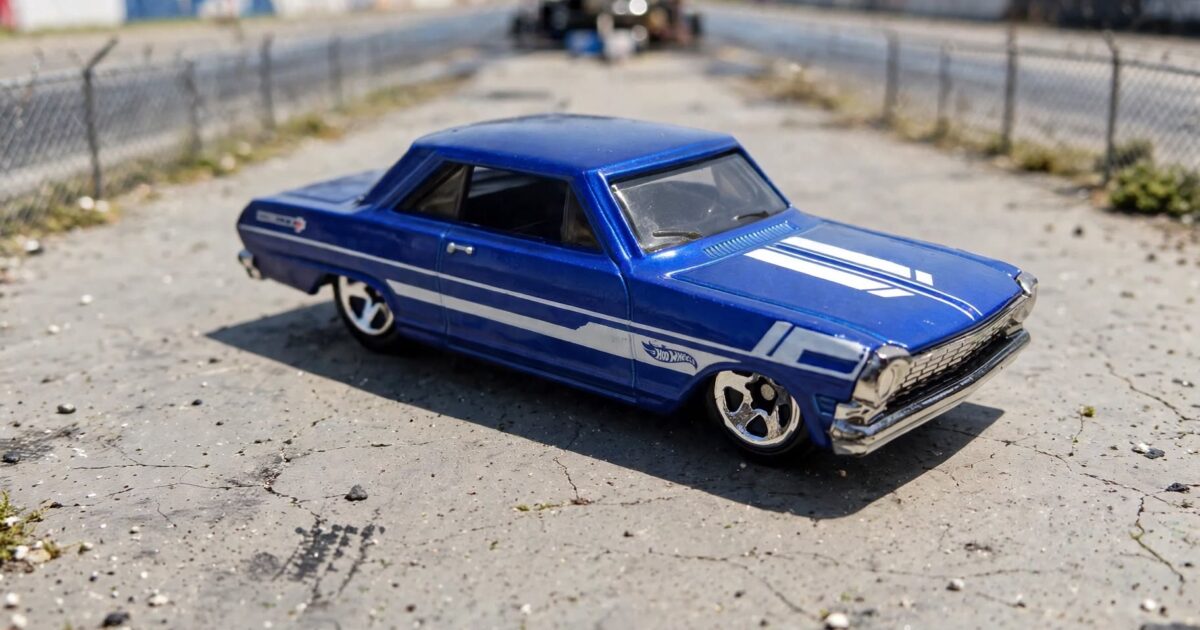
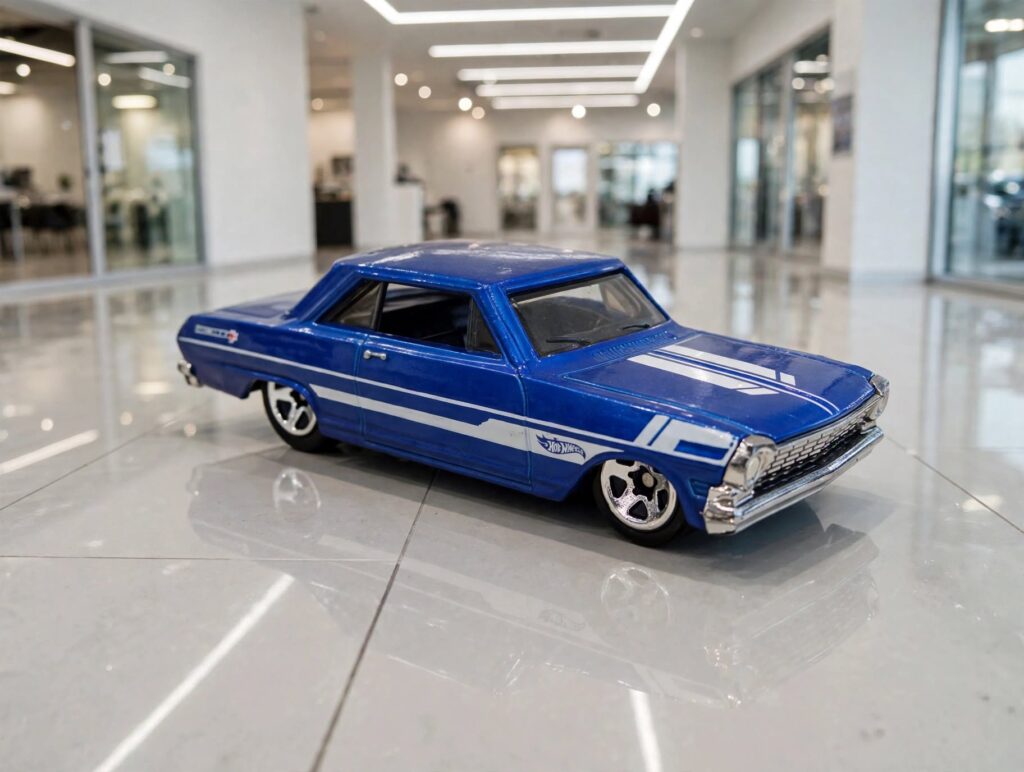
Hot Wheels got it. The greenhouse is the correct height, the C pillar has the right thickness, and the slight kick up over the rear wheel arch is there. Sit it next to a photo of the real car and nothing jumps out.
The front end carries a fine mesh grille in chrome with the headlights set into the outer corners, and the bumper is a separate chrome piece. On a car this plain, the chrome is most of the visual interest.
Blue with white stripes
The deco is straight out of sixties drag racing. A white stripe runs along the lower body from the front wheel arch to the rear, with a second thinner stripe above it, and both wrap around the front of the car and continue over the bonnet.
There is a small Hot Wheels logo on the rear quarter and a Chevy II badge printed near the tail.
What makes it work is the restraint. Real racing Chevy IIs often ran exactly this, a plain colour with a stripe and a number, because nobody was paying for elaborate paint on a car built to go fast in a straight line. Covering it in sponsor logos would have been historically wrong and visually worse.
Sleepers and why collectors like them
The Chevy II belongs to a category worth understanding. A sleeper is a car that looks ordinary and is not, and the whole appeal rests on the gap between appearance and capability.
That is a hard thing to convey in a diecast, because a model cannot demonstrate performance. All you have is the shape, and the shape is the boring part.
Which means a sleeper casting only works if you know the story. Without it, this is a small blue sedan. With it, this is the car that embarrassed people at traffic lights for a decade. Nothing on the model tells you which, and that is part of the charm.
Chevy II or Nova: is there a difference?
This confuses people constantly in listings, so it is worth setting out.
Chevy II was the model line. Nova was originally the top trim level within it. Over the following years the Nova name grew more prominent until it replaced Chevy II entirely, which is why later cars are simply Novas and early ones are not.
For a collector that means a 1963 car is correctly called a Chevy II, and a car from the seventies is correctly called a Nova. They are related and they are not interchangeable terms for the same thing.
Sellers use the words loosely, and the bodies changed a lot across those years, so read the shape in the photo instead of trusting the title. If it is small, square and plain, it is an early car regardless of what the listing says.
Buying a loose Chevy II
The stripes cross the highest point of the bonnet and run the full length of both sides, so they are exposed at every angle. Check the bonnet first and the door shut line second, because tampo over a panel gap fails early.
Then the chrome grille. It is a fine mesh pattern and it sits at the front of a short nose, so it collects damage and dust in equal measure.
Blue metallic is forgiving with fine scratches and unforgiving with chips. Look at the edges of the wings, the boot lip and the roof rail under angled light.
Then roll it. Short cars show a bent axle more obviously than long ones.
Building a sixties compact shelf
The Chevy II pairs naturally with its rivals from the same years. Ford was selling the Falcon, Chrysler had its own compacts, and all of them were built for the same buyer.
Collected together they tell you something real about what American manufacturers thought ordinary people needed in 1963, which is a more interesting question than another row of muscle cars. They also cost almost nothing, because nobody is chasing compact sedans.
So is it worth buying?
Yes, if you know why the car matters. It is a clean, correctly proportioned casting of a deliberately plain shape, wearing a stripe package that gets the history right. As an object it is quiet. As a piece of drag racing history it is one of the better stories on the shelf. Check the bonnet stripes before paying.